

56
3. Analytic Solutions of Hydrodynamic Dispersion Equations
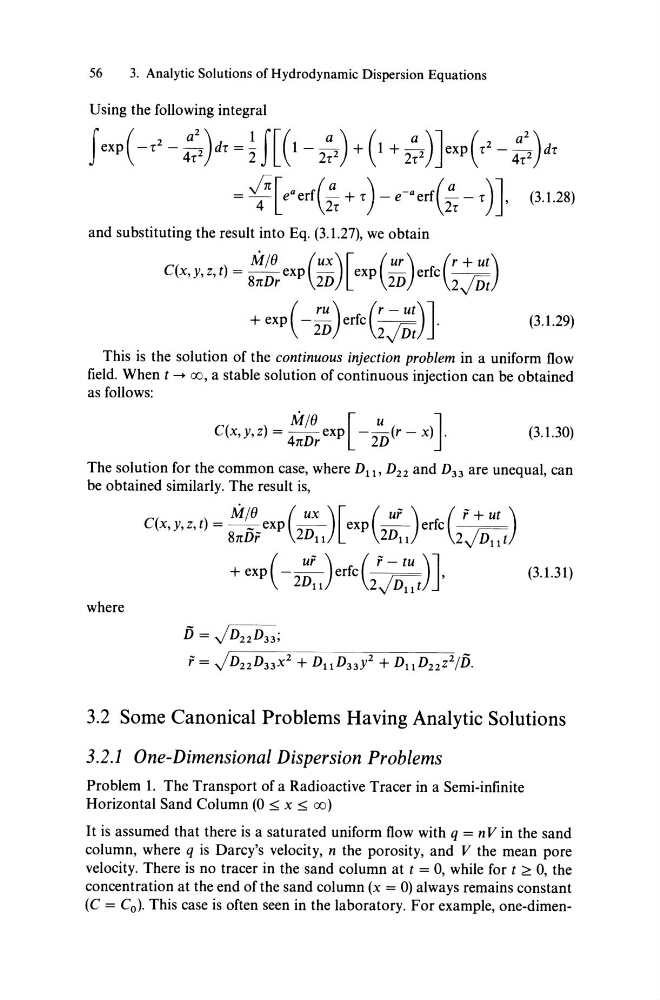
Using the following integral
f
exp (_,2 - ~)d' =! f[(1 -~) + (1 + ~)Jexp(,2 - ~)d'
4,2
2
2,2
2,2
4,2
= f[eaerf(;, + ,) - e-aerf(;, - ,) 1 (3.1.28)
and substituting the result into Eq. (3.1.27), we obtain
C(x, y, Z, t) = ~:r exp (~~) [ex p (;~) erfc Gft,)
+ exp ( - ;~) erfc Gfo,) 1
(3.1.29)
This is the solution of the continuous injection problem in a uniform flow
field. When t --+ 00, a stable solution of continuous injection can be obtained
as folIo ws:
M/e [u
]
C(x,y,z) = 4nDr exp - 2D(r - x) .
(3.1.30)
The solution for the common case, where D 11 , D 22 and D 33 are unequal, can
be obtained similarly. The result is,
C(X,y,z,t) = MI!_exP(2 ux )[exP(2 ur )erfc( r~)
8nDr
Du
Du
2y Du t
+ eXP (-2 ur )erfc( ~)J,
(3.1.31)
Dll
2 Dllt
where
3.2 Some Canonical Problems Having Analytic Solutions
3.2.1 One-Dimensional Dispersion Problems
Problem 1. The Transport of a Radioactive Tracer in a Semi-infinite
Horizontal Sand Column (0 :::;; x :::;; (0)
It is assumed that there is a saturated uniform flow with q = n V in the sand
column, where q is Darcy's velo city, n the porosity, and V the me an pore
velocity. There is no tracer in the sand column at t = 0, while for t ~ 0, the
concentration at the end of the sand column (x = 0) always remains constant
(C = Co). This case is often seen in the laboratory. For ex am pie, one-dimen-
3. Analytic Solutions of Hydrodynamic Dispersion Equations
Using the following integral
f
exp (_,2 - ~)d' =! f[(1 -~) + (1 + ~)Jexp(,2 - ~)d'
4,2
2
2,2
2,2
4,2
= f[eaerf(;, + ,) - e-aerf(;, - ,) 1 (3.1.28)
and substituting the result into Eq. (3.1.27), we obtain
C(x, y, Z, t) = ~:r exp (~~) [ex p (;~) erfc Gft,)
+ exp ( - ;~) erfc Gfo,) 1
(3.1.29)
This is the solution of the continuous injection problem in a uniform flow
field. When t --+ 00, a stable solution of continuous injection can be obtained
as folIo ws:
M/e [u
]
C(x,y,z) = 4nDr exp - 2D(r - x) .
(3.1.30)
The solution for the common case, where D 11 , D 22 and D 33 are unequal, can
be obtained similarly. The result is,
C(X,y,z,t) = MI!_exP(2 ux )[exP(2 ur )erfc( r~)
8nDr
Du
Du
2y Du t
+ eXP (-2 ur )erfc( ~)J,
(3.1.31)
Dll
2 Dllt
where
3.2 Some Canonical Problems Having Analytic Solutions
3.2.1 One-Dimensional Dispersion Problems
Problem 1. The Transport of a Radioactive Tracer in a Semi-infinite
Horizontal Sand Column (0 :::;; x :::;; (0)
It is assumed that there is a saturated uniform flow with q = n V in the sand
column, where q is Darcy's velo city, n the porosity, and V the me an pore
velocity. There is no tracer in the sand column at t = 0, while for t ~ 0, the
concentration at the end of the sand column (x = 0) always remains constant
(C = Co). This case is often seen in the laboratory. For ex am pie, one-dimen-