

3.1. Superposition of Fundamental Solutions
55
(3.1.21)
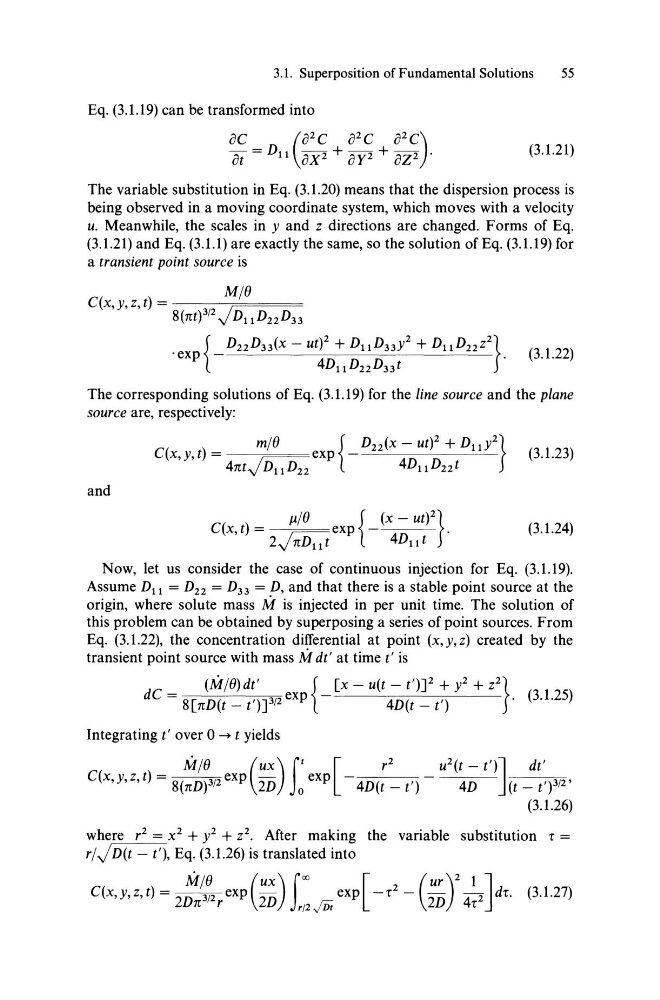
The variable substitution in Eq. (3.1.20) means that the dispersion process is
being observed in a moving coordinate system, which moves with a velocity
u. Meanwhile, the scales in y and z directions are changed. Forms of Eq.
(3.1.21) and Eq. (3.1.1) are exactly the same, so the solution ofEq. (3.1.19) for
a transient point source is
M/O
C(x, y, z, t) = ------::-::::------;====
8 (m)3/2 J D 11 D 22 D 33
{
D22D33(X - ut)2 + Dll D33y2 + Dll D22 Z 2 }
.~p
-
.
4D l l D 22 D 33 t
(3.1.22)
The corresponding solutions of Eq. (3.1.19) for the Une source and the plane
source are, respectively:
(3.1.23)
and
C()
p,/O
{(X - ut)2}
x,t =
exp -
.
2JnD l l t
4Dll t
(3.1.24)
Now, let us consider the case of continuous injection for Eq. (3.1.19).
Assurne D11 = D22 = D33 = D, and that there is a stable point source at the
origin, where solute mass M is injected in per unit time. The solution of
this problem can be obtained by superposing aseries of point sourees. From
Eq. (3.1.22), the concentration differential at point (x, y, z) created by the
transient point source with mass M dt' at time t' is
dC =
(M/O)dt'
{_[X - u(t - t')]2 + y2 + Z2}
8 [nD(t - t')]3/2 exp
4D(t _ t')
. (3.1.25)
Integrating t' over 0 -+ t yields
M/O
(ux) r
t
[
r
2
u 2 (t - t')]
dt'
C(x, y, z, t) = 8(nD)3/2 exp 2D J 0 exp - 4D(t _ t') - 4D (t _ t')3/2'
(3.1.26)
where r 2 = x 2 + y2 + Z2. After making the variable substitution r =
r/JD(t - t'), Eq. (3.1.26) is translated into
M/O
(Ux) f.oo
[2 (ur)2 1 ]
C(x, y, Z, t) = 2Dn3/2 r exp 2D r/2 JDt exp - r - 2D 4r2 dr. (3.1.27)
55
(3.1.21)
The variable substitution in Eq. (3.1.20) means that the dispersion process is
being observed in a moving coordinate system, which moves with a velocity
u. Meanwhile, the scales in y and z directions are changed. Forms of Eq.
(3.1.21) and Eq. (3.1.1) are exactly the same, so the solution ofEq. (3.1.19) for
a transient point source is
M/O
C(x, y, z, t) = ------::-::::------;====
8 (m)3/2 J D 11 D 22 D 33
{
D22D33(X - ut)2 + Dll D33y2 + Dll D22 Z 2 }
.~p
-
.
4D l l D 22 D 33 t
(3.1.22)
The corresponding solutions of Eq. (3.1.19) for the Une source and the plane
source are, respectively:
(3.1.23)
and
C()
p,/O
{(X - ut)2}
x,t =
exp -
.
2JnD l l t
4Dll t
(3.1.24)
Now, let us consider the case of continuous injection for Eq. (3.1.19).
Assurne D11 = D22 = D33 = D, and that there is a stable point source at the
origin, where solute mass M is injected in per unit time. The solution of
this problem can be obtained by superposing aseries of point sourees. From
Eq. (3.1.22), the concentration differential at point (x, y, z) created by the
transient point source with mass M dt' at time t' is
dC =
(M/O)dt'
{_[X - u(t - t')]2 + y2 + Z2}
8 [nD(t - t')]3/2 exp
4D(t _ t')
. (3.1.25)
Integrating t' over 0 -+ t yields
M/O
(ux) r
t
[
r
2
u 2 (t - t')]
dt'
C(x, y, z, t) = 8(nD)3/2 exp 2D J 0 exp - 4D(t _ t') - 4D (t _ t')3/2'
(3.1.26)
where r 2 = x 2 + y2 + Z2. After making the variable substitution r =
r/JD(t - t'), Eq. (3.1.26) is translated into
M/O
(Ux) f.oo
[2 (ur)2 1 ]
C(x, y, Z, t) = 2Dn3/2 r exp 2D r/2 JDt exp - r - 2D 4r2 dr. (3.1.27)