

42
2. Hydrodynamic Dispersion in Porous Media
tended to
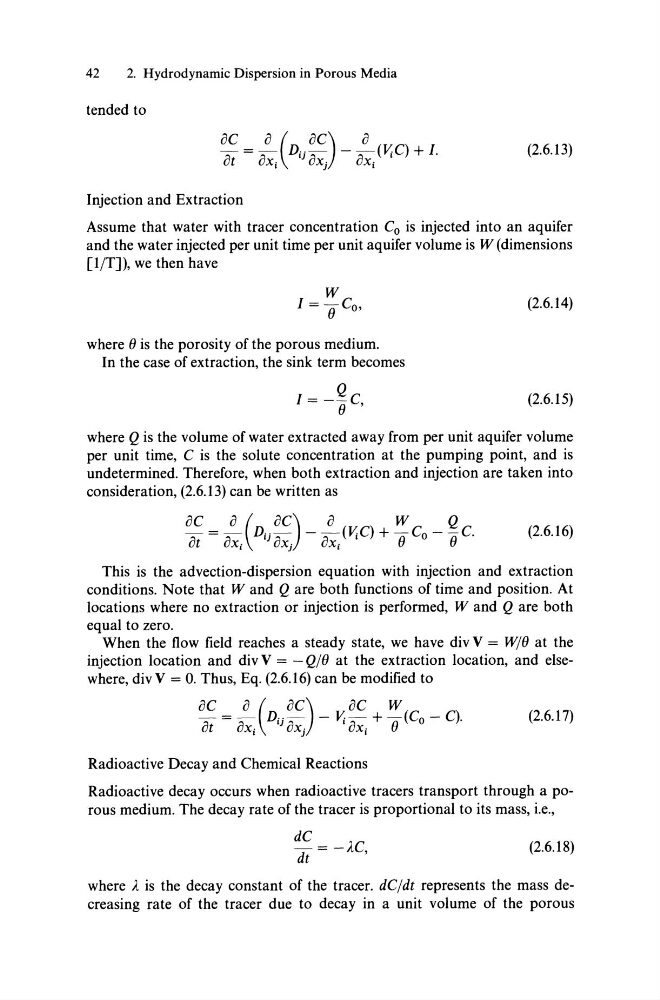
(2.6.13)
Injection and Extraction
Assume that water with tracer concentration Co is injected into an aquifer
and the water injected per unit time per unit aquifer volume is W (dimensions
[I/T]), we then have
where e is the porosity of the porous medium.
In the case of extraction, the sink term becomes
Q
1= --C
e '
(2.6.14)
(2.6.15)
where Q is the volume of water extracted away from per unit aquifer volume
per unit time, C is the solute concentration at the pumping point, and is
undetermined. Therefore, when both extraction and injection are taken into
consideration, (2.6.13) can be written as
(2.6.16)
This is the advection-dispersion equation with injection and extraction
conditions. Note that Wand Q are both functions of time and position. At
locations where no extraction or injection is performed, Wand Q are both
equal to zero.
When the flow field reaches a steady state, we have div V = wie at the
injection location and div V = - Qle at the extraction location, and elsewhere, div V = O. Thus, Eq. (2.6.16) can be modified to
oC
0 (OC)
oC W
Jt = ox. Dij ox. - V; ox. + O(Co - C).
I
}
I
(2.6.17)
Radioactive Decay and Chemical Reactions
Radioactive decay occurs when radioactive tracers transport through a porous medium. The decay rate of the tracer is proportional to its mass, i.e.,
dC = -A.C
dt
'
(2.6.18)
where A. is the decay constant of the tracer. dCjdt represents the mass decreasing rate of the tracer due to decay in a unit volume of the porous
2. Hydrodynamic Dispersion in Porous Media
tended to
(2.6.13)
Injection and Extraction
Assume that water with tracer concentration Co is injected into an aquifer
and the water injected per unit time per unit aquifer volume is W (dimensions
[I/T]), we then have
where e is the porosity of the porous medium.
In the case of extraction, the sink term becomes
Q
1= --C
e '
(2.6.14)
(2.6.15)
where Q is the volume of water extracted away from per unit aquifer volume
per unit time, C is the solute concentration at the pumping point, and is
undetermined. Therefore, when both extraction and injection are taken into
consideration, (2.6.13) can be written as
(2.6.16)
This is the advection-dispersion equation with injection and extraction
conditions. Note that Wand Q are both functions of time and position. At
locations where no extraction or injection is performed, Wand Q are both
equal to zero.
When the flow field reaches a steady state, we have div V = wie at the
injection location and div V = - Qle at the extraction location, and elsewhere, div V = O. Thus, Eq. (2.6.16) can be modified to
oC
0 (OC)
oC W
Jt = ox. Dij ox. - V; ox. + O(Co - C).
I
}
I
(2.6.17)
Radioactive Decay and Chemical Reactions
Radioactive decay occurs when radioactive tracers transport through a porous medium. The decay rate of the tracer is proportional to its mass, i.e.,
dC = -A.C
dt
'
(2.6.18)
where A. is the decay constant of the tracer. dCjdt represents the mass decreasing rate of the tracer due to decay in a unit volume of the porous