

2.6. Extensions
43
medium. Thus
I = -AC.
(2.6.19)
Substituting I into (2.6.13), we have
OC = ~(Dij OC) _ ~(V;C) - AC.
ot
oXi
oXj
OXi
(2.6.20)
This is the hydrodynamic dispersion equation with radioactive decay taken
into consideration.
The increase or decrease of components due to chemical reactions can also
be incorporated into the source and sink term. Assume that there are two
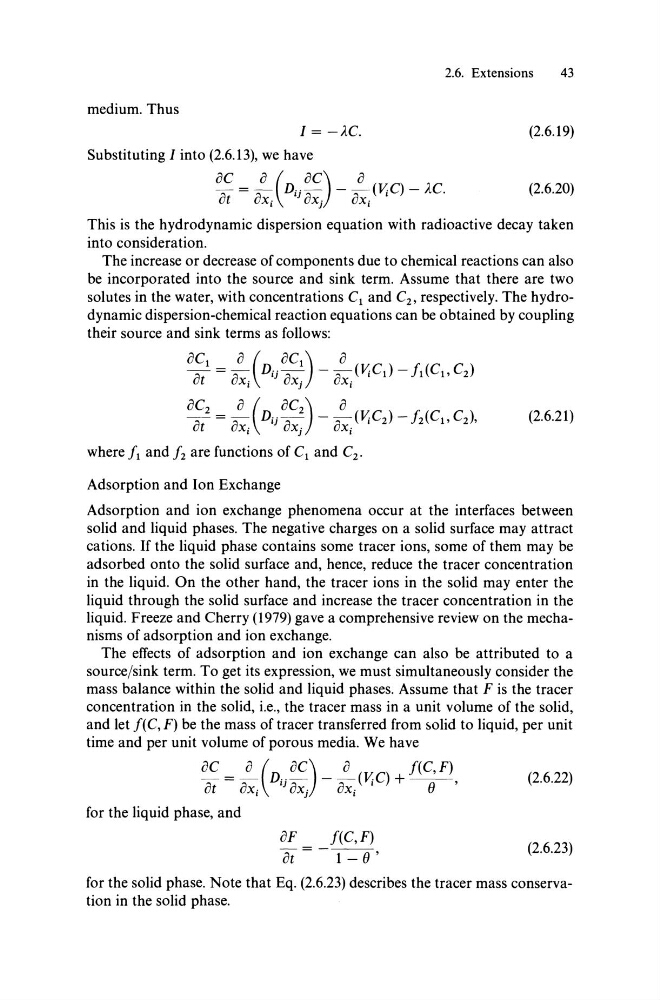
solutes in the water, with concentrations Cl and C 2 , respectively. The hydrodynamic dispersion-chemical reaction equations can be obtained by coupling
their source and sink terms as folIo ws:
(2.6.21)
Adsorption and Ion Exchange
Adsorption and ion exchange phenomena occur at the interfaces between
solid and liquid phases. The negative charges on asolid surface may attract
cations. If the liquid phase contains some tracer ions, some of them may be
adsorbed onto the solid surface and, hence, reduce the tracer concentration
in the liquid. On the other hand, the tracer ions in the solid may enter the
liquid through the solid surface and increase the tracer concentration in the
liquid. Freeze and Cherry (1979) gave a comprehensive review on the mechanisms of adsorption and ion exchange.
The effects of adsorption and ion exchange can also be attributed to a
source/sink term. To get its expression, we must simultaneously consider the
mass balance within the solid and liquid phases. Assume that F is the tracer
concentration in the solid, i.e., the tracer mass in a unit volume of the solid,
and let f( C, F) be the mass of tracer transferred from flolid to liquid, per unit
time and per unit volume of porous media. We have
OC = ~ (D .. OC) _ ~ (V C) + f( C, F)
(2.6.22)
ot
oX i 'J oX j
ox i '
f ) '
for the liquid phase, and
oF
f(C,F)
ot = -1=0'
(2.6.23)
for the solid phase. Note that Eq. (2.6.23) describes the tracer mass conservati on in the solid phase.
43
medium. Thus
I = -AC.
(2.6.19)
Substituting I into (2.6.13), we have
OC = ~(Dij OC) _ ~(V;C) - AC.
ot
oXi
oXj
OXi
(2.6.20)
This is the hydrodynamic dispersion equation with radioactive decay taken
into consideration.
The increase or decrease of components due to chemical reactions can also
be incorporated into the source and sink term. Assume that there are two
solutes in the water, with concentrations Cl and C 2 , respectively. The hydrodynamic dispersion-chemical reaction equations can be obtained by coupling
their source and sink terms as folIo ws:
(2.6.21)
Adsorption and Ion Exchange
Adsorption and ion exchange phenomena occur at the interfaces between
solid and liquid phases. The negative charges on asolid surface may attract
cations. If the liquid phase contains some tracer ions, some of them may be
adsorbed onto the solid surface and, hence, reduce the tracer concentration
in the liquid. On the other hand, the tracer ions in the solid may enter the
liquid through the solid surface and increase the tracer concentration in the
liquid. Freeze and Cherry (1979) gave a comprehensive review on the mechanisms of adsorption and ion exchange.
The effects of adsorption and ion exchange can also be attributed to a
source/sink term. To get its expression, we must simultaneously consider the
mass balance within the solid and liquid phases. Assume that F is the tracer
concentration in the solid, i.e., the tracer mass in a unit volume of the solid,
and let f( C, F) be the mass of tracer transferred from flolid to liquid, per unit
time and per unit volume of porous media. We have
OC = ~ (D .. OC) _ ~ (V C) + f( C, F)
(2.6.22)
ot
oX i 'J oX j
ox i '
f ) '
for the liquid phase, and
oF
f(C,F)
ot = -1=0'
(2.6.23)
for the solid phase. Note that Eq. (2.6.23) describes the tracer mass conservati on in the solid phase.