

2.6. Extensions
41
Spherical Coordinates (r, (), r/J)
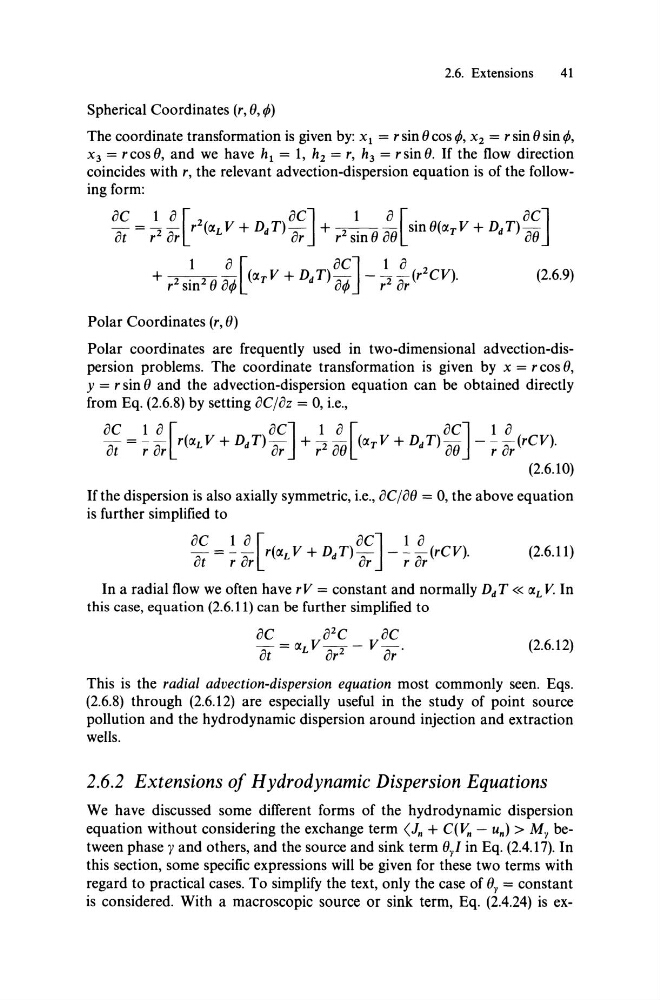
The coordinate transformation is given by: Xl = rsin()cosr/J, X 2 = rsin()sinr/J,
X 3 = r cos (), and we have h l = 1, h 2 = r, h 3 = r sin (). If the flow direction
coincides with r, the relevant advection-dispersion equation is of the following form:
oC
1 0 [ 2
OC]
1
0 [ .
OC]
at = r 2 or r (!XL V + Dd T) a;: + r2 sin () o() sm ()(!X T V + Dd T) o()
1
0 [
OC]
1 0 2
+ r2 sin2 () or/J (!XT V + Dd T) or/J - r2 or (r CV).
(2.6.9)
Polar Coordinates (r, ()
Polar coordinates are frequently used in two-dimensional advection-dispersion problems. The coordinate transformation is given by X = r cos (),
y = r sin () and the advection-dispersion equation can be obtained directly
from Eq. (2.6.8) by setting oC/oz = 0, i.e.,
OC 1 0 [
OC]
1 0 [
OC] 1 0
at = r or r(!XLV + DdT)a;: + r 2 o() (!XTV + DdT) o() - r or (rCV).
(2.6.10)
Ifthe dispersion is also axially symmetrie, i.e., oC/o() = 0, the above equation
is further simplified to
oC 1 0 [
OC] 1 0
at = r or r(!XLV + DdT)a;: - r or (rCV).
(2.6.11)
In a radial flow we often have r V = constant and normally D d T « !XL V. In
this case, equation (2.6.11) can be further simplified to
oC
02C
oC
at=!XLV or2 - Va;:'
(2.6.12)
This is the radial advection-dispersion equation most commonly seen. Eqs.
(2.6.8) through (2.6.12) are especially useful in the study of point source
pollution and the hydrodynamic dispersion around injection and extraction
weHs.
2.6.2 Extensions of Hydrodynamic Dispersion Equations
We have discussed some different forms of the hydrodynamic dispersion
equation without considering the exchange term (ln + qv" - u n ) > My between phase'}' and others, and the source and sink term ()yI in Eq. (2.4.17). In
this section, some specific expressions will be given for these two terms with
regard to practical cases. To simplify the text, only the case of ()y = constant
is considered. With a macroscopic source or sink term, Eq. (2.4.24) is ex-
41
Spherical Coordinates (r, (), r/J)
The coordinate transformation is given by: Xl = rsin()cosr/J, X 2 = rsin()sinr/J,
X 3 = r cos (), and we have h l = 1, h 2 = r, h 3 = r sin (). If the flow direction
coincides with r, the relevant advection-dispersion equation is of the following form:
oC
1 0 [ 2
OC]
1
0 [ .
OC]
at = r 2 or r (!XL V + Dd T) a;: + r2 sin () o() sm ()(!X T V + Dd T) o()
1
0 [
OC]
1 0 2
+ r2 sin2 () or/J (!XT V + Dd T) or/J - r2 or (r CV).
(2.6.9)
Polar Coordinates (r, ()
Polar coordinates are frequently used in two-dimensional advection-dispersion problems. The coordinate transformation is given by X = r cos (),
y = r sin () and the advection-dispersion equation can be obtained directly
from Eq. (2.6.8) by setting oC/oz = 0, i.e.,
OC 1 0 [
OC]
1 0 [
OC] 1 0
at = r or r(!XLV + DdT)a;: + r 2 o() (!XTV + DdT) o() - r or (rCV).
(2.6.10)
Ifthe dispersion is also axially symmetrie, i.e., oC/o() = 0, the above equation
is further simplified to
oC 1 0 [
OC] 1 0
at = r or r(!XLV + DdT)a;: - r or (rCV).
(2.6.11)
In a radial flow we often have r V = constant and normally D d T « !XL V. In
this case, equation (2.6.11) can be further simplified to
oC
02C
oC
at=!XLV or2 - Va;:'
(2.6.12)
This is the radial advection-dispersion equation most commonly seen. Eqs.
(2.6.8) through (2.6.12) are especially useful in the study of point source
pollution and the hydrodynamic dispersion around injection and extraction
weHs.
2.6.2 Extensions of Hydrodynamic Dispersion Equations
We have discussed some different forms of the hydrodynamic dispersion
equation without considering the exchange term (ln + qv" - u n ) > My between phase'}' and others, and the source and sink term ()yI in Eq. (2.4.17). In
this section, some specific expressions will be given for these two terms with
regard to practical cases. To simplify the text, only the case of ()y = constant
is considered. With a macroscopic source or sink term, Eq. (2.4.24) is ex-