

2.4. Hydrodynamic Dispersion Equations
31
diffusion dissolution, adsorption, ion exchange and so forth. The fifth term is
the source and sink term, which gives the increase, or decrease, of solute in
the system due to recharge, discharge, chemical reactions, radioactive decay,
and so forth.
All possible factors relevant to mass transport in porous media have been
taken into consideration in Eq. (2.4.17). Thus, the equation is also applicable
for the cases of multicomponent flow and deformable solid matrix.
The classical hydrodynamic dispersion theory assumes that both macro_
00
scopic molecular diffusion flux J and mechanical dispersion flux CV can be
expressed in the form of Fick's Law:
00
_
CV = - pD' grad( C/p),
J = - pD" grad(C/p),
(2.4.18)
(2.4.19)
where coefficient D' is called the mechanical dispersion coefficient and D" the
molecular diffusion coefficient in porous media, both of which are second rank
symmetric tensors. Their expressions and relationships with other physical
parameters will be discussed in detail in Section 2.6.
Adding Eq. (2.4.18) and Eq. (2.4.19) together, we have
J* = - pD grad(C/p),
(2.4.20)
_
00
where J* = J + CV is called the hydrodynamic dispersion flux. J* is a summation of the mechanical dispersion flux and the macroscopic molecular
diffusion flux. The coefficient
D=D'+D"
(2.4.21)
is called the hydrodynamic dispersion coefficient.
Let us temporarily put aside the last two terms in Eq. (2.4.17). In order to
concentrate on the main terms of the equation, the effects of adsorption, ion
exchange, chemical reaction, and radioactive decay will be discussed later. By
inserting Eq. (2.4.20) into Eq. (2.4.17) and omitting the subscript of ()y, which
indicates the volumetric fraction of the liquid phase, we then have
iJ«()C)
[
(C)] -----at = div ()Dp grad p - div«()CV).
(2.4.22)
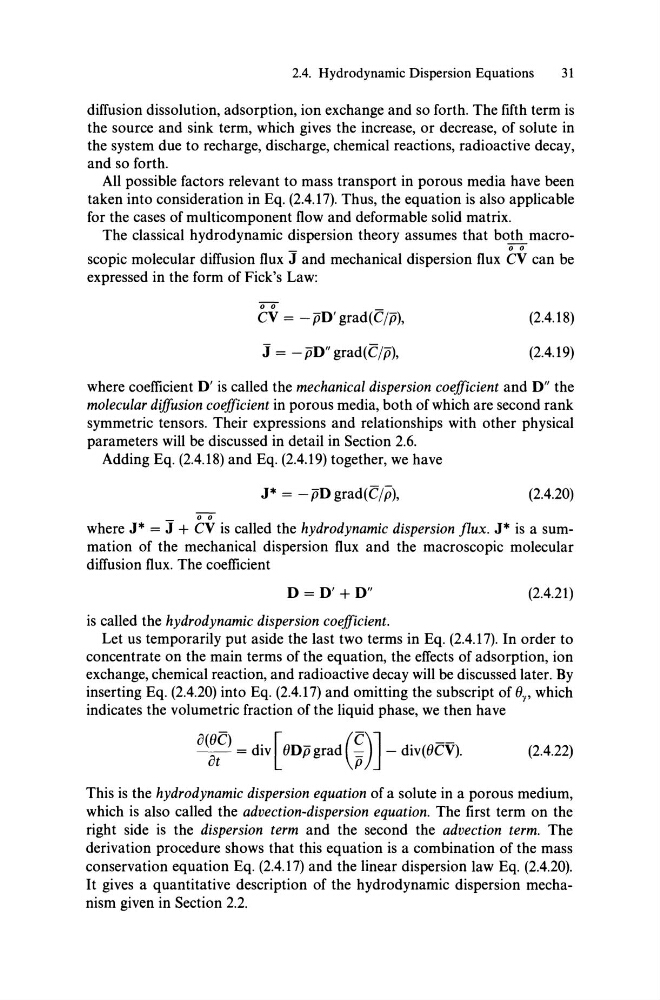
This is the hydrodynamic dispersion equation of a solute in a porous medium,
which is also called the advection-dispersion equation. The first term on the
right side is the dispersion term and the second the advection term. The
derivation procedure shows that this equation is a combination of the mass
conservation equation Eq. (2.4.17) and the linear dispersion law Eq. (2.4.20).
It gives a quantitative description of the hydrodynamic dispersion mechanism given in Section 2.2.
31
diffusion dissolution, adsorption, ion exchange and so forth. The fifth term is
the source and sink term, which gives the increase, or decrease, of solute in
the system due to recharge, discharge, chemical reactions, radioactive decay,
and so forth.
All possible factors relevant to mass transport in porous media have been
taken into consideration in Eq. (2.4.17). Thus, the equation is also applicable
for the cases of multicomponent flow and deformable solid matrix.
The classical hydrodynamic dispersion theory assumes that both macro_
00
scopic molecular diffusion flux J and mechanical dispersion flux CV can be
expressed in the form of Fick's Law:
00
_
CV = - pD' grad( C/p),
J = - pD" grad(C/p),
(2.4.18)
(2.4.19)
where coefficient D' is called the mechanical dispersion coefficient and D" the
molecular diffusion coefficient in porous media, both of which are second rank
symmetric tensors. Their expressions and relationships with other physical
parameters will be discussed in detail in Section 2.6.
Adding Eq. (2.4.18) and Eq. (2.4.19) together, we have
J* = - pD grad(C/p),
(2.4.20)
_
00
where J* = J + CV is called the hydrodynamic dispersion flux. J* is a summation of the mechanical dispersion flux and the macroscopic molecular
diffusion flux. The coefficient
D=D'+D"
(2.4.21)
is called the hydrodynamic dispersion coefficient.
Let us temporarily put aside the last two terms in Eq. (2.4.17). In order to
concentrate on the main terms of the equation, the effects of adsorption, ion
exchange, chemical reaction, and radioactive decay will be discussed later. By
inserting Eq. (2.4.20) into Eq. (2.4.17) and omitting the subscript of ()y, which
indicates the volumetric fraction of the liquid phase, we then have
iJ«()C)
[
(C)] -----at = div ()Dp grad p - div«()CV).
(2.4.22)
This is the hydrodynamic dispersion equation of a solute in a porous medium,
which is also called the advection-dispersion equation. The first term on the
right side is the dispersion term and the second the advection term. The
derivation procedure shows that this equation is a combination of the mass
conservation equation Eq. (2.4.17) and the linear dispersion law Eq. (2.4.20).
It gives a quantitative description of the hydrodynamic dispersion mechanism given in Section 2.2.