

32
2. Hydrodynamic Dispersion in Porous Media
For a solute with low concentration, pis approximately constant, and Eq.
(2.4.22) is reduced to
o(OC)
- - -
at = div(OD gradC) - div(OCV).
(2.4.23)
Furthermore, assume that 0 is a constant and let V; (i = 1,2,3) be the three
components of the mean flow velocity V, and D 11 , D 12 , ••• , D 33 be the nine
components of the second rank symmetric tensor D. Using Einstein's summation convention, Eq. (2.4.23) can be expressed in the following form:
-
= -
Dij- - -(ViC).
(2.4.24)
ot
OXi
OXj
oXi
Readers of this book should be familiar with this compact form.
The above derivation of the hydrodynamic dispersion equation is based on
the concept ofREV and the assumption that the Fick's law is valid. To derive
the hydrodynamic dispersion equation from molecular physical principles
needs more rigorous argument (Sposito et al., 1979, 1986).
2.4.4 The Integral Form of Hydrodynamic
Dispersion Equations
The integral form of the advection-dispersion equation for a porous medium
is useful, not only in describing the characteristics of the equation, but also
in deriving its numerical solutions.
Consider an arbitrary mass balance volume (R) in a porous medium. Let
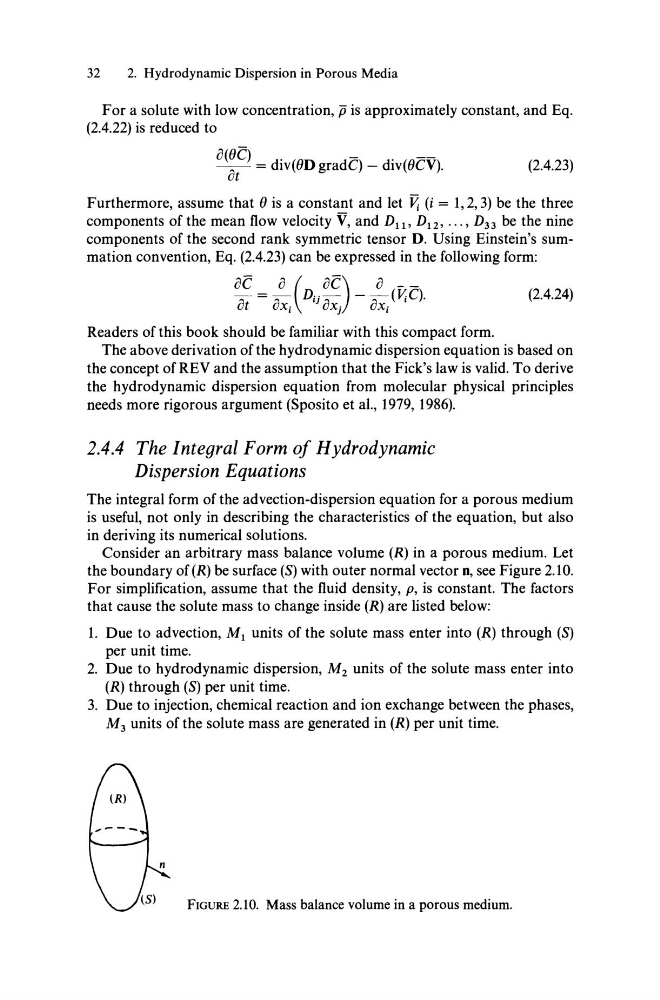
the boundary of (R) be surface (S) with outer normal vector n, see Figure 2.10.
For simplification, assume that the fluid density, p, is constant. The factors
that cause the solute mass to change inside (R) are listed below:
1. Due to advection, MI units of the solute mass enter into (R) through (S)
per unit time.
2. Due to hydrodynamic dispersion, M 2 units of the solute mass enter into
(R) through (S) per unit time.
3. Due to injection, chemical reaction and ion exchange between the phases,
M 3 units of the solute mass are generated in (R) per unit time.
FIGURE 2.10. Mass balance volume in a porous medium.
2. Hydrodynamic Dispersion in Porous Media
For a solute with low concentration, pis approximately constant, and Eq.
(2.4.22) is reduced to
o(OC)
- - -
at = div(OD gradC) - div(OCV).
(2.4.23)
Furthermore, assume that 0 is a constant and let V; (i = 1,2,3) be the three
components of the mean flow velocity V, and D 11 , D 12 , ••• , D 33 be the nine
components of the second rank symmetric tensor D. Using Einstein's summation convention, Eq. (2.4.23) can be expressed in the following form:
-
= -
Dij- - -(ViC).
(2.4.24)
ot
OXi
OXj
oXi
Readers of this book should be familiar with this compact form.
The above derivation of the hydrodynamic dispersion equation is based on
the concept ofREV and the assumption that the Fick's law is valid. To derive
the hydrodynamic dispersion equation from molecular physical principles
needs more rigorous argument (Sposito et al., 1979, 1986).
2.4.4 The Integral Form of Hydrodynamic
Dispersion Equations
The integral form of the advection-dispersion equation for a porous medium
is useful, not only in describing the characteristics of the equation, but also
in deriving its numerical solutions.
Consider an arbitrary mass balance volume (R) in a porous medium. Let
the boundary of (R) be surface (S) with outer normal vector n, see Figure 2.10.
For simplification, assume that the fluid density, p, is constant. The factors
that cause the solute mass to change inside (R) are listed below:
1. Due to advection, MI units of the solute mass enter into (R) through (S)
per unit time.
2. Due to hydrodynamic dispersion, M 2 units of the solute mass enter into
(R) through (S) per unit time.
3. Due to injection, chemical reaction and ion exchange between the phases,
M 3 units of the solute mass are generated in (R) per unit time.
FIGURE 2.10. Mass balance volume in a porous medium.