

30
2. Hydrodynamic Dispersion in Porous Media
which is Eq. (2.4.9). From this equation the average divergence of an arbitrary vector A, (div A), can be determined. By applying Eq. (2.4.9) to the three
components of vector A and summing them up, we then have:
(2.4.12)
where An is the projection of vector A onto the outer normal of [So. y]. From
the above equation we find that only when An = 0 and ()y is constant can
we have
(div A) = div A.
(2.4.13)
2.4.3 Advection-Dispersion Equations in Porous Media
By adding a source and sink term to Eq. (2.3.9) and applying spatial averaging, we then ha ve
( aC)
--- -
8i + div(CV) + div J = I.
(2.4.14)
Substituting Eqs. (2.4.6) and (2.4.12) for the relevant terms into Eq. (2.4.14)
yields:
o«() C)
-
-
-
T + div«()yCV) + div«()yJ) + On + C(v" - un) > My = ()yl. (2.4.15)
From Eq. (2.1.9) we know
_
__
00
CV= CV + CV,
(2.4.16)
Substituting Eq. (2.4.16) into Eq. (2.4.15) and rearranging the equation, we
have
o«() C)
__
7fO
_
T = -div«()yCV) - div«()yCV) - div«()yJ)
-
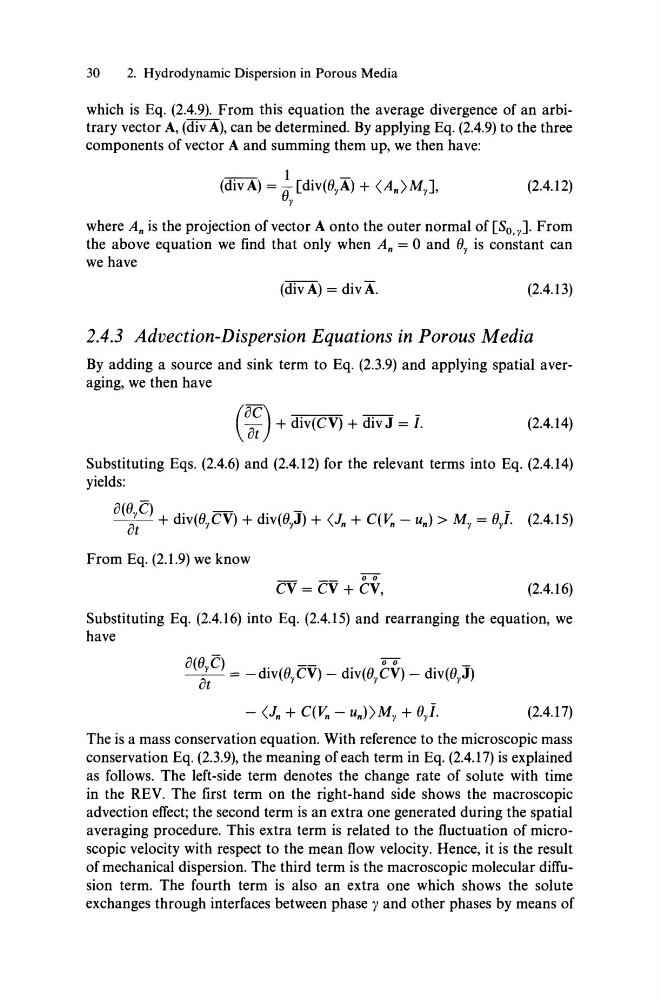
The is a mass conservation equation. With reference to the microscopic mass
conservation Eq. (2.3.9), the meaning of each term in Eq. (2.4.17) is explained
as folIows. The left-side term denotes the change rate of solute with time
in the REV. The first term on the right-hand side shows the macroscopic
advection effect; the second term is an extra one generated during the spatial
averaging procedure. This extra term is related to the fluctuation of microscopic velocity with respect to the mean flow velocity. Hence, it is the result
of mechanical dispersion. The third term is the macroscopic molecular diffusion term. The fourth term is also an extra one which shows the solute
exchanges through interfaces between phase y and other phases by means of
2. Hydrodynamic Dispersion in Porous Media
which is Eq. (2.4.9). From this equation the average divergence of an arbitrary vector A, (div A), can be determined. By applying Eq. (2.4.9) to the three
components of vector A and summing them up, we then have:
(2.4.12)
where An is the projection of vector A onto the outer normal of [So. y]. From
the above equation we find that only when An = 0 and ()y is constant can
we have
(div A) = div A.
(2.4.13)
2.4.3 Advection-Dispersion Equations in Porous Media
By adding a source and sink term to Eq. (2.3.9) and applying spatial averaging, we then ha ve
( aC)
--- -
8i + div(CV) + div J = I.
(2.4.14)
Substituting Eqs. (2.4.6) and (2.4.12) for the relevant terms into Eq. (2.4.14)
yields:
o«() C)
-
-
-
T + div«()yCV) + div«()yJ) + On + C(v" - un) > My = ()yl. (2.4.15)
From Eq. (2.1.9) we know
_
__
00
CV= CV + CV,
(2.4.16)
Substituting Eq. (2.4.16) into Eq. (2.4.15) and rearranging the equation, we
have
o«() C)
__
7fO
_
T = -div«()yCV) - div«()yCV) - div«()yJ)
-
The is a mass conservation equation. With reference to the microscopic mass
conservation Eq. (2.3.9), the meaning of each term in Eq. (2.4.17) is explained
as folIows. The left-side term denotes the change rate of solute with time
in the REV. The first term on the right-hand side shows the macroscopic
advection effect; the second term is an extra one generated during the spatial
averaging procedure. This extra term is related to the fluctuation of microscopic velocity with respect to the mean flow velocity. Hence, it is the result
of mechanical dispersion. The third term is the macroscopic molecular diffusion term. The fourth term is also an extra one which shows the solute
exchanges through interfaces between phase y and other phases by means of