

2.4. Hydrodynamic Dispersion Equations
29
If u = 0, that is, there is no deformation of [U o , y], Eq. (2.4.6) is simplified to
(~~) = ~~.
(2.4.8)
The left-hand side of Eq. (2.4.8) is the spatial average of the derivative of
concentration with respect to time, while the right side is the derivative of
spatial averaged concentration with respect to time. The former indicates
the macroscopic mean of concentration change rate while the latter indicates
the macroscopic change rate of the mean concentration. Only when [UO,y]
does not change with time can they be equal to each other.
2.4.2 The Average of Spatial Derivatives
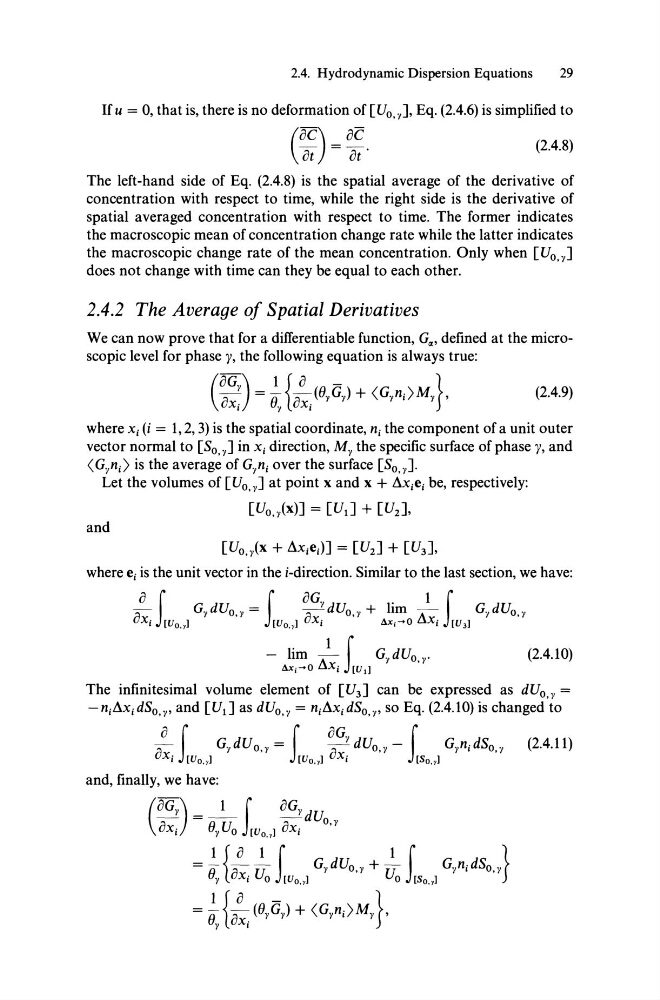
We can now prove that for a difTerentiable function, Ga, defined at the microscopic level for phase y, the following equation is always true:
( aG y )
1 { a
-
}
aXi = ~ aXi «()yGy) + (Gyni>My ,
(2.4.9)
where Xi (i = 1,2,3) is the spatial coordinate, ni the component of a unit outer
vector normal to [SO,y] in Xi direction, My the specific surface ofphase y, and
(Gyni> is the average of Gyni over the surface [SO,y].
Let the volumes of [UO,y] at point x and x + äXiei be, respectively:
[Uojx)] = [Ut ] + [U2 ],
and
[UO,y(x + äxiei)] = [U2 ] + [U3 ],
where e i is the unit vector in the i-direction. Similar to the last section, we have:
The infinitesimal volume element of [U 3 ] can be expressed as dUo,y =
-niäxidSo,y, and [Ut ] as dUo,y = niäxidSo,y, so Eq. (2.4.10) is changed to
aa r GydUo,y = r ~Gy dUo,y - r GynidSo,y (2.4.11)
Xi J [Uo.,]
J [Uo.,] Xi
J [So.,]
and, finally, we have:
( aG y ) = _1_ r aG y dUo
aXi
()yUO J[u o .,] aXi ,y
= ~{aa ~r GydUo,y + ~ r GynidSo,y}
y Xi 0 J[Uo.,]
0 J[so.,]
1 { a -
}
= ~ aXi «()yGy) + (Gyn;)My ,
29
If u = 0, that is, there is no deformation of [U o , y], Eq. (2.4.6) is simplified to
(~~) = ~~.
(2.4.8)
The left-hand side of Eq. (2.4.8) is the spatial average of the derivative of
concentration with respect to time, while the right side is the derivative of
spatial averaged concentration with respect to time. The former indicates
the macroscopic mean of concentration change rate while the latter indicates
the macroscopic change rate of the mean concentration. Only when [UO,y]
does not change with time can they be equal to each other.
2.4.2 The Average of Spatial Derivatives
We can now prove that for a difTerentiable function, Ga, defined at the microscopic level for phase y, the following equation is always true:
( aG y )
1 { a
-
}
aXi = ~ aXi «()yGy) + (Gyni>My ,
(2.4.9)
where Xi (i = 1,2,3) is the spatial coordinate, ni the component of a unit outer
vector normal to [SO,y] in Xi direction, My the specific surface ofphase y, and
(Gyni> is the average of Gyni over the surface [SO,y].
Let the volumes of [UO,y] at point x and x + äXiei be, respectively:
[Uojx)] = [Ut ] + [U2 ],
and
[UO,y(x + äxiei)] = [U2 ] + [U3 ],
where e i is the unit vector in the i-direction. Similar to the last section, we have:
The infinitesimal volume element of [U 3 ] can be expressed as dUo,y =
-niäxidSo,y, and [Ut ] as dUo,y = niäxidSo,y, so Eq. (2.4.10) is changed to
aa r GydUo,y = r ~Gy dUo,y - r GynidSo,y (2.4.11)
Xi J [Uo.,]
J [Uo.,] Xi
J [So.,]
and, finally, we have:
( aG y ) = _1_ r aG y dUo
aXi
()yUO J[u o .,] aXi ,y
= ~{aa ~r GydUo,y + ~ r GynidSo,y}
y Xi 0 J[Uo.,]
0 J[so.,]
1 { a -
}
= ~ aXi «()yGy) + (Gyn;)My ,