

26
2. Hydrodynamic Dispersion in Porous Media
Hence,
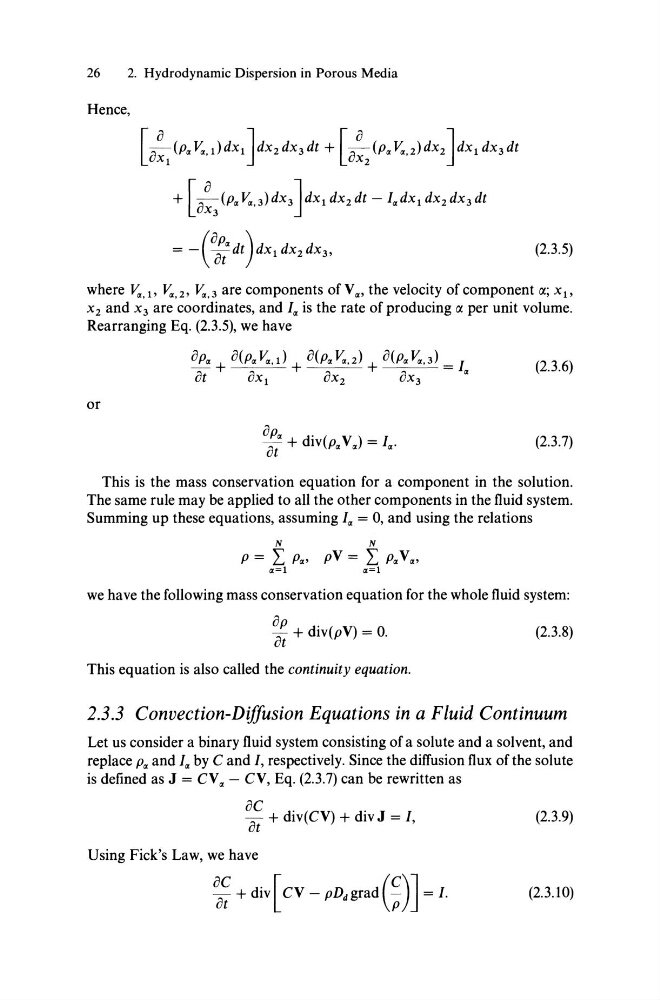
[O~l (Pt.~.ddXIJdX2dX3dt + [O~2 (Pa~.2)dX2JdXldX3dt
+ [O~3 (Pa ~.3)dx3 JdX 1 dX2 dt - f adx 1 dX2 dX3 dt
= -(O:radt)dXldX2dX3'
(2.3.5)
where ~.1' ~.2' ~.3 are components ofVa , the velocity ofcomponent 0(; Xl'
X2 and X 3 are coordinates, and f a is the rate of producing 0( per unit volume.
Rearranging Eq. (2.3.5), we have
or
OPa + O(Pa~.l) + O(Pa~.2) + O(Pa~.3) = f
ot
OX 1
OX2
OX 3
a
(2.3.6)
(2.3.7)
This is the mass conservation equation for a component in the solution.
The same rule may be applied to all the other components in the fluid system.
Summing up these equations, assuming f a = 0, and using the relations
N
N
P = L Pa' pV = L PaVa'
a=l
a=l
we have the following mass conservation equation for the whole fluid system:
~ + div(pV) = O.
(2.3.8)
This equation is also called the continuity equation.
2.3.3 Convection-Diffusion Equations in a Fluid Continuum
Let us consider a binary fluid system consisting of a solute and a solvent, and
replace Pa and f a by C and f, respectively. Since the diffusion flux of the solute
is defined as J = CV a - CV, Eq. (2.3.7) can be rewritten as
~~ + div(CV) + div J = f,
(2.3.9)
Using Fick's Law, we have
~~ + diV[ CV - PDdgrad(~) ] = l.
(2.3.10)
2. Hydrodynamic Dispersion in Porous Media
Hence,
[O~l (Pt.~.ddXIJdX2dX3dt + [O~2 (Pa~.2)dX2JdXldX3dt
+ [O~3 (Pa ~.3)dx3 JdX 1 dX2 dt - f adx 1 dX2 dX3 dt
= -(O:radt)dXldX2dX3'
(2.3.5)
where ~.1' ~.2' ~.3 are components ofVa , the velocity ofcomponent 0(; Xl'
X2 and X 3 are coordinates, and f a is the rate of producing 0( per unit volume.
Rearranging Eq. (2.3.5), we have
or
OPa + O(Pa~.l) + O(Pa~.2) + O(Pa~.3) = f
ot
OX 1
OX2
OX 3
a
(2.3.6)
(2.3.7)
This is the mass conservation equation for a component in the solution.
The same rule may be applied to all the other components in the fluid system.
Summing up these equations, assuming f a = 0, and using the relations
N
N
P = L Pa' pV = L PaVa'
a=l
a=l
we have the following mass conservation equation for the whole fluid system:
~ + div(pV) = O.
(2.3.8)
This equation is also called the continuity equation.
2.3.3 Convection-Diffusion Equations in a Fluid Continuum
Let us consider a binary fluid system consisting of a solute and a solvent, and
replace Pa and f a by C and f, respectively. Since the diffusion flux of the solute
is defined as J = CV a - CV, Eq. (2.3.7) can be rewritten as
~~ + div(CV) + div J = f,
(2.3.9)
Using Fick's Law, we have
~~ + diV[ CV - PDdgrad(~) ] = l.
(2.3.10)