

2.3. Mass Conservation
25
where J is the mass diffusion flux of the solute and Cis the solute concentration. For a dilute solution, the fluid density p can be approximated as a
constant and the above equation can be simplified to
(2.3.4)
With these assumptions, Fick's Law may be expressed in the following way:
the diffusion flux is proportional to the concentration gradient of the solute.
The negative sign on the right side indicates that the diffusion goes towards
the lower concentration fluid. Coeflicient D d is called the molecular diffusion
coefficient in the solution. It may be considered as a constant if the solute
concentration is relatively low. D d has the dimensions of [L 2 /TJ, and is a
function of the composition and temperature of the solution (Robinson and
Stokes, 1965).
2.3.2 Mass Conservation Equation of a Component
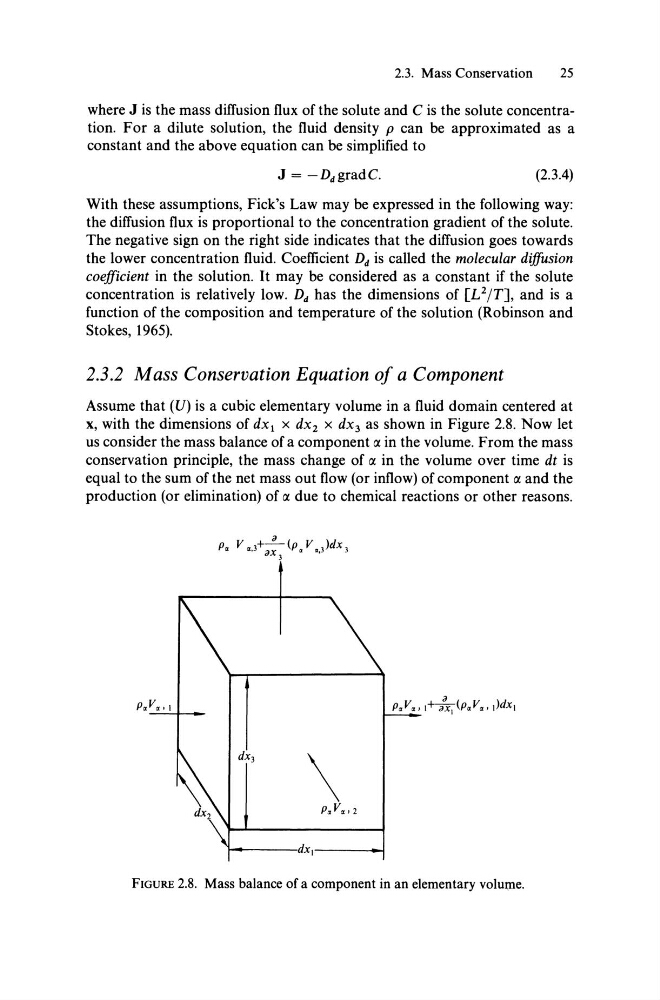
Assurne that (U) is a cubic elementary volume in a fluid domain centered at
x, with the dimensions of dXl x dX 2 X dX3 as shown in Figure 2.8. Now let
us consider the mass balance of a component oe in the volume. From the mass
conservation principle, the mass change of oe in the volume over time dt is
equal to the sum of the net mass out flow (or inflow) of component oe and the
production (or elimination) of oe due to chemical reactions or other reasons.
P.V • • \
\ P.v •. 2
FIGURE 2.8. Mass balance of a component in an elementary volume.
25
where J is the mass diffusion flux of the solute and Cis the solute concentration. For a dilute solution, the fluid density p can be approximated as a
constant and the above equation can be simplified to
(2.3.4)
With these assumptions, Fick's Law may be expressed in the following way:
the diffusion flux is proportional to the concentration gradient of the solute.
The negative sign on the right side indicates that the diffusion goes towards
the lower concentration fluid. Coeflicient D d is called the molecular diffusion
coefficient in the solution. It may be considered as a constant if the solute
concentration is relatively low. D d has the dimensions of [L 2 /TJ, and is a
function of the composition and temperature of the solution (Robinson and
Stokes, 1965).
2.3.2 Mass Conservation Equation of a Component
Assurne that (U) is a cubic elementary volume in a fluid domain centered at
x, with the dimensions of dXl x dX 2 X dX3 as shown in Figure 2.8. Now let
us consider the mass balance of a component oe in the volume. From the mass
conservation principle, the mass change of oe in the volume over time dt is
equal to the sum of the net mass out flow (or inflow) of component oe and the
production (or elimination) of oe due to chemical reactions or other reasons.
P.V • • \
\ P.v •. 2
FIGURE 2.8. Mass balance of a component in an elementary volume.