

254
8. Applications of Groundwater Quality Models
and other factors, and the factor of retardation mayaiso be added when
necessary.
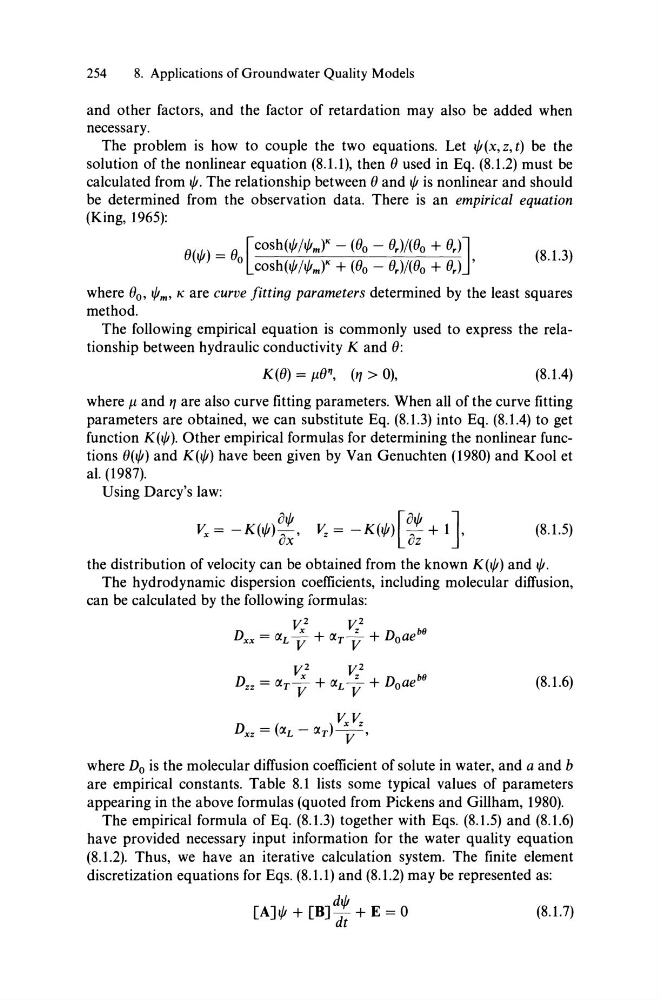
The problem is how to couple the two equations. Let t/I(x, z, t) be the
solution of the nonlinear equation (8.1.1), then () used in Eq. (8.1.2) must be
calculated from t/I. The relationship between () and t/I is nonlinear and should
be determined from the observation data. There is an empirical equation
(King, 1965):
(}(t/I) = () [COSh(t/lNm}" - (()o - ()r)/(()O + ()r)]
o cosh(t/lNm)" + (()o - ()r)/(()O + ()r) ,
(8.1.3)
where ()o, t/lm' Kare curve fitting parameters determined by the least squares
method.
The following empirical equation is commonly used to express the relationship between hydraulic conductivity K and ():
K(() = p,()", (" > 0),
(8.1.4)
where p, and " are also curve fitting parameters. When all of the curve fitting
parameters are obtained, we can substitute Eq. (8.1.3) into Eq. (8.1.4) to get
function K(t/I). Other empirical formulas for determining the nonlinear functions (}(t/I) and K(t/I) have been given by Van Genuchten (1980) and Kool et
al. (1987).
Using Darcy's law:
Vx = -K(t/I)~~, ~ = -K(t/I{~~ + 1 J.
(8.1.5)
the distribution of velocity can be obtained from the known K(t/I) and t/I.
The hydrodynamic dispersion coefficients, induding molecular diffusion,
can be calculated by the following formulas:
Vx 2
V/
b8
D = IXL - + IX T - + Doae
xx
V
V
Vx 2
~2
b8
Dzz = IX T y + IXL Y + Doae
(8.1.6)
VxVz
Dxz = (IXL - IXT)V'
where D o is the molecular diffusion coefficient of solute in water, and a and b
are empirical constants. Table 8.1 lists some typical values of parameters
appearing in the above formulas (quoted from Pickens and Gillham, 1980).
The empirical formula of Eq. (8.1.3) together with Eqs. (8.1.5) and (8.1.6)
have provided necessary input information for the water quality equation
(8.1.2). Thus, we have an iterative calculation system. The finite element
discretization equations for Eqs. (8.1.1) and (8.1.2) may be represented as:
[AJt/I + [BJ~~ + E = 0
(8.1.7)
8. Applications of Groundwater Quality Models
and other factors, and the factor of retardation mayaiso be added when
necessary.
The problem is how to couple the two equations. Let t/I(x, z, t) be the
solution of the nonlinear equation (8.1.1), then () used in Eq. (8.1.2) must be
calculated from t/I. The relationship between () and t/I is nonlinear and should
be determined from the observation data. There is an empirical equation
(King, 1965):
(}(t/I) = () [COSh(t/lNm}" - (()o - ()r)/(()O + ()r)]
o cosh(t/lNm)" + (()o - ()r)/(()O + ()r) ,
(8.1.3)
where ()o, t/lm' Kare curve fitting parameters determined by the least squares
method.
The following empirical equation is commonly used to express the relationship between hydraulic conductivity K and ():
K(() = p,()", (" > 0),
(8.1.4)
where p, and " are also curve fitting parameters. When all of the curve fitting
parameters are obtained, we can substitute Eq. (8.1.3) into Eq. (8.1.4) to get
function K(t/I). Other empirical formulas for determining the nonlinear functions (}(t/I) and K(t/I) have been given by Van Genuchten (1980) and Kool et
al. (1987).
Using Darcy's law:
Vx = -K(t/I)~~, ~ = -K(t/I{~~ + 1 J.
(8.1.5)
the distribution of velocity can be obtained from the known K(t/I) and t/I.
The hydrodynamic dispersion coefficients, induding molecular diffusion,
can be calculated by the following formulas:
Vx 2
V/
b8
D = IXL - + IX T - + Doae
xx
V
V
Vx 2
~2
b8
Dzz = IX T y + IXL Y + Doae
(8.1.6)
VxVz
Dxz = (IXL - IXT)V'
where D o is the molecular diffusion coefficient of solute in water, and a and b
are empirical constants. Table 8.1 lists some typical values of parameters
appearing in the above formulas (quoted from Pickens and Gillham, 1980).
The empirical formula of Eq. (8.1.3) together with Eqs. (8.1.5) and (8.1.6)
have provided necessary input information for the water quality equation
(8.1.2). Thus, we have an iterative calculation system. The finite element
discretization equations for Eqs. (8.1.1) and (8.1.2) may be represented as:
[AJt/I + [BJ~~ + E = 0
(8.1.7)