

2.1. Physical Parameters
11
where V is called the mean pore velocity in the region of porous media. If the
velocity within solid matrices is defined to be zero, Eq. (2.1.6) can be changed
to
-
1 i
V(x,t) = - ( - )
V(x',t)dUo.
nUo x IUo(x)]
(2.1.7)
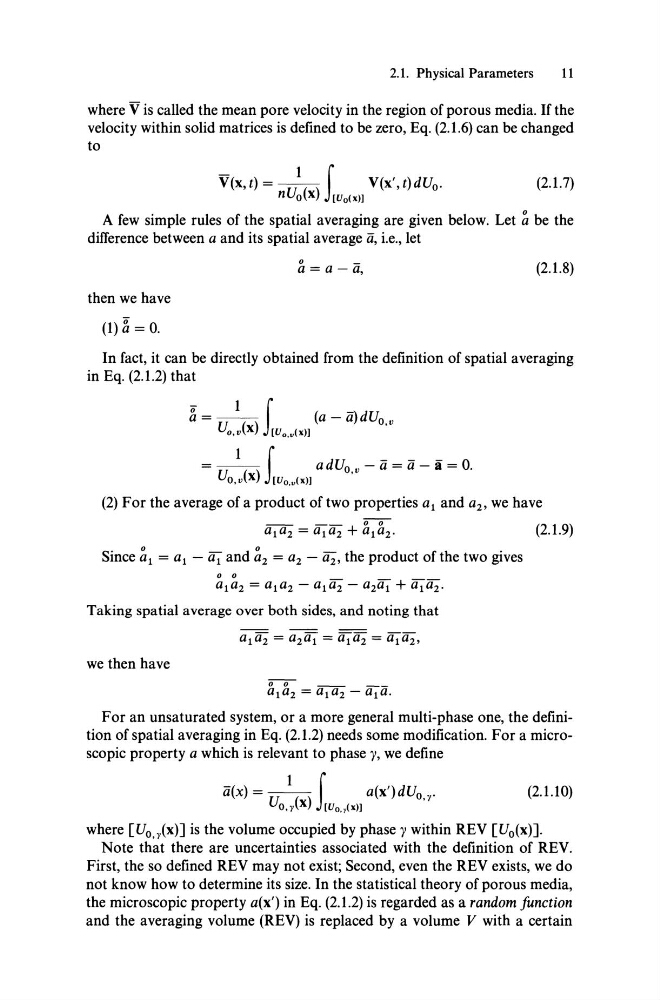
A few simple rules of the spatial averaging are given below. Let ä be the
difference between a and its spatial average a, i.e., let
then we have
"0
(1) a = O.
o
_
a=a-a,
(2.1.8)
In fact, it can be directly obtained from the definition of spatial averaging
in Eq. (2.1.2) that
~ = ~ r (a - äJ dUo v
0, v(x) J [U o.v(X)]
,
= __ 1_ r adUov-a=a-a=O.
Uo,v(x) J IUo.v(x)]
,
(2) For the average of a product of two properties a 1 and a2' we have
a1 a2 = a1 a2 + al a2'
(2.1.9)
Since ä 1 = a 1 - a 1 and ä 2 = a 2 - a 2 , the product of the two gives
o 0
a1 a2 = a1 a2 - a1a2 - a2a1 + a1 a2'
Taking spatial average over both sides, and noting that
we then have
For an unsaturated system, or a more general multi-phase one, the definition of spatial averaging in Eq. (2.1.2) needs some modification. For a microscopic property a which is relevant to phase y, we define
a(x) = TT 1( ) r a(x')dUo,y'
(2.1.10)
UO,y x JIUo.,(x)]
where [UO,y(x)] is the volume occupied by phase y within REV [Uo(x)].
Note that there are uncertainties associated with the definition of REV.
First, the so defined REV may not exist; Second, even the REV exists, we do
not know how to determine its size. In the statistical theory of porous media,
the microscopic property a(x') in Eq. (2.1.2) is regarded as a random function
and the averaging volume (REV) is replaced by a volume V with a certain
11
where V is called the mean pore velocity in the region of porous media. If the
velocity within solid matrices is defined to be zero, Eq. (2.1.6) can be changed
to
-
1 i
V(x,t) = - ( - )
V(x',t)dUo.
nUo x IUo(x)]
(2.1.7)
A few simple rules of the spatial averaging are given below. Let ä be the
difference between a and its spatial average a, i.e., let
then we have
"0
(1) a = O.
o
_
a=a-a,
(2.1.8)
In fact, it can be directly obtained from the definition of spatial averaging
in Eq. (2.1.2) that
~ = ~ r (a - äJ dUo v
0, v(x) J [U o.v(X)]
,
= __ 1_ r adUov-a=a-a=O.
Uo,v(x) J IUo.v(x)]
,
(2) For the average of a product of two properties a 1 and a2' we have
a1 a2 = a1 a2 + al a2'
(2.1.9)
Since ä 1 = a 1 - a 1 and ä 2 = a 2 - a 2 , the product of the two gives
o 0
a1 a2 = a1 a2 - a1a2 - a2a1 + a1 a2'
Taking spatial average over both sides, and noting that
we then have
For an unsaturated system, or a more general multi-phase one, the definition of spatial averaging in Eq. (2.1.2) needs some modification. For a microscopic property a which is relevant to phase y, we define
a(x) = TT 1( ) r a(x')dUo,y'
(2.1.10)
UO,y x JIUo.,(x)]
where [UO,y(x)] is the volume occupied by phase y within REV [Uo(x)].
Note that there are uncertainties associated with the definition of REV.
First, the so defined REV may not exist; Second, even the REV exists, we do
not know how to determine its size. In the statistical theory of porous media,
the microscopic property a(x') in Eq. (2.1.2) is regarded as a random function
and the averaging volume (REV) is replaced by a volume V with a certain