

10
2. Hydrodynamic Dispersion in Porous Media
and pores, can be considered as a continuum fully filled with those particles.
All relevant parameters and properties, such as the water head, concentrati on, porosity, and permeability may be regarded as continuous and even
differentiable functions. The difficulty in getting details of the microstructure
ofporous media is thus avoided. The study offlow phenomena in porous media
based on the scale of porous medium REV is called the macroscopic approach.
Let us now consider saturated flow in a porous medium. This occurs when
the pores are filled with fluid. Suppose that a(x') is a microscopic property
(scalar or vector) of the fluid, where x' represents a point in the microscopic
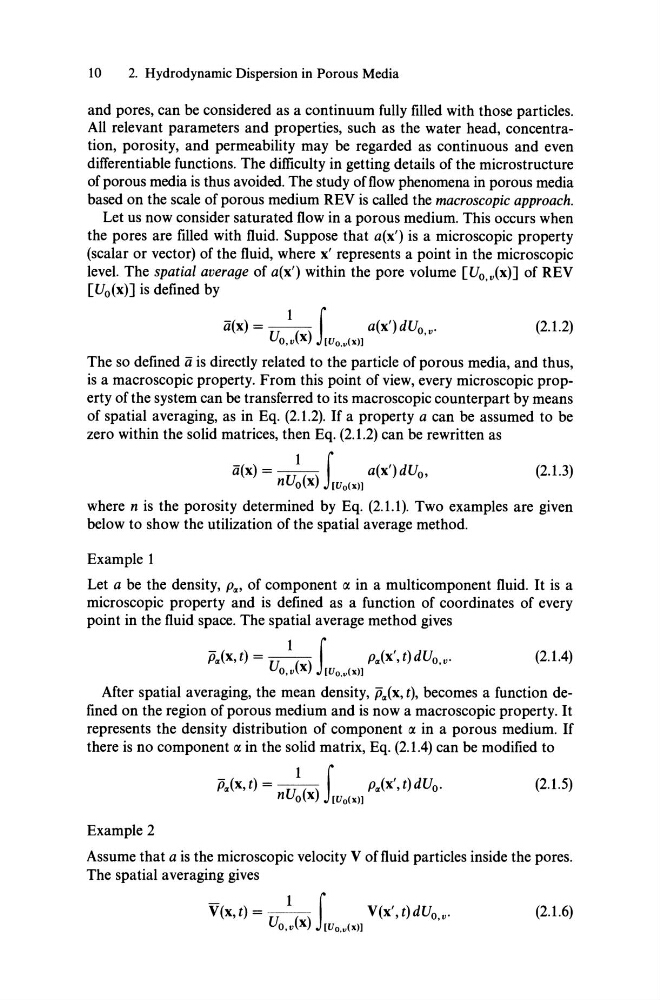
level. The spatial average of a(x') within the pore volume [Uo.v(x)] of REV
[Uo(x)] is defined by
a(x) = ~( ) f
a(x')dUo.v'
Uo. v x J [Uo.v(X)]
(2.1.2)
The so defined ais directly related to the particle of porous media, and thus,
is a macroscopic property. From this point of view, every microscopic property of the system can be transferred to its macroscopic counterpart by means
of spatial averaging, as in Eq. (2.1.2). If a property a can be assumed to be
zero within the solid matrices, then Eq. (2.1.2) can be rewritten as
a(x) = ~( ) f a(x') dUo,
(2.1.3)
nUo x J IUo(x)]
where n is the porosity determined by Eq. (2.1.1). Two examples are given
below to show the utilization of the spatial average method.
Example 1
Let a be the density, Pa' of component IX in a multicomponent fluid. It is a
microscopic property and is defined as a function of coordinates of every
point in the fluid space. The spatial average method gives
Pa(x,t) = ~( ) f
Pa(x',t)dUo.v'
(2.1.4)
UO•v x JIUo.v(X)]
After spatial averaging, the mean density, Pa(x, t), becomes a function defined on the region of porous medium and is now a macroscopic property. It
represents the density distribution of component IX in a porous medium. If
there is no component IX in the solid matrix, Eq. (2.1.4) can be modified to
pAx, t) = ~( ) f Pa(x', t) dUo.
(2.1.5)
nUo x JIUo(X)]
Example 2
Assume that a is the microscopic velocity V of fluid particles inside the pores.
The spatial averaging gives
-
1 i
V(x,t) = --(-)
V(x',t)dUo.v'
Uo.v x IUo.v(x)]
(2.1.6)
2. Hydrodynamic Dispersion in Porous Media
and pores, can be considered as a continuum fully filled with those particles.
All relevant parameters and properties, such as the water head, concentrati on, porosity, and permeability may be regarded as continuous and even
differentiable functions. The difficulty in getting details of the microstructure
ofporous media is thus avoided. The study offlow phenomena in porous media
based on the scale of porous medium REV is called the macroscopic approach.
Let us now consider saturated flow in a porous medium. This occurs when
the pores are filled with fluid. Suppose that a(x') is a microscopic property
(scalar or vector) of the fluid, where x' represents a point in the microscopic
level. The spatial average of a(x') within the pore volume [Uo.v(x)] of REV
[Uo(x)] is defined by
a(x) = ~( ) f
a(x')dUo.v'
Uo. v x J [Uo.v(X)]
(2.1.2)
The so defined ais directly related to the particle of porous media, and thus,
is a macroscopic property. From this point of view, every microscopic property of the system can be transferred to its macroscopic counterpart by means
of spatial averaging, as in Eq. (2.1.2). If a property a can be assumed to be
zero within the solid matrices, then Eq. (2.1.2) can be rewritten as
a(x) = ~( ) f a(x') dUo,
(2.1.3)
nUo x J IUo(x)]
where n is the porosity determined by Eq. (2.1.1). Two examples are given
below to show the utilization of the spatial average method.
Example 1
Let a be the density, Pa' of component IX in a multicomponent fluid. It is a
microscopic property and is defined as a function of coordinates of every
point in the fluid space. The spatial average method gives
Pa(x,t) = ~( ) f
Pa(x',t)dUo.v'
(2.1.4)
UO•v x JIUo.v(X)]
After spatial averaging, the mean density, Pa(x, t), becomes a function defined on the region of porous medium and is now a macroscopic property. It
represents the density distribution of component IX in a porous medium. If
there is no component IX in the solid matrix, Eq. (2.1.4) can be modified to
pAx, t) = ~( ) f Pa(x', t) dUo.
(2.1.5)
nUo x JIUo(X)]
Example 2
Assume that a is the microscopic velocity V of fluid particles inside the pores.
The spatial averaging gives
-
1 i
V(x,t) = --(-)
V(x',t)dUo.v'
Uo.v x IUo.v(x)]
(2.1.6)