

12
2. Hydrodynamic Dispersion in Porous Media
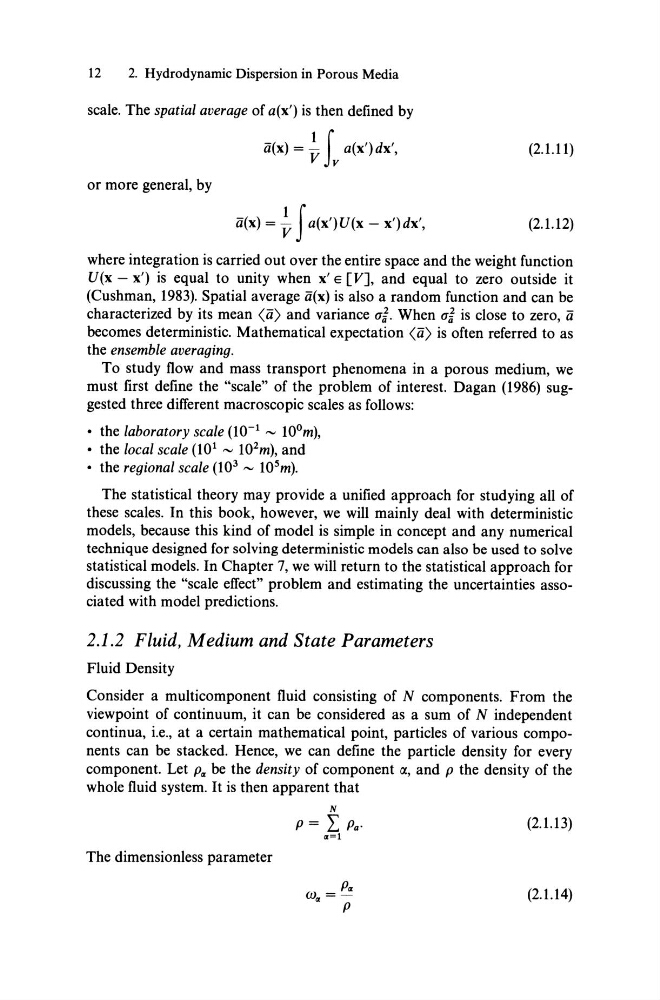
scale. The spatial average of a(x') is then defined by
ä(x) = ~ r a(x') dx',
V Jv
or more general, by
ä(x) = ~ f a(x')U(x - x')dx',
(2.1.11)
(2.1.12)
where integration is carried out over the entire space and the weight function
U(x - x') is equal to unity when x' E [V], and equal to zero outside it
(Cushman, 1983). Spatial average ä(x) is also a random function and can be
characterized by its me an (ä) and variance (11. When (1f is elose to zero, ä
becomes deterministic. Mathematical expectation (ä) is often referred to as
the ensemble averaging.
To study flow and mass transport phenomena in a porous medium, we
must first define the "scale" of the problem of interest. Dagan (1986) suggested three different macroscopic scales as follows:
• the laboratory seale (10- 1 '" 10 0 m),
• the loeal seale (10 1 '" 10 2 m), and
• the regional seale (10 3 '" 10 5 m).
The statistical theory may provide a unified approach for studying all of
these scales. In this book, however, we will mainly deal with deterministic
models, because this kind of model is simple in concept and any numerical
technique designed for solving deterministic models can also be used to solve
statistical models. In Chapter 7, we will return to the statistical approach for
discussing the "scale effect" problem and estimating the uncertainties associated with model predictions.
2.1.2 Fluid, Medium and State Parameters
Fluid Density
Consider a multicomponent fluid consisting of N components. From the
viewpoint of continuum, it can be considered as a sum of N independent
continua, i.e., at a certain mathematical point, particles of various components can be stacked. Hence, we can define the partiele density for every
component. Let Pli. be the density of component a, and P the density of the
whole fluid system. It is then apparent that
N
P = L: Pa·
(2.1.13)
11.=1
The dimensionless parameter
(2.1.14)
2. Hydrodynamic Dispersion in Porous Media
scale. The spatial average of a(x') is then defined by
ä(x) = ~ r a(x') dx',
V Jv
or more general, by
ä(x) = ~ f a(x')U(x - x')dx',
(2.1.11)
(2.1.12)
where integration is carried out over the entire space and the weight function
U(x - x') is equal to unity when x' E [V], and equal to zero outside it
(Cushman, 1983). Spatial average ä(x) is also a random function and can be
characterized by its me an (ä) and variance (11. When (1f is elose to zero, ä
becomes deterministic. Mathematical expectation (ä) is often referred to as
the ensemble averaging.
To study flow and mass transport phenomena in a porous medium, we
must first define the "scale" of the problem of interest. Dagan (1986) suggested three different macroscopic scales as follows:
• the laboratory seale (10- 1 '" 10 0 m),
• the loeal seale (10 1 '" 10 2 m), and
• the regional seale (10 3 '" 10 5 m).
The statistical theory may provide a unified approach for studying all of
these scales. In this book, however, we will mainly deal with deterministic
models, because this kind of model is simple in concept and any numerical
technique designed for solving deterministic models can also be used to solve
statistical models. In Chapter 7, we will return to the statistical approach for
discussing the "scale effect" problem and estimating the uncertainties associated with model predictions.
2.1.2 Fluid, Medium and State Parameters
Fluid Density
Consider a multicomponent fluid consisting of N components. From the
viewpoint of continuum, it can be considered as a sum of N independent
continua, i.e., at a certain mathematical point, particles of various components can be stacked. Hence, we can define the partiele density for every
component. Let Pli. be the density of component a, and P the density of the
whole fluid system. It is then apparent that
N
P = L: Pa·
(2.1.13)
11.=1
The dimensionless parameter
(2.1.14)