

234
7. Mathematical Models of Groundwater Quality
7.3.4 Experimental Design
Before we carry out pumping (or injection) and tracer injection experiments
in the field, a design is needed to designate the locations and rates of pumping
(or injection) weHs, the tracer concentration of injected water, the number
and locations of observation weHs, the sampling frequency and experiment
periods, and so on. A simple example has been given in Section 7.2.7.
In order to make a comparison between various designs and judge which
is good and which is bad, we must have a criterion. Different criteria may
lead to different optimal designs. A very common criterion is to minimize the
uncertainty of the estimated parameters, i.e., to minimize the determinant of
the covariance matrix of the estimated parameters. The design using this
criterion is caHed the D-Optimal Design. Since the inverse matrix of the
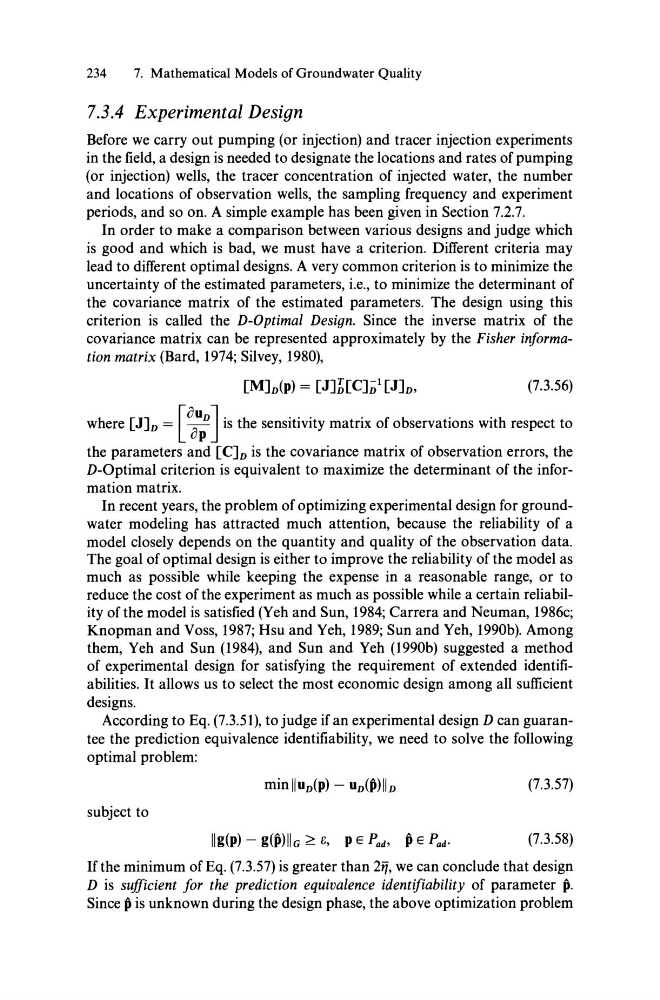
covariance matrix can be represented approximately by the Fisher information matrix (Bard, 1974; Silvey, 1980),
(7.3.56)
where [Jh = [8;;] is the sensitivity matrix of observations with respect to
the parameters and [eh is the covariance matrix of observation errors, the
D-Optimal criterion is equivalent to maximize the determinant of the information matrix.
In recent years, the problem of optimizing experimental design for groundwater modeling has attracted much attention, because the reliability of a
model closely depends on the quantity and quality of the observation data.
The goal of optimal design is either to improve the reliability of the model as
much as possible while keeping the expense in a reasonable range, or to
reduce the cost of the experiment as much as possible while a certain reliability ofthe model is satisfied (Yeh and Sun, 1984; Carrera and Neuman, 1986c;
Knopman and Voss, 1987; Hsu and Yeh, 1989; Sun and Yeh, 1990b). Among
them, Yeh and Sun (1984), and Sun and Yeh (1990b) suggested a method
of experimental design for satisfying the requirement of extended identifiabilities. It aHows us to select the most economic design among aH sufficient
designs.
According to Eq. (7.3.51), to judge if an experimental design D can guarantee the prediction equivalence identifiability, we need to solve the foHowing
optimal problem:
(7.3.57)
subject to
Ilg(p) - g(~)IIG ~ 6, pE Pad' ~ E Pad'
(7.3.58)
Ifthe minimum of Eq. (7.3.57) is greater than 2;:;, we can conclude that design
D is sufficient for the prediction equivalence identifiability of parameter ~.
Since ~ is unknown during the design phase, the above optimization problem
7. Mathematical Models of Groundwater Quality
7.3.4 Experimental Design
Before we carry out pumping (or injection) and tracer injection experiments
in the field, a design is needed to designate the locations and rates of pumping
(or injection) weHs, the tracer concentration of injected water, the number
and locations of observation weHs, the sampling frequency and experiment
periods, and so on. A simple example has been given in Section 7.2.7.
In order to make a comparison between various designs and judge which
is good and which is bad, we must have a criterion. Different criteria may
lead to different optimal designs. A very common criterion is to minimize the
uncertainty of the estimated parameters, i.e., to minimize the determinant of
the covariance matrix of the estimated parameters. The design using this
criterion is caHed the D-Optimal Design. Since the inverse matrix of the
covariance matrix can be represented approximately by the Fisher information matrix (Bard, 1974; Silvey, 1980),
(7.3.56)
where [Jh = [8;;] is the sensitivity matrix of observations with respect to
the parameters and [eh is the covariance matrix of observation errors, the
D-Optimal criterion is equivalent to maximize the determinant of the information matrix.
In recent years, the problem of optimizing experimental design for groundwater modeling has attracted much attention, because the reliability of a
model closely depends on the quantity and quality of the observation data.
The goal of optimal design is either to improve the reliability of the model as
much as possible while keeping the expense in a reasonable range, or to
reduce the cost of the experiment as much as possible while a certain reliability ofthe model is satisfied (Yeh and Sun, 1984; Carrera and Neuman, 1986c;
Knopman and Voss, 1987; Hsu and Yeh, 1989; Sun and Yeh, 1990b). Among
them, Yeh and Sun (1984), and Sun and Yeh (1990b) suggested a method
of experimental design for satisfying the requirement of extended identifiabilities. It aHows us to select the most economic design among aH sufficient
designs.
According to Eq. (7.3.51), to judge if an experimental design D can guarantee the prediction equivalence identifiability, we need to solve the foHowing
optimal problem:
(7.3.57)
subject to
Ilg(p) - g(~)IIG ~ 6, pE Pad' ~ E Pad'
(7.3.58)
Ifthe minimum of Eq. (7.3.57) is greater than 2;:;, we can conclude that design
D is sufficient for the prediction equivalence identifiability of parameter ~.
Since ~ is unknown during the design phase, the above optimization problem