

7.4. Statistic Theory and Uncertainty Analysis
235
should be solved for all possible p and ~. In Eq. (7.3.59), P ad is the admissible
set of parameters. Fortunately, in many cases, the minimum of Eq. (7.3.57)
is not sensitive to ~. As a result, it may be sufficient to run trials for only a few
estimated ~. An example of applying this method to design an experiment for
controlling the contamination of an aquifer was given by Sun and Yeh
(1990b). A complete discussion on experimental design for groundwater
modeling can be found in Sun (1994).
7.4 Statistic Theory and Uncertainty Analysis
7.4.1 The Statistic Theory 01 M ass Transport in
Porous Media
In Chapter 2, the advection-dispersion equation is derived from the microscopic level by spatial averaging over REY. In this procedure, the mechanical
dispersion coefficient D is introduced to represent the mechanical dispersive
flux:
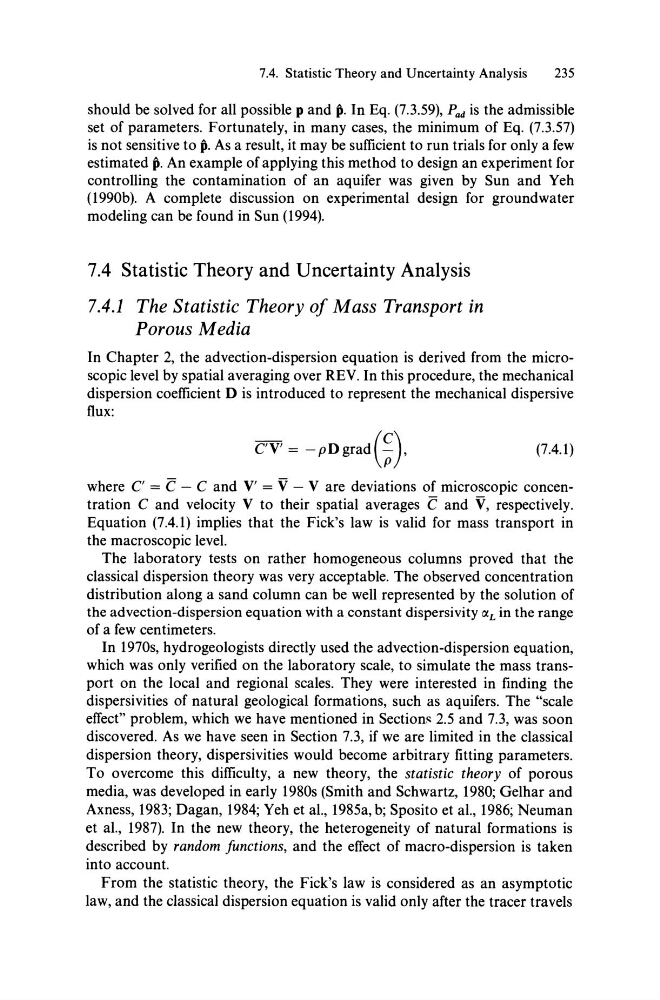
C'V' = - pD grad (~).
(7.4.1)
where C' = C - C and V' = V - V are deviations of microscopic concentration C and velocity V to their spatial averages C and V, respectively.
Equation (7.4.1) implies that the Fick's law is valid for mass transport in
the macroscopic level.
The laboratory tests on rat her homogeneous columns proved that the
classical dispersion theory was very acceptable. The observed concentration
distribution along a sand column can be weIl represented by the solution of
the advection-dispersion equation with a constant dispersivity !XL in the range
of a few centimeters.
In 1970s, hydrogeologists directly used the advection-dispersion equation,
which was only verified on the laboratory scale, to simulate the mass transport on the local and regional scales. They were interested in finding the
dispersivities of natural geological formations, such as aquifers. The "scale
effect" problem, which we have mentioned in Section!' 2.5 and 7.3, was soon
discovered. As we have seen in Section 7.3, if we are limited in the classical
dispersion theory, dispersivities would become arbitrary fitting parameters.
To overcome this difficulty, a new theory, the statistic theory of porous
media, was developed in early 1980s (Smith and Schwartz, 1980; Gelhar and
Axness, 1983; Dagan, 1984; Yeh et al., 1985a, b; Sposito et al., 1986; Neuman
et al., 1987). In the new theory, the heterogeneity of natural formations is
described by randorn functions, and the effect of macro-dispersion is taken
into account.
From the statistic theory, the Fick's law is considered as an asymptotic
law, and the classical dispersion equation is valid only after the tracer travels
235
should be solved for all possible p and ~. In Eq. (7.3.59), P ad is the admissible
set of parameters. Fortunately, in many cases, the minimum of Eq. (7.3.57)
is not sensitive to ~. As a result, it may be sufficient to run trials for only a few
estimated ~. An example of applying this method to design an experiment for
controlling the contamination of an aquifer was given by Sun and Yeh
(1990b). A complete discussion on experimental design for groundwater
modeling can be found in Sun (1994).
7.4 Statistic Theory and Uncertainty Analysis
7.4.1 The Statistic Theory 01 M ass Transport in
Porous Media
In Chapter 2, the advection-dispersion equation is derived from the microscopic level by spatial averaging over REY. In this procedure, the mechanical
dispersion coefficient D is introduced to represent the mechanical dispersive
flux:
C'V' = - pD grad (~).
(7.4.1)
where C' = C - C and V' = V - V are deviations of microscopic concentration C and velocity V to their spatial averages C and V, respectively.
Equation (7.4.1) implies that the Fick's law is valid for mass transport in
the macroscopic level.
The laboratory tests on rat her homogeneous columns proved that the
classical dispersion theory was very acceptable. The observed concentration
distribution along a sand column can be weIl represented by the solution of
the advection-dispersion equation with a constant dispersivity !XL in the range
of a few centimeters.
In 1970s, hydrogeologists directly used the advection-dispersion equation,
which was only verified on the laboratory scale, to simulate the mass transport on the local and regional scales. They were interested in finding the
dispersivities of natural geological formations, such as aquifers. The "scale
effect" problem, which we have mentioned in Section!' 2.5 and 7.3, was soon
discovered. As we have seen in Section 7.3, if we are limited in the classical
dispersion theory, dispersivities would become arbitrary fitting parameters.
To overcome this difficulty, a new theory, the statistic theory of porous
media, was developed in early 1980s (Smith and Schwartz, 1980; Gelhar and
Axness, 1983; Dagan, 1984; Yeh et al., 1985a, b; Sposito et al., 1986; Neuman
et al., 1987). In the new theory, the heterogeneity of natural formations is
described by randorn functions, and the effect of macro-dispersion is taken
into account.
From the statistic theory, the Fick's law is considered as an asymptotic
law, and the classical dispersion equation is valid only after the tracer travels