

7.3. Coupled Inverse Problems of Groundwater Flow and Mass Transport
231
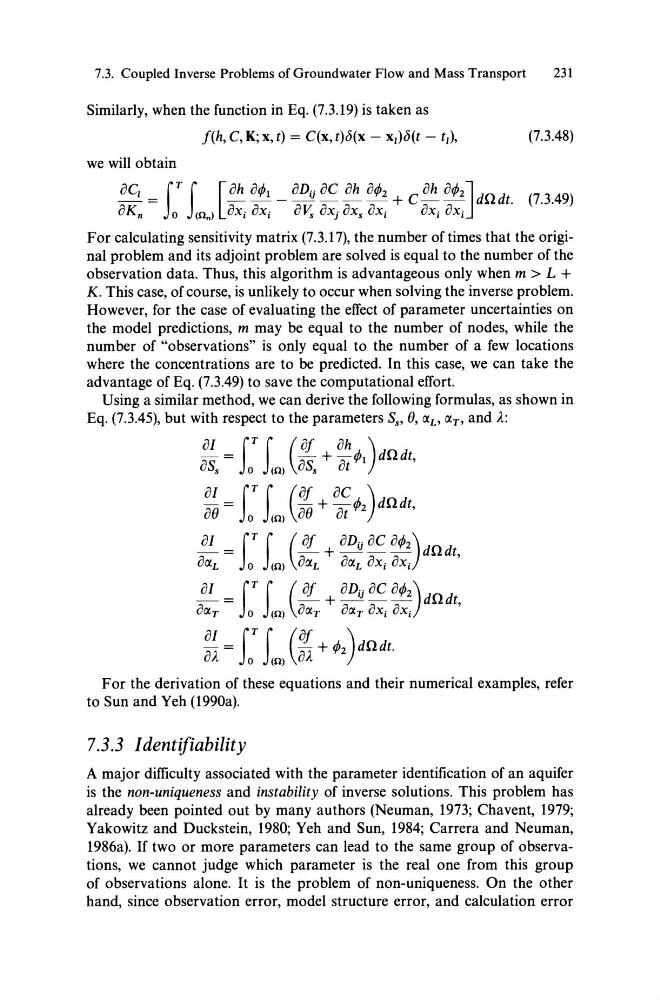
Similarly, when the function in Eq. (7.3.19) is taken as
f(h, C, K; x, t) = C(x, t)c5(x - x ,)c5(t - t,),
(7.3.48)
we will 0 btain
oC , = f T r [Oh OrPl _ oDij oC ~ OrP2 + C oh OrP2] dD. dt. (7.3.49)
oKn
0 J(Qn) oXi oXi
ov. oXj oXs oXi
oXi oXi
For calculating sensitivity matrix (7.3.17), the number of times that the original problem and its adjoint problem are solved is equal to the number of the
observation data. Thus, this algorithm is advantageous only when m > L +
K. This case, of course, is unlikely to occur when solving the inverse problem.
However, for the case of evaluating the effect of parameter uncertainties on
the model predictions, m may be equal to the number of no des, while the
number of "observations" is only equal to the number of a few locations
where the concentrations are to be predicted. In this case, we can take the
advantage of Eq. (7.3.49) to save the computational effort.
Using a similar method, we can derive the following formulas, as shown in
Eq. (7.3.45), but with respect to the parameters Ss' e, IXL> IX T , and A:
01
fTf (Of oh )
oS =
oS + ar P1 dD.dt,
s
0
(Q)
s
t
01
fT r (Of oC )
oe = 0 J(Q) oe + Tt rP 2 dD.dt,
~ = fT r (Of + oDij oC OrP2)dD.dt
OIXL
0 J (Q) OIXL OIXL oXi oXi
'
~ = fT r (Of + oDij oC OrP2)dD.dt
OIXT
0 J (Q) OIXT OIXT oXi oXi
'
:~ = IT i Q) (Z + rP2)dD.dt.
For the derivation of these equations and their numerical examples, refer
to Sun and Yeh (1990a).
7.3.3 Identifiability
A major difficulty associated with the parameter identification of an aquifer
is the non-uniqueness and instability of inverse solutions. This problem has
already been pointed out by many authors (Neuman, 1973; Chavent, 1979;
Yakowitz and Duckstein, 1980; Yeh and Sun, 1984; Carrera and Neuman,
1986a). If two or more parameters can lead to the same group of observations, we cannot judge which parameter is the real one from this group
of observations alone. It is the problem of non-uniqueness. On the other
hand, since observation error, model structure error, and calculation error
231
Similarly, when the function in Eq. (7.3.19) is taken as
f(h, C, K; x, t) = C(x, t)c5(x - x ,)c5(t - t,),
(7.3.48)
we will 0 btain
oC , = f T r [Oh OrPl _ oDij oC ~ OrP2 + C oh OrP2] dD. dt. (7.3.49)
oKn
0 J(Qn) oXi oXi
ov. oXj oXs oXi
oXi oXi
For calculating sensitivity matrix (7.3.17), the number of times that the original problem and its adjoint problem are solved is equal to the number of the
observation data. Thus, this algorithm is advantageous only when m > L +
K. This case, of course, is unlikely to occur when solving the inverse problem.
However, for the case of evaluating the effect of parameter uncertainties on
the model predictions, m may be equal to the number of no des, while the
number of "observations" is only equal to the number of a few locations
where the concentrations are to be predicted. In this case, we can take the
advantage of Eq. (7.3.49) to save the computational effort.
Using a similar method, we can derive the following formulas, as shown in
Eq. (7.3.45), but with respect to the parameters Ss' e, IXL> IX T , and A:
01
fTf (Of oh )
oS =
oS + ar P1 dD.dt,
s
0
(Q)
s
t
01
fT r (Of oC )
oe = 0 J(Q) oe + Tt rP 2 dD.dt,
~ = fT r (Of + oDij oC OrP2)dD.dt
OIXL
0 J (Q) OIXL OIXL oXi oXi
'
~ = fT r (Of + oDij oC OrP2)dD.dt
OIXT
0 J (Q) OIXT OIXT oXi oXi
'
:~ = IT i Q) (Z + rP2)dD.dt.
For the derivation of these equations and their numerical examples, refer
to Sun and Yeh (1990a).
7.3.3 Identifiability
A major difficulty associated with the parameter identification of an aquifer
is the non-uniqueness and instability of inverse solutions. This problem has
already been pointed out by many authors (Neuman, 1973; Chavent, 1979;
Yakowitz and Duckstein, 1980; Yeh and Sun, 1984; Carrera and Neuman,
1986a). If two or more parameters can lead to the same group of observations, we cannot judge which parameter is the real one from this group
of observations alone. It is the problem of non-uniqueness. On the other
hand, since observation error, model structure error, and calculation error