

7.3. Coupled Inverse Problems of Groundwater Flow and Mass Transport
229
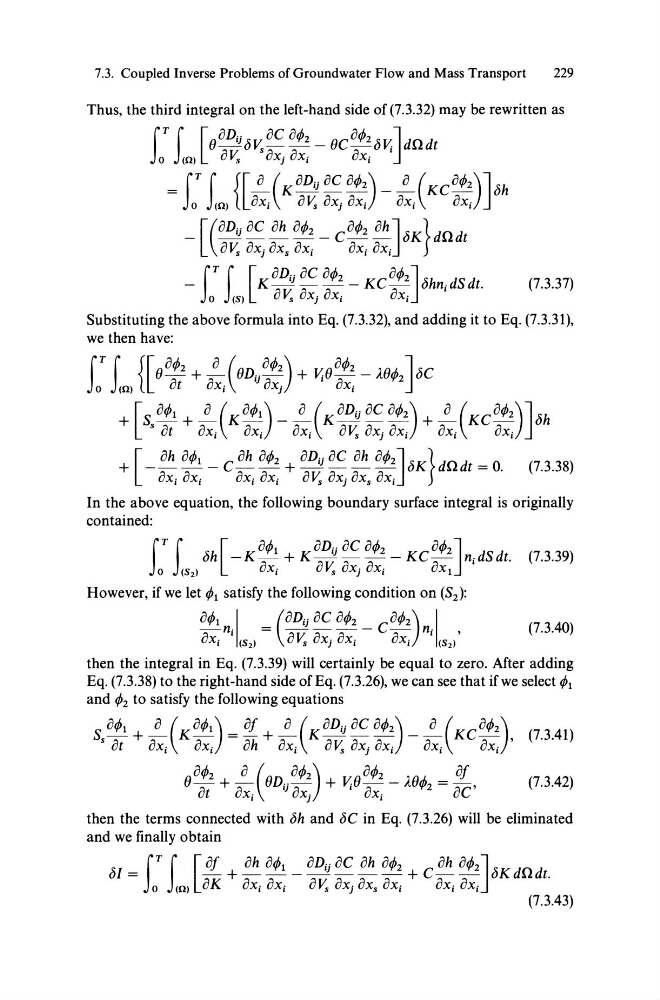
Thus, the third integral on the left-hand side of (7.3.32) may be rewritten as
(T ( [(}aDij"v.ac arP2 _ (}C arP2 "V;] do'dt
Jo J(O) av. aXj aXi aXi
_ (T ( {[~(KaDij ac arP2) _ ~(KCarP2)]"h
- Jo J(O) aXi av. aXj aXi aXi aXi
_ [(aDij ac ah arP2 _ CarP2 ah]"K}do'dt
av. aXj axs aXi aXi aXi
_ (T ( [K aDij ac arP2 _ KC arP2 ] "hnidSdt.
Jo JS) av. aXj aXi
aXi
(7.3.37)
Substituting the above formula into Eq. (7.3.32), and adding it to Eq. (7.3.31),
we then have:
i
T
I {[ arP2 a (a rP2 ) arP2 ]
()- + - (}Dij- + V;()- - ). . (}rP2 "C
o (0)
at aXi
aXj
aXi
+ [ss arPl + ~(KarPI) _ ~(KaDij ac a rP2 ) + ~(KCarP2)]"h
at aXi aXi aXi av. aXj aXi aXi aXi
+ [_ ah arPl _ c ah arP2 + aDij ac ah a rP2 ] "K} do'dt = O. (7.3.38)
aXi aXi aXi aXi av. aXj ax. aXi
In the above equation, the following boundary surfaee integral is originally
eontained:
(T ( "h[_KarPl + KaDijaC arP2 _ Kc arP2 ]n i dSdt. (7.3.39)
Jo JS2)
aXi av. aXj aXi
aXI
However, if we let rPl satisfy the following eondition on (S2):
arPl I (aD ij ac arP2 c arP2 ) I
aXi n i (S2) = av. aXj aXi - aXi n i (S2)'
(7.3.40)
then the integral in Eq. (7.3.39) will certainly be equal to zero. After adding
Eq. (7.3.38) to the right-hand side ofEq. (7.3.26), we ean see that ifwe seleet rPl
and rP2 to satisfy the following equations
Ss arPl + ~(KarPI) = af + ~(KaDij ac a rP2 ) _ ~(KCarP2), (7.3.41)
at aXi aXi ah aXi av. aXj aXi aXi
aXi
(7.3.42)
then the terms eonneeted with "h and "C in Eq. (7.3.26) will be eliminated
and we finally obtain
M = f T r [a f + ah arPl _ aDij ac ah arP2 + c ah arP2] "K do' dt.
o Jo) aK aXi aXi av. aXj axs aXi aXi aXi
(7.3.43)
229
Thus, the third integral on the left-hand side of (7.3.32) may be rewritten as
(T ( [(}aDij"v.ac arP2 _ (}C arP2 "V;] do'dt
Jo J(O) av. aXj aXi aXi
_ (T ( {[~(KaDij ac arP2) _ ~(KCarP2)]"h
- Jo J(O) aXi av. aXj aXi aXi aXi
_ [(aDij ac ah arP2 _ CarP2 ah]"K}do'dt
av. aXj axs aXi aXi aXi
_ (T ( [K aDij ac arP2 _ KC arP2 ] "hnidSdt.
Jo JS) av. aXj aXi
aXi
(7.3.37)
Substituting the above formula into Eq. (7.3.32), and adding it to Eq. (7.3.31),
we then have:
i
T
I {[ arP2 a (a rP2 ) arP2 ]
()- + - (}Dij- + V;()- - ). . (}rP2 "C
o (0)
at aXi
aXj
aXi
+ [ss arPl + ~(KarPI) _ ~(KaDij ac a rP2 ) + ~(KCarP2)]"h
at aXi aXi aXi av. aXj aXi aXi aXi
+ [_ ah arPl _ c ah arP2 + aDij ac ah a rP2 ] "K} do'dt = O. (7.3.38)
aXi aXi aXi aXi av. aXj ax. aXi
In the above equation, the following boundary surfaee integral is originally
eontained:
(T ( "h[_KarPl + KaDijaC arP2 _ Kc arP2 ]n i dSdt. (7.3.39)
Jo JS2)
aXi av. aXj aXi
aXI
However, if we let rPl satisfy the following eondition on (S2):
arPl I (aD ij ac arP2 c arP2 ) I
aXi n i (S2) = av. aXj aXi - aXi n i (S2)'
(7.3.40)
then the integral in Eq. (7.3.39) will certainly be equal to zero. After adding
Eq. (7.3.38) to the right-hand side ofEq. (7.3.26), we ean see that ifwe seleet rPl
and rP2 to satisfy the following equations
Ss arPl + ~(KarPI) = af + ~(KaDij ac a rP2 ) _ ~(KCarP2), (7.3.41)
at aXi aXi ah aXi av. aXj aXi aXi
aXi
(7.3.42)
then the terms eonneeted with "h and "C in Eq. (7.3.26) will be eliminated
and we finally obtain
M = f T r [a f + ah arPl _ aDij ac ah arP2 + c ah arP2] "K do' dt.
o Jo) aK aXi aXi av. aXj axs aXi aXi aXi
(7.3.43)