

228
7. Mathematical Models of Groundwater Quality
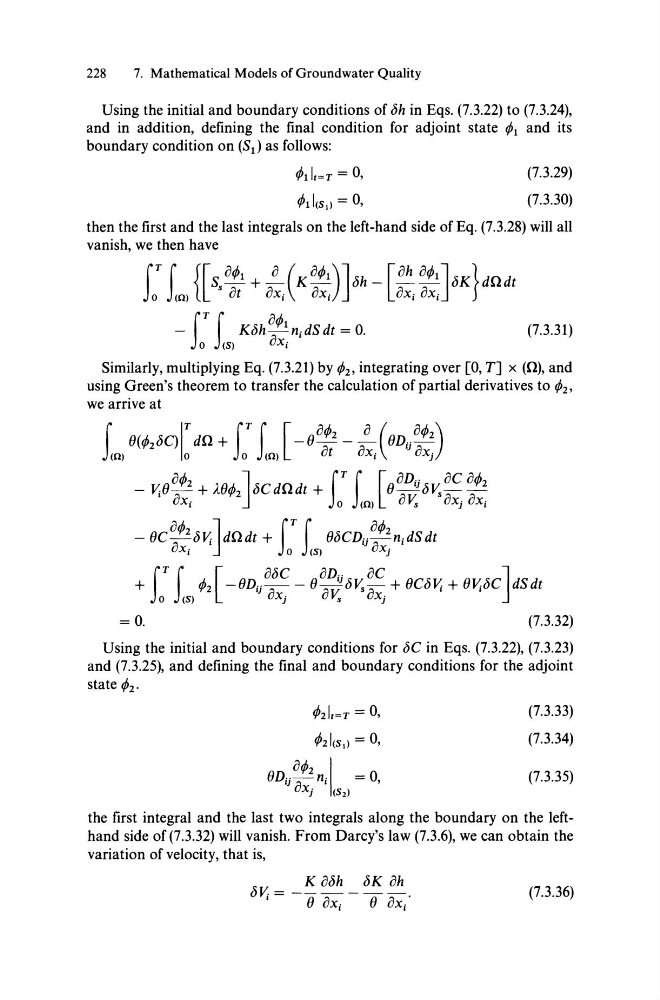
Using the initial and boundary conditions of ~h in Eqs. (7.3.22) to (7.3.24),
and in addition, defining the final condition for adjoint state f/Jl and its
boundary condition on (Sd as folIows:
(7.3.29)
f/J11(s,) = 0,
(7.3.30)
then the first and the last integrals on the left-hand side of Eq. (7.3.28) will all
vanish, we then have
f T r {[Ss Of/Jl + ~(KOf/Jl)J~h _ [Oh Of/JIJ~K}do.dt
o J (0) ot OXi OXi
OXi oXi
f Tf
of/J
-
K~h-o InidSdt = 0.
o (S)
Xi
(7.3.31)
Similarly, multiplying Eq. (7.3.21) by f/J2' integrating over [0, T] x (0.), and
using Green's theorem to transfer the calculation of partial derivatives to f/J2'
we arrive at
f
Tf
[
o~e
oD·· oe
]
+
f/J2 -eDij- - e~~v.- + ee~v; + ev;~e dSdt
o (S)
oXj
ov. oXj
=Q
~1~
Using the initial and boundary conditions for ~e in Eqs. (7.3.22), (7.3.23)
and (7.3.25), and defining the final and boundary conditions for the adjoint
state f/J2.
f/J2It=T = 0,
f/J21(stl = 0,
eD ij Of/J2 n i I = 0,
OXj (S2)
(7.3.33)
(7.3.34)
(7.3.35)
the first integral and the last two integrals along the boundary on the lefthand side of (7.3.32) will vanish. From Darcy's law (7.3.6), we can obtain the
variation of velocity, that is,
>:
K o~h ~K oh
uv,=-----I
e OXi
e OXi·
(7.3.36)
7. Mathematical Models of Groundwater Quality
Using the initial and boundary conditions of ~h in Eqs. (7.3.22) to (7.3.24),
and in addition, defining the final condition for adjoint state f/Jl and its
boundary condition on (Sd as folIows:
(7.3.29)
f/J11(s,) = 0,
(7.3.30)
then the first and the last integrals on the left-hand side of Eq. (7.3.28) will all
vanish, we then have
f T r {[Ss Of/Jl + ~(KOf/Jl)J~h _ [Oh Of/JIJ~K}do.dt
o J (0) ot OXi OXi
OXi oXi
f Tf
of/J
-
K~h-o InidSdt = 0.
o (S)
Xi
(7.3.31)
Similarly, multiplying Eq. (7.3.21) by f/J2' integrating over [0, T] x (0.), and
using Green's theorem to transfer the calculation of partial derivatives to f/J2'
we arrive at
f
Tf
[
o~e
oD·· oe
]
+
f/J2 -eDij- - e~~v.- + ee~v; + ev;~e dSdt
o (S)
oXj
ov. oXj
=Q
~1~
Using the initial and boundary conditions for ~e in Eqs. (7.3.22), (7.3.23)
and (7.3.25), and defining the final and boundary conditions for the adjoint
state f/J2.
f/J2It=T = 0,
f/J21(stl = 0,
eD ij Of/J2 n i I = 0,
OXj (S2)
(7.3.33)
(7.3.34)
(7.3.35)
the first integral and the last two integrals along the boundary on the lefthand side of (7.3.32) will vanish. From Darcy's law (7.3.6), we can obtain the
variation of velocity, that is,
>:
K o~h ~K oh
uv,=-----I
e OXi
e OXi·
(7.3.36)