

206
7. Mathematical Models of Groundwater Quality
tion methods for each scale. The four scales are: the local scale, global scale I,
global scale 11 and regional scale. The following presentation is based on
Fried (1975) and some later reports.
The Local Scale (Average Distance of Propagation Is 2 to 4 m)
The single weIl injection-extraction method, first suggested by Mercado
(1966), can be used on this scale. Inject a radioactive tracer, typically 131 1 or
34Br, into a weIl; inject fresh water to push for some time, and then extract
water from the weIl. During the whole process, the changes of the velocity
and the tracer concentration at different depths will be recorded by a probe.
This process can be easily described by a mathematical model.
Since the experiment is limited to the area near a weIl, the natural flow
velocity in the aquifer can be neglected in comparison to the velocities imposed by injection and extraction. In this case, a radial flow is formed around
the weIl and the dispersion can be simplified to a radial dispersion. Because
the flow velocity is large near the weIl, the effect of molecular diffusion can be
ignored. Moreover, the density and viscosity of the fluid do not vary after the
radioactive tracer is added. In consideration of the above points, we can
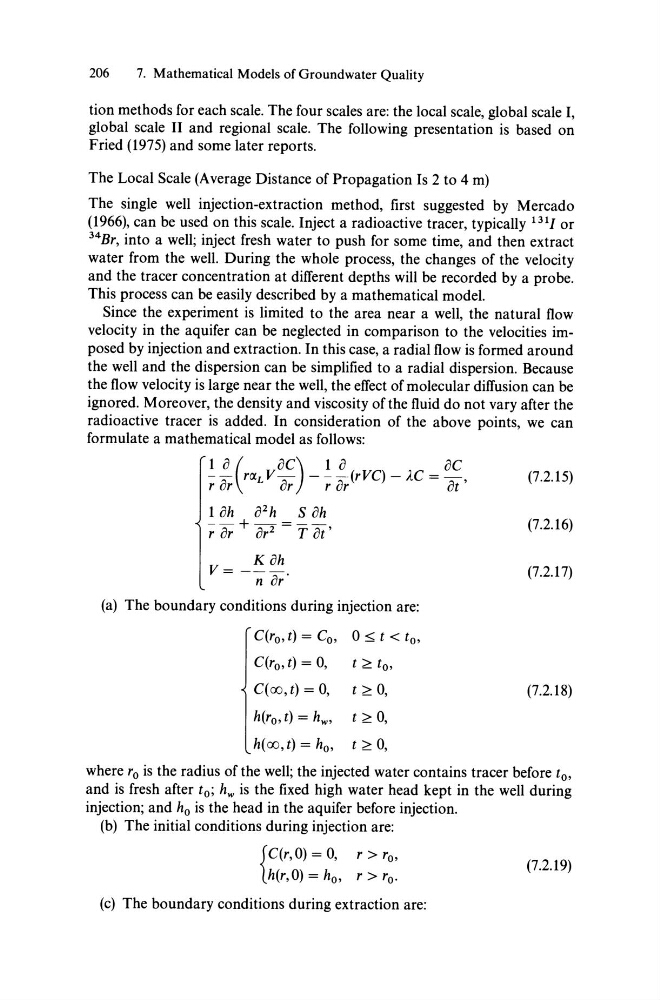
formulate a mathematical model as follows:
! ~(rIXL V OC ) _! ~(rVC) _ ÄC = oC,
r or
or
r or
ot
loh o2h S oh
r or + or 2 = T ot '
K oh
V= --~.
n or
(a) The boundary conditions during injection are:
C(ro, t) = Co, 0:::;; t < to,
C(ro, t) = 0, t ~ to,
C(oo,t) = 0, t ~ 0,
h(ro, t) = hw' t ~ 0,
h(oo,t)=h o , t~O,
(7.2.15)
(7.2.16)
(7.2.17)
(7.2.18)
where r o is the radius of the weIl; the injected water contains tracer before t o ,
and is fresh after t o ; h w is the fixed high water head kept in the weIl during
injection; and h o is the head in the aquifer before injection.
(b) The initial conditions during injection are:
{
C(r, 0) = 0,
h(r, 0) = ho,
(c) The boundary conditions during extraction are:
(7.2.19)
7. Mathematical Models of Groundwater Quality
tion methods for each scale. The four scales are: the local scale, global scale I,
global scale 11 and regional scale. The following presentation is based on
Fried (1975) and some later reports.
The Local Scale (Average Distance of Propagation Is 2 to 4 m)
The single weIl injection-extraction method, first suggested by Mercado
(1966), can be used on this scale. Inject a radioactive tracer, typically 131 1 or
34Br, into a weIl; inject fresh water to push for some time, and then extract
water from the weIl. During the whole process, the changes of the velocity
and the tracer concentration at different depths will be recorded by a probe.
This process can be easily described by a mathematical model.
Since the experiment is limited to the area near a weIl, the natural flow
velocity in the aquifer can be neglected in comparison to the velocities imposed by injection and extraction. In this case, a radial flow is formed around
the weIl and the dispersion can be simplified to a radial dispersion. Because
the flow velocity is large near the weIl, the effect of molecular diffusion can be
ignored. Moreover, the density and viscosity of the fluid do not vary after the
radioactive tracer is added. In consideration of the above points, we can
formulate a mathematical model as follows:
! ~(rIXL V OC ) _! ~(rVC) _ ÄC = oC,
r or
or
r or
ot
loh o2h S oh
r or + or 2 = T ot '
K oh
V= --~.
n or
(a) The boundary conditions during injection are:
C(ro, t) = Co, 0:::;; t < to,
C(ro, t) = 0, t ~ to,
C(oo,t) = 0, t ~ 0,
h(ro, t) = hw' t ~ 0,
h(oo,t)=h o , t~O,
(7.2.15)
(7.2.16)
(7.2.17)
(7.2.18)
where r o is the radius of the weIl; the injected water contains tracer before t o ,
and is fresh after t o ; h w is the fixed high water head kept in the weIl during
injection; and h o is the head in the aquifer before injection.
(b) The initial conditions during injection are:
{
C(r, 0) = 0,
h(r, 0) = ho,
(c) The boundary conditions during extraction are:
(7.2.19)