

162
6. Numerical Solutions of Advection-Dominated Problems
are the upstream weighting coefficients. When the flow direction is illustrated
by the arrows in Figure 6.4, the weighting coefficients are taken as positive.
It is evident that the two-dimensional weighting functions given by Eq. (6.2.22)
are a direct extension ofthe one-dimensional form given by Eq. (6.2.12). The
upstream and downstream relations for the nodes are shown by arrows.
The triangle element is very important both in theory and application. The
linear basis functions corresponding to the three nodes i, i, k in a triangle
element (A) have been given in Eq. (5.1.32) and are repeated here as
1
rP,(X, y) = 2A (al + b,x + c,y),
1= i,i, k; (x,y) E (A)
(6.2.23)
where the coefficients a" b "
and C, are determined by the coordinates of the
nodes (see Eq. (5.1.23)). The asymmetric weighting functions are defined as
{
~(x, y) : rPi + F;,
~~~-~+~
~U~
w,.(x, y) = rPk + Fk·
The expressions of the three modifying functions F i , Fj, and F k , which contain
the upstream weighting coefficients l1. i , I1.j, and I1. k , are
{
Fi = -3l1.krPirPj + 3I1.jrPirP,.,
Fj = - 3l1.irPjrP,. + 3l1.krPA,
Fk = - 3l1.jrP,.rPi + 3l1.irPkrPj.
(6.2.25)
Substituting these equations into Eq. (6.2.24), we can obtain the required
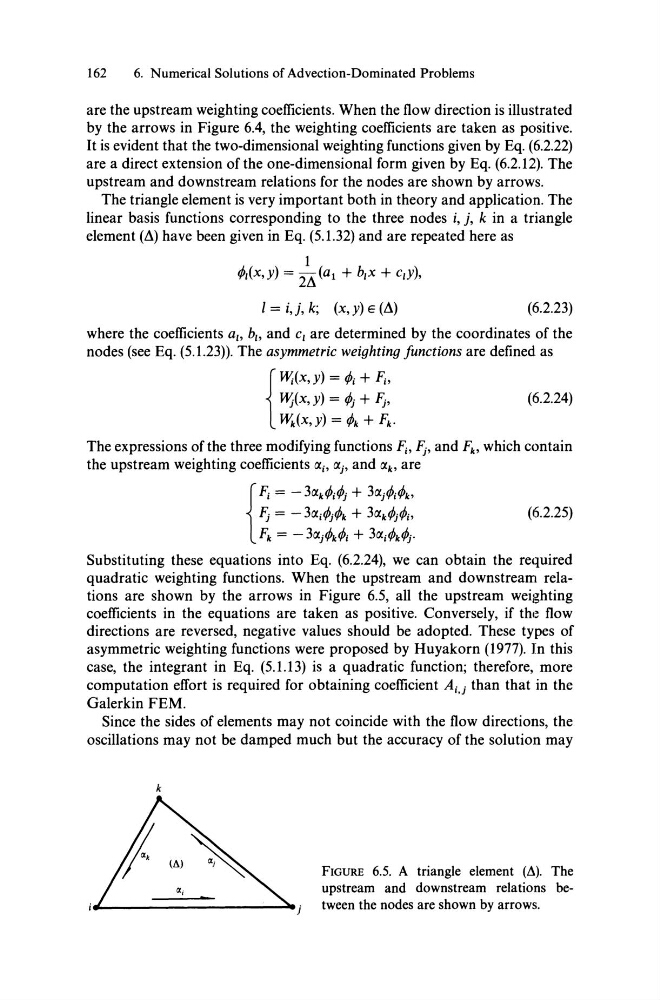
quadratic weighting functions. When the upstream and downstream relations are shown by the arrows in Figure 6.5, all the upstream weighting
eoefficients in the equations are taken as positive. Conversely, if thl~ flow
directions are reversed, negative values should be adopted. These types of
asymmetrie weighting functions were proposed by Huyakorn (1977). In this
ease, the integrant in Eq. (5.1.13) is a quadratic funetion; therefore, more
eomputation effort is required for obtaining eoefficient Ai,j than that in the
Galerkin FEM.
Since the sides of elements may not eoincide with the flow direetions, the
oseillations may not be damped mueh but the aeeuraey of the solution may
k
FIGURE 6.5. A triangle element (.1). The
IX,
upstream and downstream relations beL---=====:""'_-";-=:::-'j tween the nodes are shown by arrows.
6. Numerical Solutions of Advection-Dominated Problems
are the upstream weighting coefficients. When the flow direction is illustrated
by the arrows in Figure 6.4, the weighting coefficients are taken as positive.
It is evident that the two-dimensional weighting functions given by Eq. (6.2.22)
are a direct extension ofthe one-dimensional form given by Eq. (6.2.12). The
upstream and downstream relations for the nodes are shown by arrows.
The triangle element is very important both in theory and application. The
linear basis functions corresponding to the three nodes i, i, k in a triangle
element (A) have been given in Eq. (5.1.32) and are repeated here as
1
rP,(X, y) = 2A (al + b,x + c,y),
1= i,i, k; (x,y) E (A)
(6.2.23)
where the coefficients a" b "
and C, are determined by the coordinates of the
nodes (see Eq. (5.1.23)). The asymmetric weighting functions are defined as
{
~(x, y) : rPi + F;,
~~~-~+~
~U~
w,.(x, y) = rPk + Fk·
The expressions of the three modifying functions F i , Fj, and F k , which contain
the upstream weighting coefficients l1. i , I1.j, and I1. k , are
{
Fi = -3l1.krPirPj + 3I1.jrPirP,.,
Fj = - 3l1.irPjrP,. + 3l1.krPA,
Fk = - 3l1.jrP,.rPi + 3l1.irPkrPj.
(6.2.25)
Substituting these equations into Eq. (6.2.24), we can obtain the required
quadratic weighting functions. When the upstream and downstream relations are shown by the arrows in Figure 6.5, all the upstream weighting
eoefficients in the equations are taken as positive. Conversely, if thl~ flow
directions are reversed, negative values should be adopted. These types of
asymmetrie weighting functions were proposed by Huyakorn (1977). In this
ease, the integrant in Eq. (5.1.13) is a quadratic funetion; therefore, more
eomputation effort is required for obtaining eoefficient Ai,j than that in the
Galerkin FEM.
Since the sides of elements may not eoincide with the flow direetions, the
oseillations may not be damped mueh but the aeeuraey of the solution may
k
FIGURE 6.5. A triangle element (.1). The
IX,
upstream and downstream relations beL---=====:""'_-";-=:::-'j tween the nodes are shown by arrows.