

6.2. Upstream Weighted Methods
161
Noorishad et al. (1992) suggested using
2
IX = er -Pe
(6.2.20b)
as a weighting coefficient when the Crank-Nicolson Galerkin FFM is used to
solve the one-dimensional advection-dominated problem. In (6.2.20b), er =
V I'lt/ I'lx is the Courant number. When Pe· er :::;; 2, upwind weighting is not
needed.
In the Petrov-Galerkin method, high-order basis functions can also be
used. Heinrich and Zienkilwiez (1977) proposed some cubic asymmetrie
weighting functions, and used them in combination with the quadratic basis
functions.
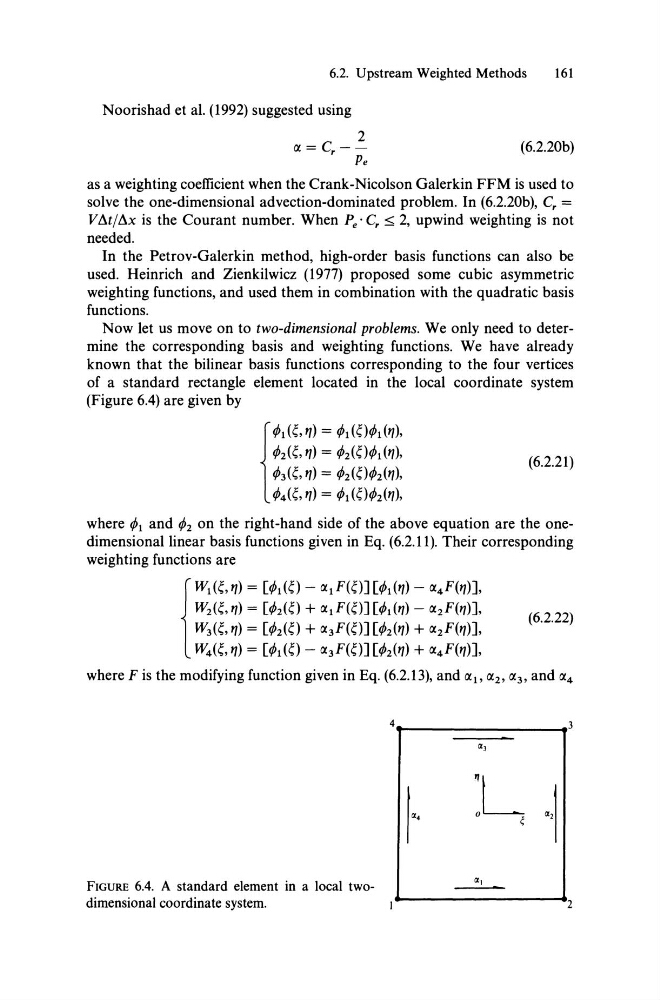
Now let us move on to two-dimensional problems. We only need to determine the corresponding basis and weighting functions. We have already
known that the bilinear basis functions corresponding to the four vertices
of a standard rectangle element located in the local coordinate system
(Figure 6.4) are given by
(6.2.21)
where rPl and rP2 on the right-hand side of the above equation are the onedimensional linear basis functions given in Eq. (6.2.11). Their corresponding
weighting functions are
{
Wl(~'I1) = [rPl(~) -lXlF(~)][rPl(I1) -1X4F(I1)],
W2(~' 11) = [rP2(~) + IXI F(,)] [rPl (11) - 1X2F(I1)],
W3(~' 11) = [rP2(~) + 1X3F(~)] [rP2(I1) + 1X2F(I1)],
W4(~' 11) = [rPl (~) - 1X3F(~)] [rP2(I1) + 1X4F(I1)],
(6.2.22)
where F is the modifying function given in Eq. (6.2.13), and IXl' 1X2' 1X3' and 1X4
FIGURE 6.4. A standard element in a local twodimensional co ordinate system.
4
IX.
1X3
~L
o
~
3
1X2
2
161
Noorishad et al. (1992) suggested using
2
IX = er -Pe
(6.2.20b)
as a weighting coefficient when the Crank-Nicolson Galerkin FFM is used to
solve the one-dimensional advection-dominated problem. In (6.2.20b), er =
V I'lt/ I'lx is the Courant number. When Pe· er :::;; 2, upwind weighting is not
needed.
In the Petrov-Galerkin method, high-order basis functions can also be
used. Heinrich and Zienkilwiez (1977) proposed some cubic asymmetrie
weighting functions, and used them in combination with the quadratic basis
functions.
Now let us move on to two-dimensional problems. We only need to determine the corresponding basis and weighting functions. We have already
known that the bilinear basis functions corresponding to the four vertices
of a standard rectangle element located in the local coordinate system
(Figure 6.4) are given by
(6.2.21)
where rPl and rP2 on the right-hand side of the above equation are the onedimensional linear basis functions given in Eq. (6.2.11). Their corresponding
weighting functions are
{
Wl(~'I1) = [rPl(~) -lXlF(~)][rPl(I1) -1X4F(I1)],
W2(~' 11) = [rP2(~) + IXI F(,)] [rPl (11) - 1X2F(I1)],
W3(~' 11) = [rP2(~) + 1X3F(~)] [rP2(I1) + 1X2F(I1)],
W4(~' 11) = [rPl (~) - 1X3F(~)] [rP2(I1) + 1X4F(I1)],
(6.2.22)
where F is the modifying function given in Eq. (6.2.13), and IXl' 1X2' 1X3' and 1X4
FIGURE 6.4. A standard element in a local twodimensional co ordinate system.
4
IX.
1X3
~L
o
~
3
1X2
2