

6.2. Upstream Weighted Methods
157
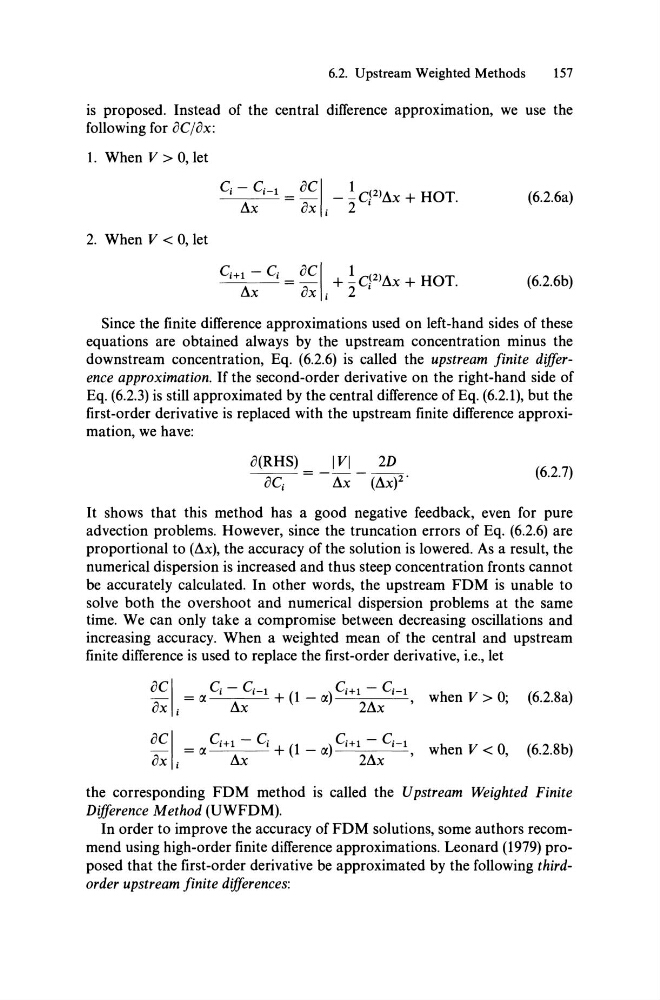
is proposed. Instead of the central difference approximation, we use the
following for oC;ox:
1. When V > 0, let
Ci - C i - 1 = OC/_ !C!2)ä
HOT
äx
ox. 2 I X +
.
I
(6.2.6a)
2. When V < 0, let
Ci+l - Ci = OC/ !C!2)A
HOT
äx
OX . + 2 I L1X +
.
I
(6.2.6b)
Since the finite difference approximations used on left-hand sides of these
equations are obtained always by the upstream concentration minus the
downstream concentration, Eq. (6.2.6) is called the upstream finite difference approximation. If the second-order derivative on the right-hand side of
Eq. (6.2.3) is still approximated by the central difference ofEq. (6.2.1), but the
first-order derivative is replaced with the upstream finite difference approximation, we have:
o(RHS)
lVI
2D
(6.2.7)
= - äx - (äX)2'
It shows that this method has a good negative feedback, even for pure
advection problems. However, since the truncation errors of Eq. (6.2.6) are
proportional to (äx), the accuracy of the solution is lowered. As a result, the
numerical dispersion is increased and thus steep concentration fronts cannot
be accurately calculated. In other words, the upstream FDM is unable to
solve both the overshoot and numerical dispersion problems at the same
time. We can only take a compromise between decreasing oscillations and
increasing accuracy. When a weighted mean of the central and upstream
finite difference is used to replace the first-order derivative, i.e., let
OC/ = Ci - C i - 1 + (1 _ )C i + 1 - C i - 1 when V> 0,'
ox. IX
äx
IX
2äx
'
I
(6.2.8a)
OC/ = C i + 1 - Ci + (1 _ )Ci+l - C i - 1 when V< 0,
ox. IX
äx
IX
2äx
'
I
(6.2.8b)
the corresponding FDM method is called the Upstream Weighted Finite
Difference Method (UWFDM).
In order to improve the accuracy of FDM solutions, some authors recommend using high-order finite difference approximations. Leonard (1979) proposed that the first-order derivative be approximated by the following thirdorder upstream finite differences:
157
is proposed. Instead of the central difference approximation, we use the
following for oC;ox:
1. When V > 0, let
Ci - C i - 1 = OC/_ !C!2)ä
HOT
äx
ox. 2 I X +
.
I
(6.2.6a)
2. When V < 0, let
Ci+l - Ci = OC/ !C!2)A
HOT
äx
OX . + 2 I L1X +
.
I
(6.2.6b)
Since the finite difference approximations used on left-hand sides of these
equations are obtained always by the upstream concentration minus the
downstream concentration, Eq. (6.2.6) is called the upstream finite difference approximation. If the second-order derivative on the right-hand side of
Eq. (6.2.3) is still approximated by the central difference ofEq. (6.2.1), but the
first-order derivative is replaced with the upstream finite difference approximation, we have:
o(RHS)
lVI
2D
(6.2.7)
= - äx - (äX)2'
It shows that this method has a good negative feedback, even for pure
advection problems. However, since the truncation errors of Eq. (6.2.6) are
proportional to (äx), the accuracy of the solution is lowered. As a result, the
numerical dispersion is increased and thus steep concentration fronts cannot
be accurately calculated. In other words, the upstream FDM is unable to
solve both the overshoot and numerical dispersion problems at the same
time. We can only take a compromise between decreasing oscillations and
increasing accuracy. When a weighted mean of the central and upstream
finite difference is used to replace the first-order derivative, i.e., let
OC/ = Ci - C i - 1 + (1 _ )C i + 1 - C i - 1 when V> 0,'
ox. IX
äx
IX
2äx
'
I
(6.2.8a)
OC/ = C i + 1 - Ci + (1 _ )Ci+l - C i - 1 when V< 0,
ox. IX
äx
IX
2äx
'
I
(6.2.8b)
the corresponding FDM method is called the Upstream Weighted Finite
Difference Method (UWFDM).
In order to improve the accuracy of FDM solutions, some authors recommend using high-order finite difference approximations. Leonard (1979) proposed that the first-order derivative be approximated by the following thirdorder upstream finite differences: