

158
6. Numerical Solutions of Advection-Dominated Problems
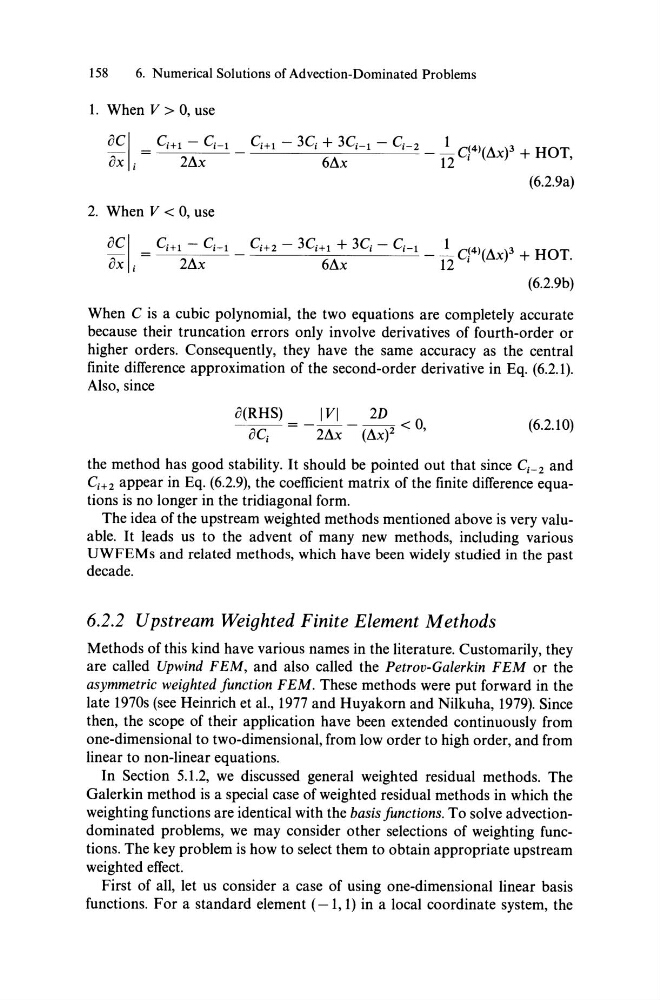
1. When V > 0, use
- -
-
--·L.lx+H
OCI _ Ci+l - Ci- 1 Ci+l - 3Ci + 3Ci- 1 - Ci- Z 1 C(4)(A )3
OT
ox i
2~x
6~x
12 I
,
(6.2.9a)
2. When V < 0, use
OCI = Ci+l - Ci- 1 _ Ci+Z - 3Ci+l + 3Ci - Ci- 1 _ ~C!4)(~X)3 + HOT.
ox i
2~x
6~x
12
(6.2.9b)
When C is a cubic polynomial, the two equations are completely accurate
because their truncation errors only involve derivatives of fourth-order or
higher orders. Consequently, they have the same accuracy as the central
finite difference approximation of the second-order derivative in Eq. (6.2.1).
Also, since
o(RHS) = _l!1_ ~ < °
oC i
2~x
(~x)Z
'
(6.2.10)
the method has good stability. It should be pointed out that since Ci- Z and
C i + Z appear in Eq. (6.2.9), the coefficient matrix of the finite difference equations is no longer in the tridiagonal form.
The idea of the upstream weighted methods mentioned above is very valuable. It leads us to the advent of many new methods, induding various
UWFEMs and related methods, which have been widely studied in the past
decade.
6.2.2 U pstream Weighted Finite Element M ethods
Methods of this kind have various names in the literat ure. Customarily, they
are called Upwind FEM, and also called the Petrov-Galerkin FEM or the
asymmetrie weighted funetion F EM. These methods were put forward in the
late 1970s (see Heinrich et al., 1977 and Huyakorn and Nilkuha, 1979). Since
then, the scope of their application have been extended continuously from
one-dimensional to two-dimensional, from low order to high order, and from
linear to non-linear equations.
In Section 5.1.2, we discussed general weighted residual methods. The
Galerkin method is a special ca se of weighted residual methods in which the
weighting functions are identical with the basis funetions. To solve advectiondomina ted problems, we may consider other selections of weighting functions. The key problem is how to select them to obtain appropriate upstream
weighted effect.
First of all, let us consider a ca se of using one-dimensional linear basis
functions. For a standard element (-1,1) in a local coordinate system, the
6. Numerical Solutions of Advection-Dominated Problems
1. When V > 0, use
- -
-
--·L.lx+H
OCI _ Ci+l - Ci- 1 Ci+l - 3Ci + 3Ci- 1 - Ci- Z 1 C(4)(A )3
OT
ox i
2~x
6~x
12 I
,
(6.2.9a)
2. When V < 0, use
OCI = Ci+l - Ci- 1 _ Ci+Z - 3Ci+l + 3Ci - Ci- 1 _ ~C!4)(~X)3 + HOT.
ox i
2~x
6~x
12
(6.2.9b)
When C is a cubic polynomial, the two equations are completely accurate
because their truncation errors only involve derivatives of fourth-order or
higher orders. Consequently, they have the same accuracy as the central
finite difference approximation of the second-order derivative in Eq. (6.2.1).
Also, since
o(RHS) = _l!1_ ~ < °
oC i
2~x
(~x)Z
'
(6.2.10)
the method has good stability. It should be pointed out that since Ci- Z and
C i + Z appear in Eq. (6.2.9), the coefficient matrix of the finite difference equations is no longer in the tridiagonal form.
The idea of the upstream weighted methods mentioned above is very valuable. It leads us to the advent of many new methods, induding various
UWFEMs and related methods, which have been widely studied in the past
decade.
6.2.2 U pstream Weighted Finite Element M ethods
Methods of this kind have various names in the literat ure. Customarily, they
are called Upwind FEM, and also called the Petrov-Galerkin FEM or the
asymmetrie weighted funetion F EM. These methods were put forward in the
late 1970s (see Heinrich et al., 1977 and Huyakorn and Nilkuha, 1979). Since
then, the scope of their application have been extended continuously from
one-dimensional to two-dimensional, from low order to high order, and from
linear to non-linear equations.
In Section 5.1.2, we discussed general weighted residual methods. The
Galerkin method is a special ca se of weighted residual methods in which the
weighting functions are identical with the basis funetions. To solve advectiondomina ted problems, we may consider other selections of weighting functions. The key problem is how to select them to obtain appropriate upstream
weighted effect.
First of all, let us consider a ca se of using one-dimensional linear basis
functions. For a standard element (-1,1) in a local coordinate system, the