

146
5. Finite Element Methods for Solving Hydrodynamic Dispersion Equations
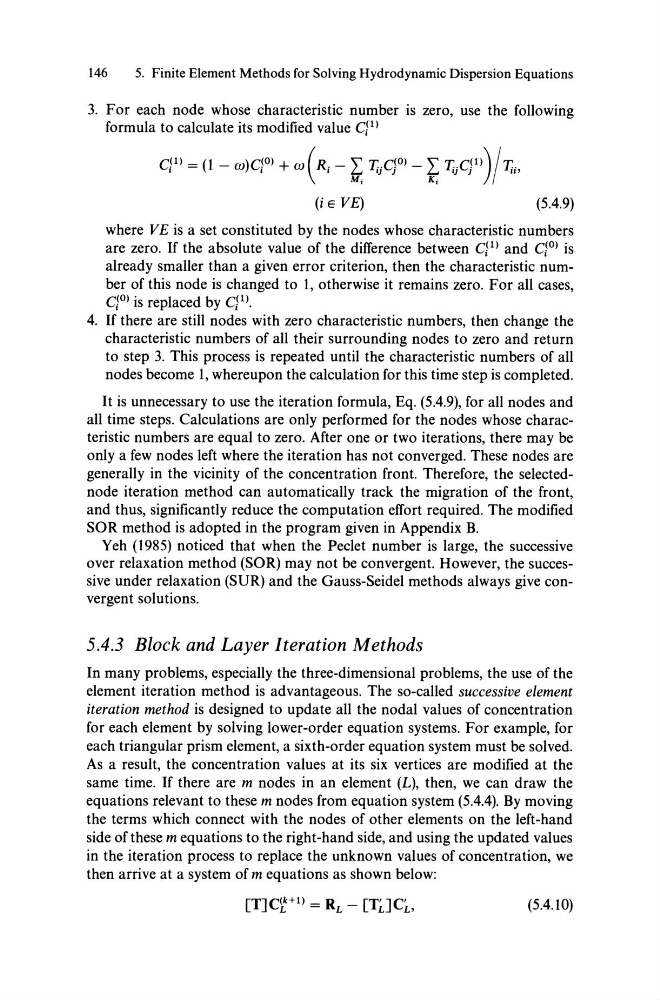
3. For each node whose characteristic number is zero, use the following
formula to calculate its modified value c[ll
CPl = (1 - w)C!°l + w(R. - " T-C!0l - " T-C!ll)jT,
,
t
~
'J J
L... lJ J
IP
Mi
K i
(i E VE)
(5.4.9)
where VE is a set constituted by the nodes whose characteristic numbers
are zero. If the absolute value of the difference between c[ll and c[0l is
already sm aller than a given error criterion, then the characteristic number of this node is changed to 1, otherwise it remains zero. For all cases,
c[0l is replaced by CPl.
4. If there are still nodes with zero characteristic numbers, then change the
characteristic numbers of all their surrounding nodes to zero and return
to step 3. This process is repeated until the characteristic numbers of all
nodes become 1, whereupon the calculation for this time step is completed.
It is unnecessary to use the iteration formula, Eq. (5.4.9), for all nodes and
all time steps. Calculations are only performed for the nodes whose characteristic numbers are equal to zero. After one or two iterations, there may be
only a few nodes left where the iteration has not converged. These nodes are
generally in the vicinity of the concentration front. Therefore, the selectednode iteration method can automatically track the migration of the front,
and thus, significantly reduce the computation effort required. The modified
SOR method is adopted in the pro gram given in Appendix B.
Yeh (1985) noticed that when the Peclet number is large, the successive
over relaxation method (SOR) may not be convergent. However, the successive under relaxation (SUR) and the Gauss-Seidel methods always give convergent solutions.
5.4.3 Block and Layer Iteration Methods
In many problems, especially the three-dimensional problems, the use of the
element iteration method is advantageous. The so-called successive element
iteration method is designed to update all the nodal values of concentration
for each element by solving lower-order equation systems. For example, for
each triangular prism element, a sixth-order equation system must be solved.
As a result, the concentration values at its six vertices are modified at the
same time. If there are m nodes in an element (L), then, we can draw the
equations relevant to these m nodes from equation system (5.4.4). By moving
the terms which connect with the nodes of other elements on the left-hand
side ofthese m equations to the right-hand side, and using the updated values
in the iteration process to replace the unknown values of concentration, we
then arrive at a system of m equations as shown below:
(5.4.10)
5. Finite Element Methods for Solving Hydrodynamic Dispersion Equations
3. For each node whose characteristic number is zero, use the following
formula to calculate its modified value c[ll
CPl = (1 - w)C!°l + w(R. - " T-C!0l - " T-C!ll)jT,
,
t
~
'J J
L... lJ J
IP
Mi
K i
(i E VE)
(5.4.9)
where VE is a set constituted by the nodes whose characteristic numbers
are zero. If the absolute value of the difference between c[ll and c[0l is
already sm aller than a given error criterion, then the characteristic number of this node is changed to 1, otherwise it remains zero. For all cases,
c[0l is replaced by CPl.
4. If there are still nodes with zero characteristic numbers, then change the
characteristic numbers of all their surrounding nodes to zero and return
to step 3. This process is repeated until the characteristic numbers of all
nodes become 1, whereupon the calculation for this time step is completed.
It is unnecessary to use the iteration formula, Eq. (5.4.9), for all nodes and
all time steps. Calculations are only performed for the nodes whose characteristic numbers are equal to zero. After one or two iterations, there may be
only a few nodes left where the iteration has not converged. These nodes are
generally in the vicinity of the concentration front. Therefore, the selectednode iteration method can automatically track the migration of the front,
and thus, significantly reduce the computation effort required. The modified
SOR method is adopted in the pro gram given in Appendix B.
Yeh (1985) noticed that when the Peclet number is large, the successive
over relaxation method (SOR) may not be convergent. However, the successive under relaxation (SUR) and the Gauss-Seidel methods always give convergent solutions.
5.4.3 Block and Layer Iteration Methods
In many problems, especially the three-dimensional problems, the use of the
element iteration method is advantageous. The so-called successive element
iteration method is designed to update all the nodal values of concentration
for each element by solving lower-order equation systems. For example, for
each triangular prism element, a sixth-order equation system must be solved.
As a result, the concentration values at its six vertices are modified at the
same time. If there are m nodes in an element (L), then, we can draw the
equations relevant to these m nodes from equation system (5.4.4). By moving
the terms which connect with the nodes of other elements on the left-hand
side ofthese m equations to the right-hand side, and using the updated values
in the iteration process to replace the unknown values of concentration, we
then arrive at a system of m equations as shown below:
(5.4.10)