

5.4. The Solution of Finite Element Systems
145
The process of point iteration includes the following main steps:
1. Determine the order for point iteration, which is generally in nodal order,
but can also be carried out in any preset order.
2. To obtain the concentration values of the (k + 1)th iteration from the
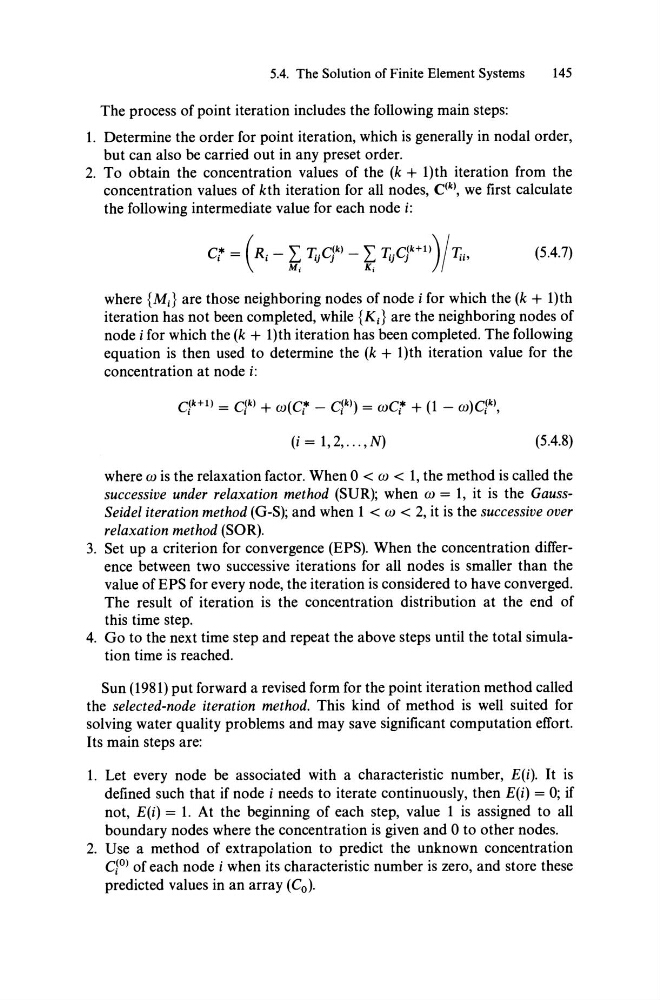
concentration values of kth iteration for all nodes, C(k), we first calculate
the following intermediate value for each node i:
(5.4.7)
where {M;} are those neighboring no des of node i for which the (k + 1)th
iteration has not been completed, while {K;} are the neighboring nodes of
node i for which the (k + 1)th iteration has been completed. The following
equation is then used to determine the (k + 1)th iteration value for the
concentration at node i:
(i= 1,2, ... ,N)
(5.4.8)
where (J) is the relaxation factor. When 0< (J) < 1, the method is called the
successive under relaxation method (SUR); when (J) = 1, it is the GaussSeidel iteration method (G-S); and when 1 < (J) < 2, it is the successive over
relaxation method (SOR).
3. Set up a criterion for convergence (EPS). When the concentration difference between two successive iterations for all nodes is smaller than the
value of EPS for every node, the iteration is considered to have converged.
The result of iteration is the concentration distribution at the end of
this time step.
4. Go to the next time step and repeat the above steps until the total simulation time is reached.
Sun (1981) put forward a revised form for the point iteration method called
the selected-node iteration method. This kind of method is well suited for
solving water quality problems and may save significant computation effort.
Its main steps are:
1. Let every node be associated with a characteristic number, E(i). It is
defined such that if node i needs to iterate continuously, then E(i) = 0; if
not, E(i) = 1. At the beginning of each step, value 1 is assigned to all
boundary nodes where the concentration is given and 0 to other nodes.
2. Use a method of extrapolation to predict the unknown concentration
qO) of each node i when its characteristic number is zero, and store these
predicted values in an array (Co).
145
The process of point iteration includes the following main steps:
1. Determine the order for point iteration, which is generally in nodal order,
but can also be carried out in any preset order.
2. To obtain the concentration values of the (k + 1)th iteration from the
concentration values of kth iteration for all nodes, C(k), we first calculate
the following intermediate value for each node i:
(5.4.7)
where {M;} are those neighboring no des of node i for which the (k + 1)th
iteration has not been completed, while {K;} are the neighboring nodes of
node i for which the (k + 1)th iteration has been completed. The following
equation is then used to determine the (k + 1)th iteration value for the
concentration at node i:
(i= 1,2, ... ,N)
(5.4.8)
where (J) is the relaxation factor. When 0< (J) < 1, the method is called the
successive under relaxation method (SUR); when (J) = 1, it is the GaussSeidel iteration method (G-S); and when 1 < (J) < 2, it is the successive over
relaxation method (SOR).
3. Set up a criterion for convergence (EPS). When the concentration difference between two successive iterations for all nodes is smaller than the
value of EPS for every node, the iteration is considered to have converged.
The result of iteration is the concentration distribution at the end of
this time step.
4. Go to the next time step and repeat the above steps until the total simulation time is reached.
Sun (1981) put forward a revised form for the point iteration method called
the selected-node iteration method. This kind of method is well suited for
solving water quality problems and may save significant computation effort.
Its main steps are:
1. Let every node be associated with a characteristic number, E(i). It is
defined such that if node i needs to iterate continuously, then E(i) = 0; if
not, E(i) = 1. At the beginning of each step, value 1 is assigned to all
boundary nodes where the concentration is given and 0 to other nodes.
2. Use a method of extrapolation to predict the unknown concentration
qO) of each node i when its characteristic number is zero, and store these
predicted values in an array (Co).