

5.4. The Solution of Finite Element Systems
147
where the component of CL is the nodal concentration of element (L), C~ the
concentrations of the nodes wh ich are adjacent to these nodes but belong to
other elements. The coefficient matrix [TLJ in Eq. (5.4.10) is a low-order
matrix, so we can adopt the general Gauss elimination to obtain the solution
directly.
When using the element iteration method, the submatrices of the coefficient matrix [TJ in Eq. (5.4.4) will be stored according to the order of
elements. Most of the zero elements of matrix [TJ do not need to store. Since
this method can modify values of more nodes at the same time, its COnvergence rate is usually faster than that of the point iteration methods.
In order to speed up the convergence of element iteration, a relaxation
factor may be added. Take the solution of Eq. (5.4.10) as the intermediate
value, Ci, and define the result of the (k + 1 )th iteration as
(5.4.11)
When 1 < (J) < 2, it is the over relaxation successive element iteration method.
Element iteration methods are applicable to various kinds of threedimensional problems, including FEM with isoparametric three-dimensional
elements and the mixed method of FEM and FDM.
If we use the partition method suggested in Section 5.3.2, i.e., partitioning
the three-dimensional region into many layers of triangular prism elements
which are aligned from top to bottom, then a layer-by-Iayer iteration method
can be used. No matter what method is used, either the Galerkin FEM, or the
mixed method of FEM and FDM, we only need to collect the equations
associated with the mth layer to obtain the following equation:
(5.4.12)
where C m is the nodal concentration ofthe mth layer, and C m - l and C m +1 the
nodal concentrations of layer m - 1 and layer m + 1, respectively. If we use
the known values of C m - l and C m +1 in the iteration, then the modified values
of C m can be solved from Eq. (5.4.12). The coefficient matrix [TJ can nOw be
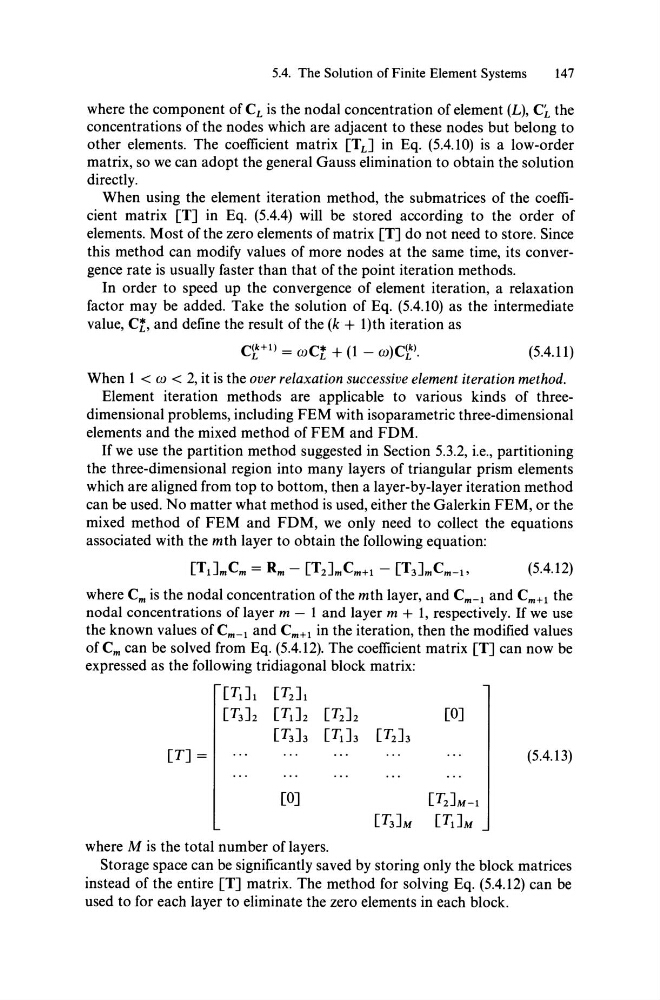
expressed as the following tridiagonal block matrix:
[T1Jl [T2Jl
[T3J2 [T1J2 [T2J2
[OJ
[T3J3 [T1J3 [T2J3
[T] =
(5.4.13)
[OJ
[T2JM-l
[T3JM
[T1JM
where M is the total number of layers.
Storage space can be significantly saved by storing only the block matrices
instead of the entire [TJ matrix. The method for solving Eq. (5.4.12) can be
used to for each layer to eliminate the zero elements in each block.
147
where the component of CL is the nodal concentration of element (L), C~ the
concentrations of the nodes wh ich are adjacent to these nodes but belong to
other elements. The coefficient matrix [TLJ in Eq. (5.4.10) is a low-order
matrix, so we can adopt the general Gauss elimination to obtain the solution
directly.
When using the element iteration method, the submatrices of the coefficient matrix [TJ in Eq. (5.4.4) will be stored according to the order of
elements. Most of the zero elements of matrix [TJ do not need to store. Since
this method can modify values of more nodes at the same time, its COnvergence rate is usually faster than that of the point iteration methods.
In order to speed up the convergence of element iteration, a relaxation
factor may be added. Take the solution of Eq. (5.4.10) as the intermediate
value, Ci, and define the result of the (k + 1 )th iteration as
(5.4.11)
When 1 < (J) < 2, it is the over relaxation successive element iteration method.
Element iteration methods are applicable to various kinds of threedimensional problems, including FEM with isoparametric three-dimensional
elements and the mixed method of FEM and FDM.
If we use the partition method suggested in Section 5.3.2, i.e., partitioning
the three-dimensional region into many layers of triangular prism elements
which are aligned from top to bottom, then a layer-by-Iayer iteration method
can be used. No matter what method is used, either the Galerkin FEM, or the
mixed method of FEM and FDM, we only need to collect the equations
associated with the mth layer to obtain the following equation:
(5.4.12)
where C m is the nodal concentration ofthe mth layer, and C m - l and C m +1 the
nodal concentrations of layer m - 1 and layer m + 1, respectively. If we use
the known values of C m - l and C m +1 in the iteration, then the modified values
of C m can be solved from Eq. (5.4.12). The coefficient matrix [TJ can nOw be
expressed as the following tridiagonal block matrix:
[T1Jl [T2Jl
[T3J2 [T1J2 [T2J2
[OJ
[T3J3 [T1J3 [T2J3
[T] =
(5.4.13)
[OJ
[T2JM-l
[T3JM
[T1JM
where M is the total number of layers.
Storage space can be significantly saved by storing only the block matrices
instead of the entire [TJ matrix. The method for solving Eq. (5.4.12) can be
used to for each layer to eliminate the zero elements in each block.