

134
5. Finite Element Methods for Solving Hydrodynamic Dispersion Equations
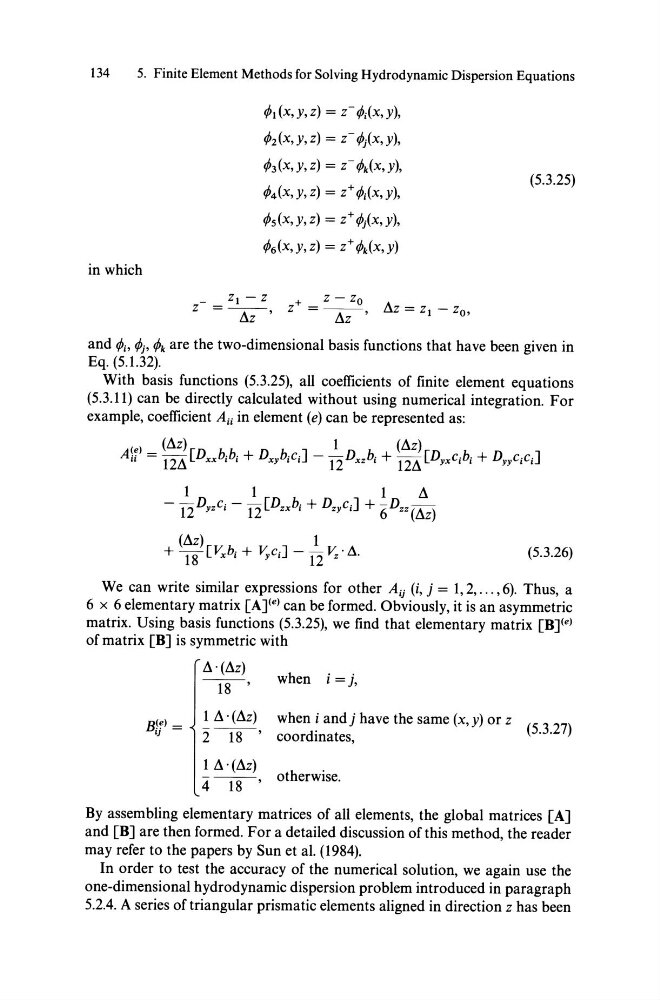
in which
tPl(X,y,Z) = Z-tPi(X,y),
tP2(X,y,Z) = z-tPix,y),
tP3(X,y,Z) = z-tA(x,y),
tP4(X, y, z) = z+ tPi(X, y),
tPs(x,y,z) = z+ #x,y),
tP6(X, y, z) = z+ tA(x, y)
+
z - Zo
z =~' .1.z = Zl - ZO,
(5.3.25)
and tPi' r/lj' tPk are the two-dimensional basis funetions that have been given in
Eq. (5.1.32).
With basis funetions (5.3.25), all eoeffieients of finite element equations
(5.3.11) ean be direetly ealculated without using numerieal integration. For
example, eoeffieient A ii in element (e) ean be represented as:
(e) _ (.1.z)
1
(.1.z)
Aii - 12.1. [Dxxbibi + Dxybic;] - 12Dxzbi + 12.1. [DyxCibi + DyyCiC;]
(5.3.26)
We ean write similar expressions for other Au (i, j = 1,2, ... ,6). Thus, a
6 x 6 elementary matrix [A]
.1. . (.1.z)
-18-'
1 .1.. (.1.z)
2-18-'
when i = j,
when i and j have the same (x, y) or z
d .
(5.3.27)
eoor mates,
1 .1. . (.1.z) otherwise.
4-18-'
By assembling elementary matriees of all elements, the global matrices [A]
and [B] are then formed. For a detailed diseussion ofthis method, the reader
may refer to the papers by Sun et al. (1984).
In order to test the aeeuraey of the numerical solution, we again use the
one-dimensional hydrodynamie dispersion problem introdueed in paragraph
5.2.4. Aseries of triangular prismatie elements aligned in direetion z has been
5. Finite Element Methods for Solving Hydrodynamic Dispersion Equations
in which
tPl(X,y,Z) = Z-tPi(X,y),
tP2(X,y,Z) = z-tPix,y),
tP3(X,y,Z) = z-tA(x,y),
tP4(X, y, z) = z+ tPi(X, y),
tPs(x,y,z) = z+ #x,y),
tP6(X, y, z) = z+ tA(x, y)
+
z - Zo
z =~' .1.z = Zl - ZO,
(5.3.25)
and tPi' r/lj' tPk are the two-dimensional basis funetions that have been given in
Eq. (5.1.32).
With basis funetions (5.3.25), all eoeffieients of finite element equations
(5.3.11) ean be direetly ealculated without using numerieal integration. For
example, eoeffieient A ii in element (e) ean be represented as:
(e) _ (.1.z)
1
(.1.z)
Aii - 12.1. [Dxxbibi + Dxybic;] - 12Dxzbi + 12.1. [DyxCibi + DyyCiC;]
(5.3.26)
We ean write similar expressions for other Au (i, j = 1,2, ... ,6). Thus, a
6 x 6 elementary matrix [A]
.1. . (.1.z)
-18-'
1 .1.. (.1.z)
2-18-'
when i = j,
when i and j have the same (x, y) or z
d .
(5.3.27)
eoor mates,
1 .1. . (.1.z) otherwise.
4-18-'
By assembling elementary matriees of all elements, the global matrices [A]
and [B] are then formed. For a detailed diseussion ofthis method, the reader
may refer to the papers by Sun et al. (1984).
In order to test the aeeuraey of the numerical solution, we again use the
one-dimensional hydrodynamie dispersion problem introdueed in paragraph
5.2.4. Aseries of triangular prismatie elements aligned in direetion z has been