

5.3. Finite Element Methods for Three-Dimensional Problems
133
1. Nodal numbers and coordinates of triangle elements at the largest cross
section.
2. Number of layers and their intervals in the vertical direction.
3. Number ofnodes that are located at the outside ofthe aquifer.
The amount of this input data is almost the same as that for two-dimensional models.
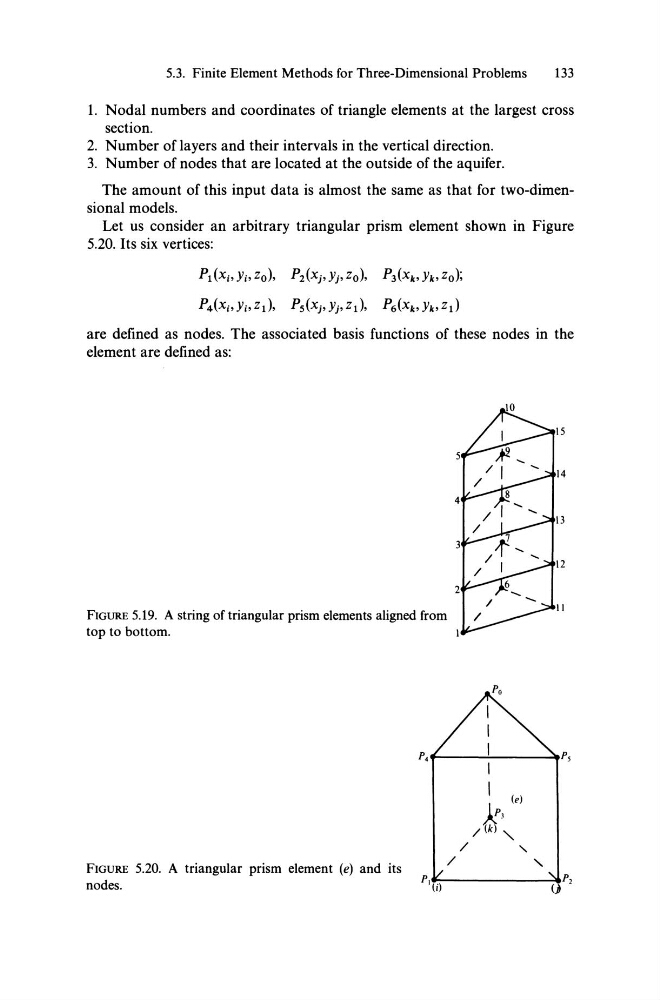
Let us consider an arbitrary triangular prism element shown in Figure
5.20. Its six vertices:
P1 (xj , Yj, zo), P2 (xj , Yj' zo), P3(Xk, Yk' zo);
P4 (Xj, Yj, zd, Ps (Xj' Yj' zd, P6(Xk'Yk,Zl)
are defined as nodes. The associated basis functions of these nodes in the
element are defined as:
FrGURE 5.19. Astring of triangular prism elements aligned from
top to bottom.
FrGuRE 5.20. A triangular prism element (e) and its
nodes.
133
1. Nodal numbers and coordinates of triangle elements at the largest cross
section.
2. Number of layers and their intervals in the vertical direction.
3. Number ofnodes that are located at the outside ofthe aquifer.
The amount of this input data is almost the same as that for two-dimensional models.
Let us consider an arbitrary triangular prism element shown in Figure
5.20. Its six vertices:
P1 (xj , Yj, zo), P2 (xj , Yj' zo), P3(Xk, Yk' zo);
P4 (Xj, Yj, zd, Ps (Xj' Yj' zd, P6(Xk'Yk,Zl)
are defined as nodes. The associated basis functions of these nodes in the
element are defined as:
FrGURE 5.19. Astring of triangular prism elements aligned from
top to bottom.
FrGuRE 5.20. A triangular prism element (e) and its
nodes.