

132
5. Finite Element Methods for Solving Hydrodynamic Dispersion Equations
in the local coordinates:
(5.3.23)
The Gaussian quadrature formula for calculating tripIe integrals is
where Wi' Wj' W k are weighting coefficients and ~;. Yfj' (k are basis points of the
Gaussian quadrature formula, and m is the number of basis points used in
each direction.
Gupta et al. (1975) developed a FORTRAN code which uses the 3-D
isoparametric FEM to solve groundwater quality problems.
5.3.2 Triangular Prism Elements and Associated Basis
Functions
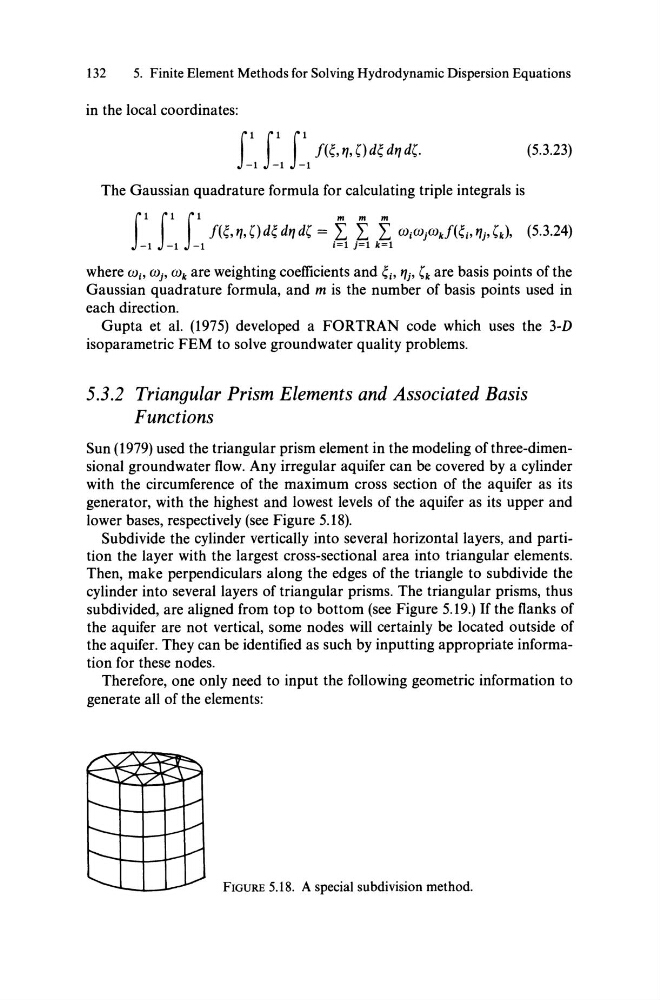
Sun (1979) used the triangular prism element in the modeling ofthree-dimensional groundwater flow. Any irregular aquifer can be covered by a cylinder
with the circumference of the maximum cross seetion of the aquifer as its
generator, with the highest and lowest levels of the aquifer as its upper and
lower bases, respeetively (see Figure 5.18).
Subdivide the eylinder vertically into several horizontallayers, and partition the layer with the largest eross-sectional area into triangular elements.
Then, make perpendieulars along the edges of the triangle to subdivide the
eylinder into severallayers of triangular prisms. The triangular prisms, thus
subdivided, are aligned from top to bottom (see Figure 5.19.) If the flanks of
the aquifer are not vertieal, some nodes will eertainly be located outside of
the aquifer. They ean be identified as sueh by inputting appropriate information for these nodes.
Therefore, one only need to input the following geometrie information to
generate all of the elements:
FIGURE 5.18. A special subdivision method.
5. Finite Element Methods for Solving Hydrodynamic Dispersion Equations
in the local coordinates:
(5.3.23)
The Gaussian quadrature formula for calculating tripIe integrals is
where Wi' Wj' W k are weighting coefficients and ~;. Yfj' (k are basis points of the
Gaussian quadrature formula, and m is the number of basis points used in
each direction.
Gupta et al. (1975) developed a FORTRAN code which uses the 3-D
isoparametric FEM to solve groundwater quality problems.
5.3.2 Triangular Prism Elements and Associated Basis
Functions
Sun (1979) used the triangular prism element in the modeling ofthree-dimensional groundwater flow. Any irregular aquifer can be covered by a cylinder
with the circumference of the maximum cross seetion of the aquifer as its
generator, with the highest and lowest levels of the aquifer as its upper and
lower bases, respeetively (see Figure 5.18).
Subdivide the eylinder vertically into several horizontallayers, and partition the layer with the largest eross-sectional area into triangular elements.
Then, make perpendieulars along the edges of the triangle to subdivide the
eylinder into severallayers of triangular prisms. The triangular prisms, thus
subdivided, are aligned from top to bottom (see Figure 5.19.) If the flanks of
the aquifer are not vertieal, some nodes will eertainly be located outside of
the aquifer. They ean be identified as sueh by inputting appropriate information for these nodes.
Therefore, one only need to input the following geometrie information to
generate all of the elements:
FIGURE 5.18. A special subdivision method.