

5.3. Finite Element Methods for Three-Dimensional Problems
131
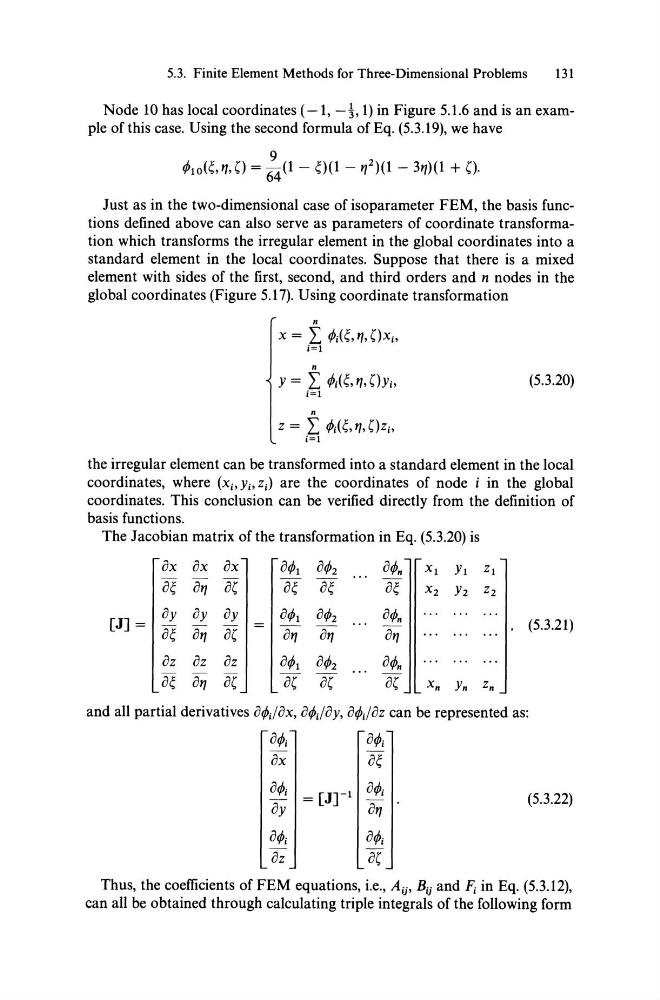
Node 10 has local coordinates (-1, -t, 1) in Figure 5.1.6 and is an exampIe of this case. Using the second formula of Eq. (5.3.19), we have
9
tP10(~' '1, 0 = 64 (1 - ~)(1 - '1 2 )(1 - 3'1)(1 + O·
Just as in the two-dimensional case of iso parameter FEM, the basis functions defined above can also serve as parameters of co ordinate transformation which transforms the irregular element in the global coordinates into a
standard element in the local coordinates. Suppose that there is a mixed
element with sides of the first, second, and third orders and n nodes in the
global coordinates (Figure 5.17). U sing co ordinate transformation
n
X = L tPi(~' '1, Oxi,
i=l
n
Y = L tPi(~' '1, OYi'
(5.3.20)
i=l
n
Z = L tPi(~' '1, OZi'
i=l
the irregular element can be transformed into a standard element in the local
coordinates, where (Xi' Yi' Zi) are the coordinates of node i in the global
coordinates. This conclusion can be verified directly from the definition of
basis functions.
The Jacobian matrix of the transformation in Eq. (5.3.20) is
OX ox ox
°tP1 °tP2
OtPn Xl Y1 Zl
O~ 0'1 0'
O~
O~
O~
X2 Yz Z2
[J] =
oy oy oy
OtP1 OtP2
otPn
(5.3.21)
o~ 0'1 0'
0'1 0'1
0'1
,
OZ OZ OZ
°tP1 °tP2
otPn
o~ 0'1 0'
0' 0'
0'
Xn Yn Zn
and all partial derivatives otPdox, otPdoy, otPdoz can be represented as:
Mi
°tPi
OX
o~
OtPi = [Jr 1 °tPi
(5.3.22)
oY
0'1
OtPi
°tPi
OZ
0'
Thus, the coefficients of FEM equations, i.e., Au, B u and F i in Eq. (5.3.12),
can all be obtained through calculating tripie integrals of the following form
131
Node 10 has local coordinates (-1, -t, 1) in Figure 5.1.6 and is an exampIe of this case. Using the second formula of Eq. (5.3.19), we have
9
tP10(~' '1, 0 = 64 (1 - ~)(1 - '1 2 )(1 - 3'1)(1 + O·
Just as in the two-dimensional case of iso parameter FEM, the basis functions defined above can also serve as parameters of co ordinate transformation which transforms the irregular element in the global coordinates into a
standard element in the local coordinates. Suppose that there is a mixed
element with sides of the first, second, and third orders and n nodes in the
global coordinates (Figure 5.17). U sing co ordinate transformation
n
X = L tPi(~' '1, Oxi,
i=l
n
Y = L tPi(~' '1, OYi'
(5.3.20)
i=l
n
Z = L tPi(~' '1, OZi'
i=l
the irregular element can be transformed into a standard element in the local
coordinates, where (Xi' Yi' Zi) are the coordinates of node i in the global
coordinates. This conclusion can be verified directly from the definition of
basis functions.
The Jacobian matrix of the transformation in Eq. (5.3.20) is
OX ox ox
°tP1 °tP2
OtPn Xl Y1 Zl
O~ 0'1 0'
O~
O~
O~
X2 Yz Z2
[J] =
oy oy oy
OtP1 OtP2
otPn
(5.3.21)
o~ 0'1 0'
0'1 0'1
0'1
,
OZ OZ OZ
°tP1 °tP2
otPn
o~ 0'1 0'
0' 0'
0'
Xn Yn Zn
and all partial derivatives otPdox, otPdoy, otPdoz can be represented as:
Mi
°tPi
OX
o~
OtPi = [Jr 1 °tPi
(5.3.22)
oY
0'1
OtPi
°tPi
OZ
0'
Thus, the coefficients of FEM equations, i.e., Au, B u and F i in Eq. (5.3.12),
can all be obtained through calculating tripie integrals of the following form