

98
5. Finite Element Methods for Solving Hydrodynamic Dispersion Equations
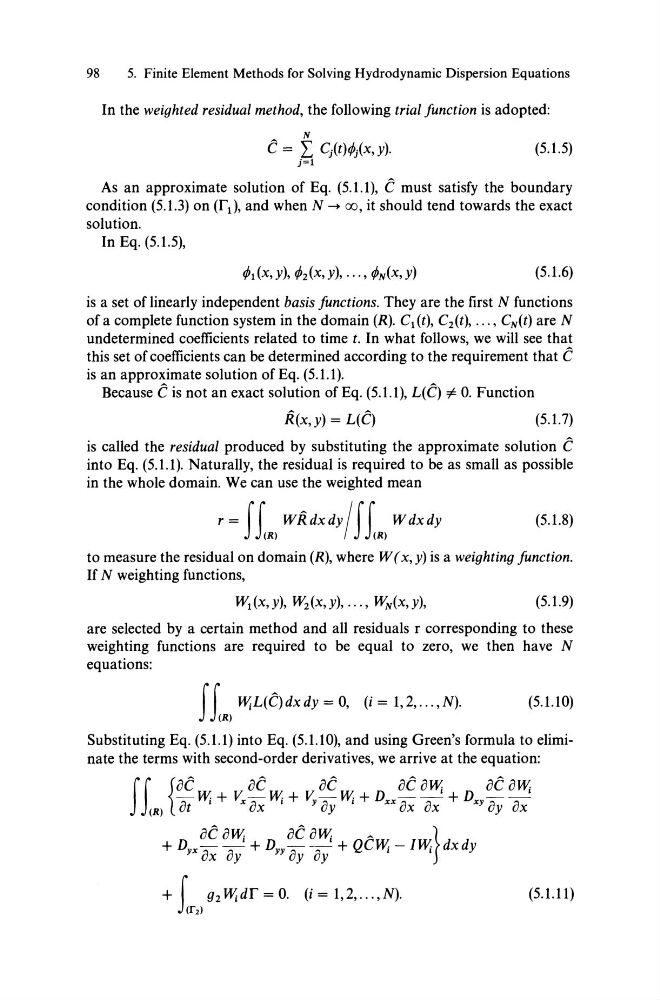
In the weighted residual method, the following trial function is adopted:
(5.1.5)
As an approximate solution of Eq. (5.1.1), C must satisfy the boundary
condition (5.1.3) on (rd, and when N -+ 00, it should tend towards the exact
solution.
In Eq. (5.1.5),
is a set of linearly independent basis junctions. They are the first N functions
of a complete function system in the domain (R). Cl (t), C2(t), ... , CN(t) are N
undetermined coefficients related to time t. In what follows, we will see that
this set of coefficients can be determined according to the requirement that C
is an approximate solution of Eq. (5.1.1).
Because C is not an exact solution of Eq. (5.1.1), L(C) i= O. Function
R(x,y) = L(C)
(5.1.7)
is called the residual produced by substituting the approximate solution C
into Eq. (5.1.1). Naturally, the residual is required to be as small as possible
in the whole domain. We can use the weighted mean
r=fr WRdXdylfr Wdxdy
J(R)
J(R)
(5.1.8)
to measure the residual on domain (R), where W (x, y) is a weighting junction.
If N weighting functions,
(5.1.9)
are selected by a certain method and all residuals r corresponding to these
weighting functions are required to be equal to zero, we then have N
equations:
f r W;L(C)dxdy = 0, (i = 1,2, ... ,N).
JR)
(5.1.10)
Substituting Eq. (5.1.1) into Eq. (5.1.10), and using Green's formula to eliminate the terms with second-order derivatives, we arrive at the equation:
f
r {ac oC oC
oC oW;
oC oW;
J(R) at w; + v., ox w; + V, oy w; + D xx ox ax + D xy oy ax
oC oW;
oC oW;
~
}
+ Dyx ox oy + Dyy oy oy + QCW; - IW; dx dy
+ r g2 W;dr = o. (i = 1,2, .. . ,N).
J(r2)
(5.1.11)
5. Finite Element Methods for Solving Hydrodynamic Dispersion Equations
In the weighted residual method, the following trial function is adopted:
(5.1.5)
As an approximate solution of Eq. (5.1.1), C must satisfy the boundary
condition (5.1.3) on (rd, and when N -+ 00, it should tend towards the exact
solution.
In Eq. (5.1.5),
is a set of linearly independent basis junctions. They are the first N functions
of a complete function system in the domain (R). Cl (t), C2(t), ... , CN(t) are N
undetermined coefficients related to time t. In what follows, we will see that
this set of coefficients can be determined according to the requirement that C
is an approximate solution of Eq. (5.1.1).
Because C is not an exact solution of Eq. (5.1.1), L(C) i= O. Function
R(x,y) = L(C)
(5.1.7)
is called the residual produced by substituting the approximate solution C
into Eq. (5.1.1). Naturally, the residual is required to be as small as possible
in the whole domain. We can use the weighted mean
r=fr WRdXdylfr Wdxdy
J(R)
J(R)
(5.1.8)
to measure the residual on domain (R), where W (x, y) is a weighting junction.
If N weighting functions,
(5.1.9)
are selected by a certain method and all residuals r corresponding to these
weighting functions are required to be equal to zero, we then have N
equations:
f r W;L(C)dxdy = 0, (i = 1,2, ... ,N).
JR)
(5.1.10)
Substituting Eq. (5.1.1) into Eq. (5.1.10), and using Green's formula to eliminate the terms with second-order derivatives, we arrive at the equation:
f
r {ac oC oC
oC oW;
oC oW;
J(R) at w; + v., ox w; + V, oy w; + D xx ox ax + D xy oy ax
oC oW;
oC oW;
~
}
+ Dyx ox oy + Dyy oy oy + QCW; - IW; dx dy
+ r g2 W;dr = o. (i = 1,2, .. . ,N).
J(r2)
(5.1.11)