

5
Finite Element Methods for Solving
Hydrodynamic Dispersion Equations
5.1 Finite Element Methods for Two-Dimensional
Problems
5.1.1 The Weighted Residual M ethod
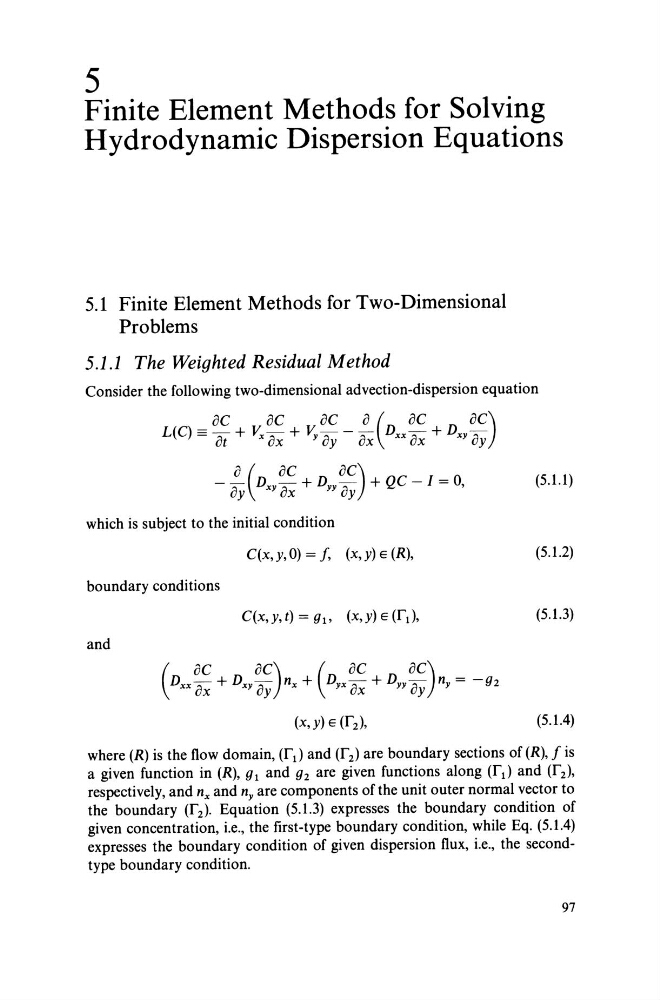
Consider the following two-dimensional advection-dispersion equation
(5.1.1)
which is subject to the initial condition
C(x, y, 0) = f, (x, y) E (R),
(5.1.2)
boundary conditions
C(X,y,t) = gl' (x,y) E (r1)'
(5.1.3)
and
(5.1.4)
where (R) is the flow domain, (rd and (r 2 ) are boundary sections of (R), f is
a given function in (R), gl and g2 are given functions along (r 1 ) and (r 2 ),
respectively, and n x and ny are components of the unit outer normal vector to
the boundary (r2)' Equation (5.1.3) expresses the boundary condition of
given concentration, i.e., the first-type boundary condition, while Eq. (5.1.4)
expresses the boundary condition of given dispersion flux, i.e., the secondtype boundary condition.
97
Finite Element Methods for Solving
Hydrodynamic Dispersion Equations
5.1 Finite Element Methods for Two-Dimensional
Problems
5.1.1 The Weighted Residual M ethod
Consider the following two-dimensional advection-dispersion equation
(5.1.1)
which is subject to the initial condition
C(x, y, 0) = f, (x, y) E (R),
(5.1.2)
boundary conditions
C(X,y,t) = gl' (x,y) E (r1)'
(5.1.3)
and
(5.1.4)
where (R) is the flow domain, (rd and (r 2 ) are boundary sections of (R), f is
a given function in (R), gl and g2 are given functions along (r 1 ) and (r 2 ),
respectively, and n x and ny are components of the unit outer normal vector to
the boundary (r2)' Equation (5.1.3) expresses the boundary condition of
given concentration, i.e., the first-type boundary condition, while Eq. (5.1.4)
expresses the boundary condition of given dispersion flux, i.e., the secondtype boundary condition.
97