

4.2. The Method of Characteristics
87
(4.2.8) to find the new Ioeation of particle P at time tk+l' After the same
eomputation is eompieted for all particles, a new distribution of the particles
will be obtained.
The next step is to ealculate how many partieles have entered eaeh grid
square. The eoneentrations of particles that have fallen into the same grid
square are averaged, and the obtained mean eoneentration is assigned to
the node of this grid square. Thus, eaeh node (i,j) at tk+l' has a mean eoneentration denoted by q:i,k+l' The superseript asterisk indieates that it is not
the final eoneentration of node (i,j) at time tk+l' but onIy the result of
adveetion.
As for the estimation of Q:i,k+l' Konikow and Bredehoeft (1978) simply let
it be equal to the arithmetie mean of eoneentrations of the particles in the
grid assoeiated with node (i,j). Huyakorn and Pinder (1983) pointed out that
the mean ealculated in this way is not very smooth, in other words, the means
of two adjaeent grid squares may be signifieantly ehanged when there is one
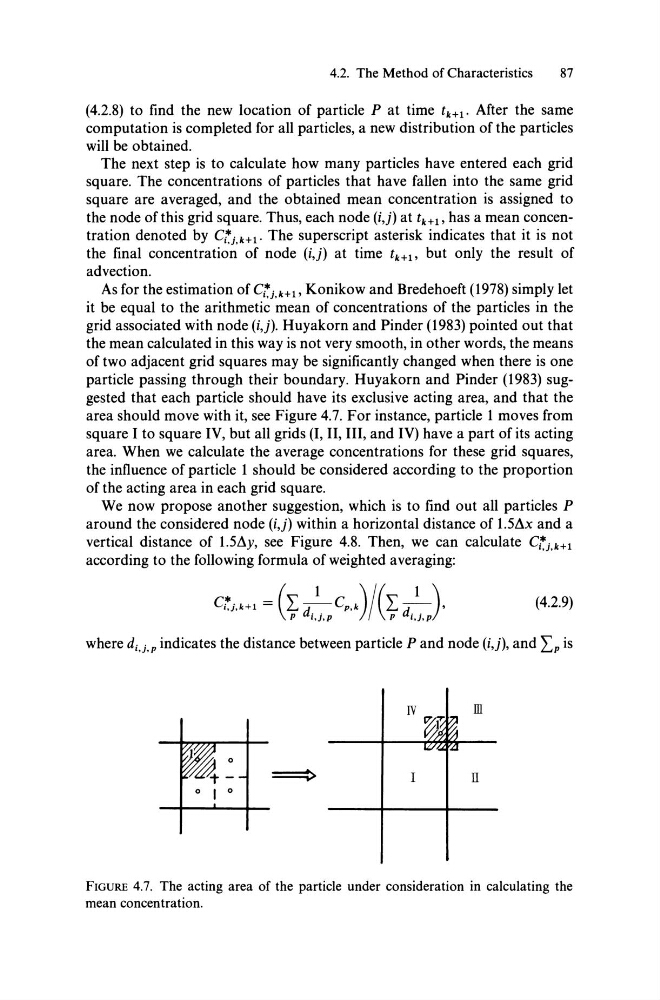
particle passing through their boundary. Huyakorn and Pinder (1983) suggested that eaeh particle should have its exclusive aeting area, and that the
area should move with it, see Figure 4.7. For instanee, particle 1 moves from
square I to square IV, but all grids (I, 11, 111, and IV) have apart of its aeting
area. When we ealculate the average eoneentrations for these grid squares,
the influenee of particle 1 should be eonsidered aeeording to the proportion
of the aeting area in eaeh grid square.
We now propose another suggestion, whieh is to find out all particles P
around the eonsidered node (i,j) within a horizontal distanee of 1.5L\x and a
vertieal distanee of 1.5L\y, see Figure 4.8. Then, we ean ealculate C;":i,k+l
aeeording to the following formula of weighted averaging:
Ci~i,k+l = (L ~Cp'k)/(L ~),
p
I,j,p
P
I,j,p
(4.2.9)
where di,i,p indieates the distanee between particle P and node (i,j), and Lp is
I
n
01 0
FIGURE 4.7. The acting area of the particle under consideration in calculating the
mean concentration.
87
(4.2.8) to find the new Ioeation of particle P at time tk+l' After the same
eomputation is eompieted for all particles, a new distribution of the particles
will be obtained.
The next step is to ealculate how many partieles have entered eaeh grid
square. The eoneentrations of particles that have fallen into the same grid
square are averaged, and the obtained mean eoneentration is assigned to
the node of this grid square. Thus, eaeh node (i,j) at tk+l' has a mean eoneentration denoted by q:i,k+l' The superseript asterisk indieates that it is not
the final eoneentration of node (i,j) at time tk+l' but onIy the result of
adveetion.
As for the estimation of Q:i,k+l' Konikow and Bredehoeft (1978) simply let
it be equal to the arithmetie mean of eoneentrations of the particles in the
grid assoeiated with node (i,j). Huyakorn and Pinder (1983) pointed out that
the mean ealculated in this way is not very smooth, in other words, the means
of two adjaeent grid squares may be signifieantly ehanged when there is one
particle passing through their boundary. Huyakorn and Pinder (1983) suggested that eaeh particle should have its exclusive aeting area, and that the
area should move with it, see Figure 4.7. For instanee, particle 1 moves from
square I to square IV, but all grids (I, 11, 111, and IV) have apart of its aeting
area. When we ealculate the average eoneentrations for these grid squares,
the influenee of particle 1 should be eonsidered aeeording to the proportion
of the aeting area in eaeh grid square.
We now propose another suggestion, whieh is to find out all particles P
around the eonsidered node (i,j) within a horizontal distanee of 1.5L\x and a
vertieal distanee of 1.5L\y, see Figure 4.8. Then, we ean ealculate C;":i,k+l
aeeording to the following formula of weighted averaging:
Ci~i,k+l = (L ~Cp'k)/(L ~),
p
I,j,p
P
I,j,p
(4.2.9)
where di,i,p indieates the distanee between particle P and node (i,j), and Lp is
I
n
01 0
FIGURE 4.7. The acting area of the particle under consideration in calculating the
mean concentration.