

88
4. Finite DilTerence Methods
0
0
0
•
0
0
0
(iJ)
0
0
0
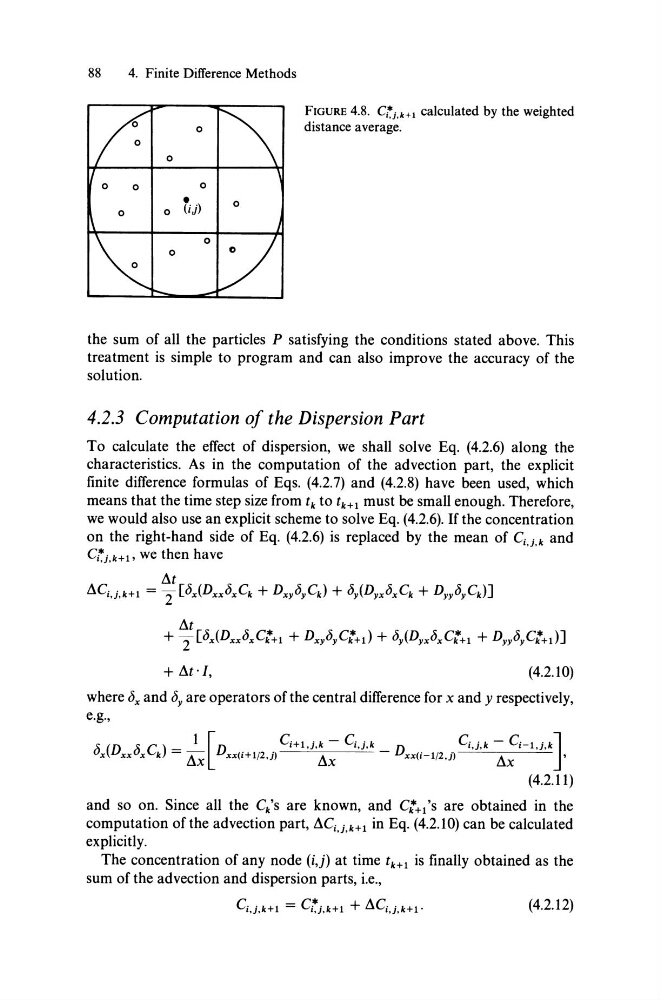
FIGURE 4.8. Cti.k+l calculated by the weighted
distance average.
the sum of all the particles P satisfying the eonditions stated above. This
treatment is simple to program and ean also improve the aeeuraey of the
solution.
4.2.3 Computation of the Dispersion Part
To ealculate the efTeet of dispersion, we shall solve Eq. (4.2.6) along the
eharaeteristies. As in the eomputation of the adveetion part, the explieit
finite difTerenee formulas of Eqs. (4.2.7) and (4.2.8) have been used, whieh
means that the time step size from t k to tk+l must be small enough. Therefore,
we would also use an explieit sehe me to solve Eq. (4.2.6). If the eoneentration
on the right-hand side of Eq. (4.2.6) is replaeed by the me an of Ci,j.k and
C;":i.k+l> we then have
/lt
dCi,i,k+1 = 2 [bADxxbxCk + DxybyCd + by(DyxbxCk + DyybyCd]
+ ~t [bADxxbxC:+1 + DxybYC:+l) + by(DyxbxC:+l + Dyy byC:+1)]
+/lt'J,
(4.2.10)
where b x and b y are operators ofthe eentral difTerenee for x and y respeetively,
e.g.,
b (D 15 C)
1 [D
Ci+l,i.k - Ci,i,k
Ci,i,k - Ci-1'i'k]
x xx x k = dx xx(i+l/2.i)
dx
- Dxx(i-l/2,i)
dx
'
(4.2.11)
and so on. Sinee all the Ck's are known, and C:+1's are obtained in the
eomputation of the adveetion part, dCi,i,k+1 in Eq. (4.2.10) ean be ealculated
explieitly.
The eoneentration of any node (i,j) at time tk+l is finally obtained as the
sum of the adveetion and dispersion parts, i.e.,
(4.2.12)
4. Finite DilTerence Methods
0
0
0
•
0
0
0
(iJ)
0
0
0
FIGURE 4.8. Cti.k+l calculated by the weighted
distance average.
the sum of all the particles P satisfying the eonditions stated above. This
treatment is simple to program and ean also improve the aeeuraey of the
solution.
4.2.3 Computation of the Dispersion Part
To ealculate the efTeet of dispersion, we shall solve Eq. (4.2.6) along the
eharaeteristies. As in the eomputation of the adveetion part, the explieit
finite difTerenee formulas of Eqs. (4.2.7) and (4.2.8) have been used, whieh
means that the time step size from t k to tk+l must be small enough. Therefore,
we would also use an explieit sehe me to solve Eq. (4.2.6). If the eoneentration
on the right-hand side of Eq. (4.2.6) is replaeed by the me an of Ci,j.k and
C;":i.k+l> we then have
/lt
dCi,i,k+1 = 2 [bADxxbxCk + DxybyCd + by(DyxbxCk + DyybyCd]
+ ~t [bADxxbxC:+1 + DxybYC:+l) + by(DyxbxC:+l + Dyy byC:+1)]
+/lt'J,
(4.2.10)
where b x and b y are operators ofthe eentral difTerenee for x and y respeetively,
e.g.,
b (D 15 C)
1 [D
Ci+l,i.k - Ci,i,k
Ci,i,k - Ci-1'i'k]
x xx x k = dx xx(i+l/2.i)
dx
- Dxx(i-l/2,i)
dx
'
(4.2.11)
and so on. Sinee all the Ck's are known, and C:+1's are obtained in the
eomputation of the adveetion part, dCi,i,k+1 in Eq. (4.2.10) ean be ealculated
explieitly.
The eoneentration of any node (i,j) at time tk+l is finally obtained as the
sum of the adveetion and dispersion parts, i.e.,
(4.2.12)