

40
D. Parra-Guevara and Y.N. Skiba
Φ
n +
1
3
− Φ
n −
1
3
= −τ A
h
3
Φ
n +
1
3
+ Φ
n −
1
3
+ 2τ q[n]
(2.45)
Φ
n +
4 − i
3
− Φ
n +
3 − i
3
= −
τ
2
A
h
i
Φ
n +
4 − i
3
+ Φ
n +
3 − i
3
(i = 2, 1)
and
G
n +
3 − i
3
− G
n +
4 − i
3
= −
τ
2
(A
h
i )
∗
G
n +
3 − i
3
+ G
n +
4 − i
3
(i = 1, 2)
G
n −
1
3
− G
n +
1
3
= −τ (A
h
3 )
∗
G
n −
1
3
+ G
n +
1
3
+ 2τ p[n]
(2.46)
G
n −
4 − i
3
− G
n −
3 − i
3
= −
τ
2
(A
h
i )
∗
G
n −
4 − i
3
+ G
n −
3 − i
3
(i = 2, 1),
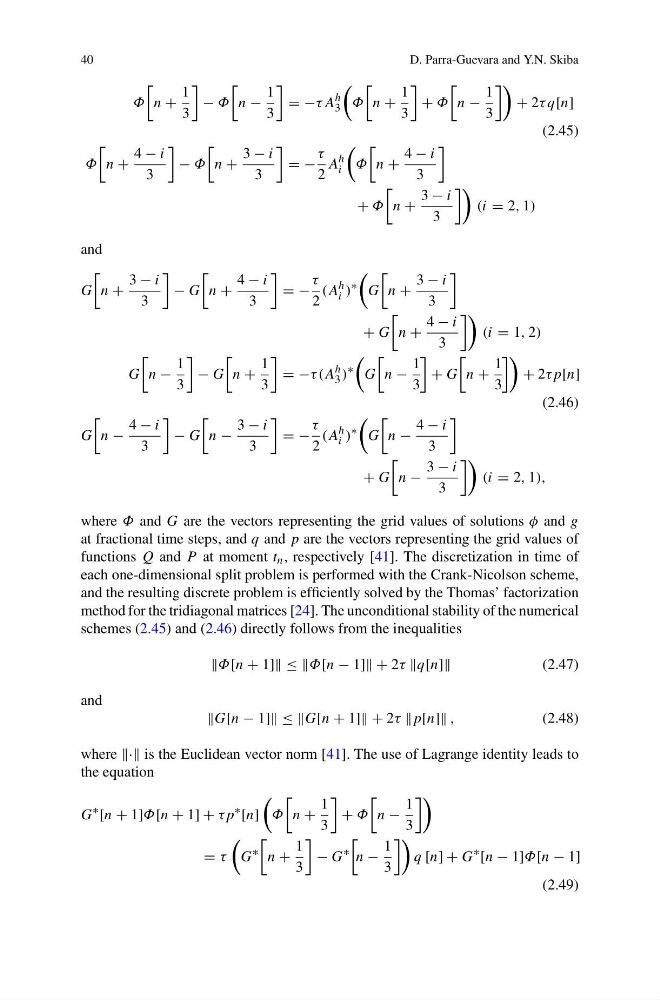
where Φ and G are the vectors representing the grid values of solutions φ and g
at fractional time steps, and q and p are the vectors representing the grid values of
functions Q and P at moment t n , respectively [41]. The discretization in time of
each one-dimensional split problem is performed with the Crank-Nicolson scheme,
and the resulting discrete problem is efficiently solved by the Thomas’ factorization
method for the tridiagonal matrices [24]. The unconditional stability of the numerical
schemes (2.45) and (2.46) directly follows from the inequalities
Φ[n + 1] ≤ Φ[n − 1] + 2τ q[n]
(2.47)
and
G[n − 1] ≤ G[n + 1] + 2τ p[n] ,
(2.48)
where · is the Euclidean vector norm [41]. The use of Lagrange identity leads to
the equation
G
∗
[n + 1]Φ[n + 1] + τ p
∗
[n]
Φ
n +
1
3
+ Φ
n −
1
3
= τ
G
∗
n +
1
3
− G
∗
n −
1
3
q [n] + G
∗
[n − 1]Φ[n − 1]
(2.49)
D. Parra-Guevara and Y.N. Skiba
Φ
n +
1
3
− Φ
n −
1
3
= −τ A
h
3
Φ
n +
1
3
+ Φ
n −
1
3
+ 2τ q[n]
(2.45)
Φ
n +
4 − i
3
− Φ
n +
3 − i
3
= −
τ
2
A
h
i
Φ
n +
4 − i
3
+ Φ
n +
3 − i
3
(i = 2, 1)
and
G
n +
3 − i
3
− G
n +
4 − i
3
= −
τ
2
(A
h
i )
∗
G
n +
3 − i
3
+ G
n +
4 − i
3
(i = 1, 2)
G
n −
1
3
− G
n +
1
3
= −τ (A
h
3 )
∗
G
n −
1
3
+ G
n +
1
3
+ 2τ p[n]
(2.46)
G
n −
4 − i
3
− G
n −
3 − i
3
= −
τ
2
(A
h
i )
∗
G
n −
4 − i
3
+ G
n −
3 − i
3
(i = 2, 1),
where Φ and G are the vectors representing the grid values of solutions φ and g
at fractional time steps, and q and p are the vectors representing the grid values of
functions Q and P at moment t n , respectively [41]. The discretization in time of
each one-dimensional split problem is performed with the Crank-Nicolson scheme,
and the resulting discrete problem is efficiently solved by the Thomas’ factorization
method for the tridiagonal matrices [24]. The unconditional stability of the numerical
schemes (2.45) and (2.46) directly follows from the inequalities
Φ[n + 1] ≤ Φ[n − 1] + 2τ q[n]
(2.47)
and
G[n − 1] ≤ G[n + 1] + 2τ p[n] ,
(2.48)
where · is the Euclidean vector norm [41]. The use of Lagrange identity leads to
the equation
G
∗
[n + 1]Φ[n + 1] + τ p
∗
[n]
Φ
n +
1
3
+ Φ
n −
1
3
= τ
G
∗
n +
1
3
− G
∗
n −
1
3
q [n] + G
∗
[n − 1]Φ[n − 1]
(2.49)