

2 A Strategy for Bioremediation of Marine Shorelines …
41
in each subinterval [t n − Δt, t n + Δt]. The sum of such relations over all subintervals
in [0, T ] (i.e., over all n) and the use of conditions (2.10) and (2.24) leads to a discrete
version of adjoint estimate (2.26).
2.6 Theoretical Results: Existence, Uniqueness
and Formulation of Discharge Parameters
2.6.1 First Stage: Discharge Points and Basic Form
of Discharge Rates of Nutrient
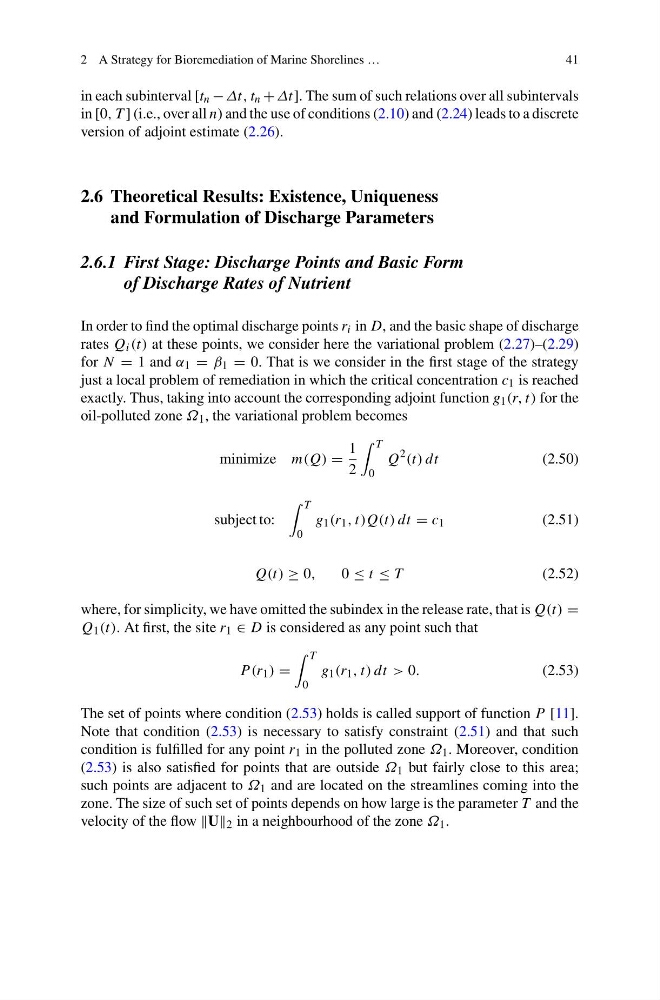
In order to find the optimal discharge points r i in D, and the basic shape of discharge
rates Q i (t) at these points, we consider here the variational problem (2.27)–(2.29)
for N = 1 and α 1 = β 1 = 0. That is we consider in the first stage of the strategy
just a local problem of remediation in which the critical concentration c 1 is reached
exactly. Thus, taking into account the corresponding adjoint function g 1 (r, t) for the
oil-polluted zone Ω 1 , the variational problem becomes
minimize m(Q) =
1
2
T
0
Q
2
(t) dt
(2.50)
subject to:
T
0
g 1 (r 1 , t)Q(t) dt = c 1
(2.51)
Q(t) ≥ 0,
0 ≤ t ≤ T
(2.52)
where, for simplicity, we have omitted the subindex in the release rate, that is Q(t) =
Q 1 (t). At first, the site r 1 ∈ D is considered as any point such that
P(r 1 ) =
T
0
g 1 (r 1 , t) dt > 0.
(2.53)
The set of points where condition (2.53) holds is called support of function P [11].
Note that condition (2.53) is necessary to satisfy constraint (2.51) and that such
condition is fulfilled for any point r 1 in the polluted zone Ω 1 . Moreover, condition
(2.53) is also satisfied for points that are outside Ω 1 but fairly close to this area;
such points are adjacent to Ω 1 and are located on the streamlines coming into the
zone. The size of such set of points depends on how large is the parameter T and the
velocity of the flow U 2 in a neighbourhood of the zone Ω 1 .
41
in each subinterval [t n − Δt, t n + Δt]. The sum of such relations over all subintervals
in [0, T ] (i.e., over all n) and the use of conditions (2.10) and (2.24) leads to a discrete
version of adjoint estimate (2.26).
2.6 Theoretical Results: Existence, Uniqueness
and Formulation of Discharge Parameters
2.6.1 First Stage: Discharge Points and Basic Form
of Discharge Rates of Nutrient
In order to find the optimal discharge points r i in D, and the basic shape of discharge
rates Q i (t) at these points, we consider here the variational problem (2.27)–(2.29)
for N = 1 and α 1 = β 1 = 0. That is we consider in the first stage of the strategy
just a local problem of remediation in which the critical concentration c 1 is reached
exactly. Thus, taking into account the corresponding adjoint function g 1 (r, t) for the
oil-polluted zone Ω 1 , the variational problem becomes
minimize m(Q) =
1
2
T
0
Q
2
(t) dt
(2.50)
subject to:
T
0
g 1 (r 1 , t)Q(t) dt = c 1
(2.51)
Q(t) ≥ 0,
0 ≤ t ≤ T
(2.52)
where, for simplicity, we have omitted the subindex in the release rate, that is Q(t) =
Q 1 (t). At first, the site r 1 ∈ D is considered as any point such that
P(r 1 ) =
T
0
g 1 (r 1 , t) dt > 0.
(2.53)
The set of points where condition (2.53) holds is called support of function P [11].
Note that condition (2.53) is necessary to satisfy constraint (2.51) and that such
condition is fulfilled for any point r 1 in the polluted zone Ω 1 . Moreover, condition
(2.53) is also satisfied for points that are outside Ω 1 but fairly close to this area;
such points are adjacent to Ω 1 and are located on the streamlines coming into the
zone. The size of such set of points depends on how large is the parameter T and the
velocity of the flow U 2 in a neighbourhood of the zone Ω 1 .