

2 A Strategy for Bioremediation of Marine Shorelines …
39
φ i jk = φ(x i , y j , z k ), u i jk = u(x i−1/2 , y j , z k ), v i jk = v(x i , y j−1/2 , z k )
w i jk = w(x i , y j , z k−1/2 ), μ k = μ(z k ), v i jk = v(x i , y j , z k−1/2 )
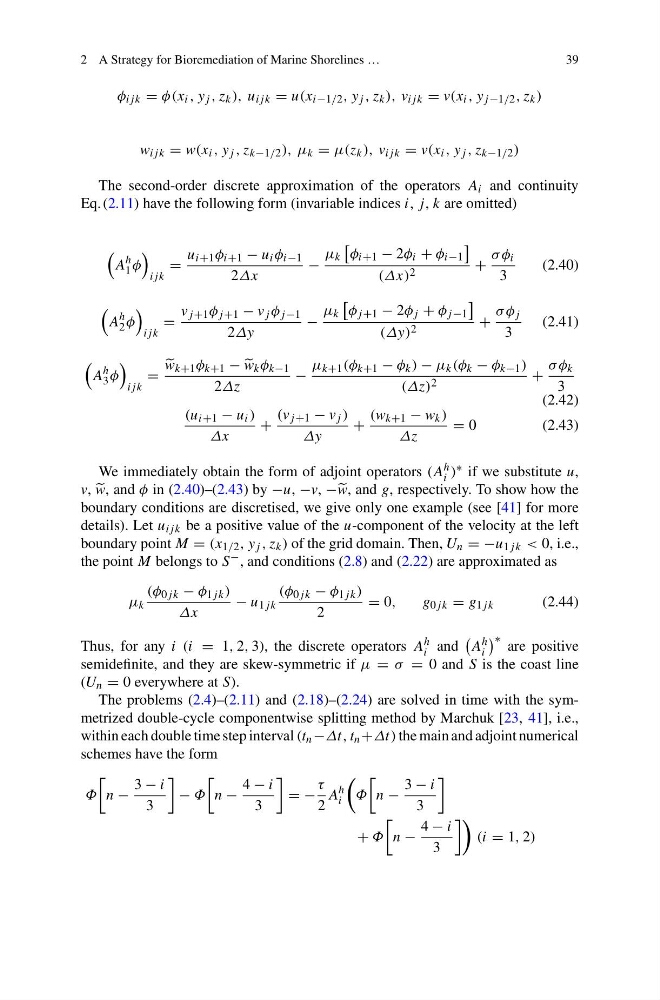
The second-order discrete approximation of the operators A i and continuity
Eq. (2.11) have the following form (invariable indices i, j, k are omitted)
A
h
1 φ
i jk
=
u i+1 φ i+1 − u i φ i−1
2Δx
−
μ k
φ i+1 − 2φ i + φ i−1
(Δx) 2
+
σ φ i
3
(2.40)
A
h
2 φ
i jk
=
v j+1 φ j+1 − v j φ j−1
2Δy
−
μ k
φ j+1 − 2φ j + φ j−1
(Δy) 2
+
σ φ j
3
(2.41)
A
h
3 φ
i jk
=
w k+1 φ k+1 − w k φ k−1
2Δz
−
μ k+1 (φ k+1 − φ k ) − μ k (φ k − φ k−1 )
(Δz) 2
+
σ φ k
3
(2.42)
(u i+1 − u i )
Δx
+
(v j+1 − v j )
Δy
+
(w k+1 − w k )
Δz
= 0
(2.43)
We immediately obtain the form of adjoint operators (A h
i ) ∗ if we substitute u,
v, w, and φ in (2.40)–(2.43) by −u, −v, − w, and g, respectively. To show how the
boundary conditions are discretised, we give only one example (see [41] for more
details). Let u i jk be a positive value of the u-component of the velocity at the left
boundary point M = (x 1/2 , y j , z k ) of the grid domain. Then, U n = −u 1 jk < 0, i.e.,
the point M belongs to S − , and conditions (2.8) and (2.22) are approximated as
μ k
(φ 0 jk − φ 1 jk )
Δx
− u 1 jk
(φ 0 jk − φ 1 jk )
2
= 0,
g 0 jk = g 1 jk
(2.44)
Thus, for any i (i = 1, 2, 3), the discrete operators A h
i and
A h
i
∗ are positive
semidefinite, and they are skew-symmetric if μ = σ = 0 and S is the coast line
(U n = 0 everywhere at S).
The problems (2.4)–(2.11) and (2.18)–(2.24) are solved in time with the symmetrized double-cycle componentwise splitting method by Marchuk [23, 41], i.e.,
within each double time step interval (t n −Δt, t n +Δt) the main and adjoint numerical
schemes have the form
Φ
n −
3 − i
3
− Φ
n −
4 − i
3
= −
τ
2
A
h
i
Φ
n −
3 − i
3
+ Φ
n −
4 − i
3
(i = 1, 2)
39
φ i jk = φ(x i , y j , z k ), u i jk = u(x i−1/2 , y j , z k ), v i jk = v(x i , y j−1/2 , z k )
w i jk = w(x i , y j , z k−1/2 ), μ k = μ(z k ), v i jk = v(x i , y j , z k−1/2 )
The second-order discrete approximation of the operators A i and continuity
Eq. (2.11) have the following form (invariable indices i, j, k are omitted)
A
h
1 φ
i jk
=
u i+1 φ i+1 − u i φ i−1
2Δx
−
μ k
φ i+1 − 2φ i + φ i−1
(Δx) 2
+
σ φ i
3
(2.40)
A
h
2 φ
i jk
=
v j+1 φ j+1 − v j φ j−1
2Δy
−
μ k
φ j+1 − 2φ j + φ j−1
(Δy) 2
+
σ φ j
3
(2.41)
A
h
3 φ
i jk
=
w k+1 φ k+1 − w k φ k−1
2Δz
−
μ k+1 (φ k+1 − φ k ) − μ k (φ k − φ k−1 )
(Δz) 2
+
σ φ k
3
(2.42)
(u i+1 − u i )
Δx
+
(v j+1 − v j )
Δy
+
(w k+1 − w k )
Δz
= 0
(2.43)
We immediately obtain the form of adjoint operators (A h
i ) ∗ if we substitute u,
v, w, and φ in (2.40)–(2.43) by −u, −v, − w, and g, respectively. To show how the
boundary conditions are discretised, we give only one example (see [41] for more
details). Let u i jk be a positive value of the u-component of the velocity at the left
boundary point M = (x 1/2 , y j , z k ) of the grid domain. Then, U n = −u 1 jk < 0, i.e.,
the point M belongs to S − , and conditions (2.8) and (2.22) are approximated as
μ k
(φ 0 jk − φ 1 jk )
Δx
− u 1 jk
(φ 0 jk − φ 1 jk )
2
= 0,
g 0 jk = g 1 jk
(2.44)
Thus, for any i (i = 1, 2, 3), the discrete operators A h
i and
A h
i
∗ are positive
semidefinite, and they are skew-symmetric if μ = σ = 0 and S is the coast line
(U n = 0 everywhere at S).
The problems (2.4)–(2.11) and (2.18)–(2.24) are solved in time with the symmetrized double-cycle componentwise splitting method by Marchuk [23, 41], i.e.,
within each double time step interval (t n −Δt, t n +Δt) the main and adjoint numerical
schemes have the form
Φ
n −
3 − i
3
− Φ
n −
4 − i
3
= −
τ
2
A
h
i
Φ
n −
3 − i
3
+ Φ
n −
4 − i
3
(i = 1, 2)