

38
D. Parra-Guevara and Y.N. Skiba
A 1 φ =
1
2
∂
∂ x
(uφ) +
1
2
u
∂φ
∂ x
−
∂
∂ x
μ
∂φ
∂ x
+
1
3
σ φ
A 2 φ =
1
2
∂
∂ y
(vφ) +
1
2
v
∂φ
∂ y
−
∂
∂ y
μ
∂φ
∂ y
+
1
3
σ φ
(2.38)
A 3 φ =
1
2
∂
∂z
( wφ) +
1
2
w
∂φ
∂z
−
∂
∂z
μ
∂φ
∂z
+
1
3
σ φ
and w = w − v s .
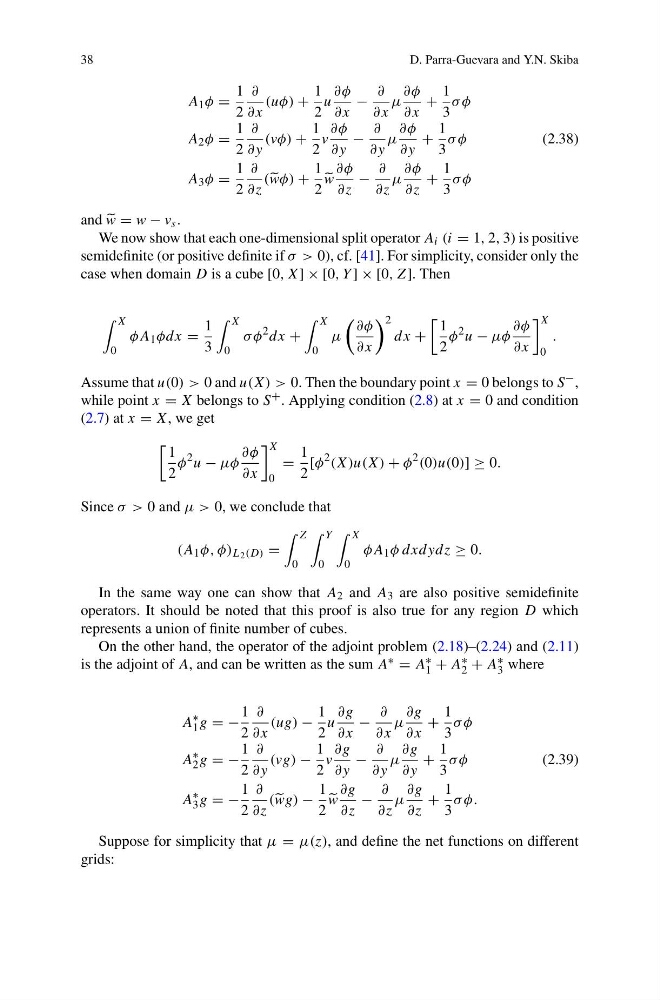
We now show that each one-dimensional split operator A i (i = 1, 2, 3) is positive
semidefinite (or positive definite if σ > 0), cf. [41]. For simplicity, consider only the
case when domain D is a cube [0, X ] × [0, Y ] × [0, Z ]. Then
X
0
φ A 1 φdx =
1
3
X
0
σ φ
2 dx +
X
0
μ
∂φ
∂ x
2
dx +
1
2
φ
2 u − μφ
∂φ
∂ x
X
0
.
Assume that u(0) > 0 and u(X ) > 0. Then the boundary point x = 0 belongs to S − ,
while point x = X belongs to S + . Applying condition (2.8) at x = 0 and condition
(2.7) at x = X , we get
1
2
φ
2 u − μφ
∂φ
∂ x
X
0
=
1
2
[φ
2
(X )u(X ) + φ
2
(0)u(0)] ≥ 0.
Since σ > 0 and μ > 0, we conclude that
(A 1 φ, φ) L 2 (D) =
Z
0
Y
0
X
0
φ A 1 φ dxdydz ≥ 0.
In the same way one can show that A 2 and A 3 are also positive semidefinite
operators. It should be noted that this proof is also true for any region D which
represents a union of finite number of cubes.
On the other hand, the operator of the adjoint problem (2.18)–(2.24) and (2.11)
is the adjoint of A, and can be written as the sum A ∗ = A ∗
1 + A ∗
2 + A ∗
3 where
A
∗
1 g = −
1
2
∂
∂ x
(ug) −
1
2
u
∂g
∂ x
−
∂
∂ x
μ
∂g
∂ x
+
1
3
σ φ
A
∗
2 g = −
1
2
∂
∂ y
(vg) −
1
2
v
∂g
∂ y
−
∂
∂ y
μ
∂g
∂ y
+
1
3
σ φ
(2.39)
A
∗
3 g = −
1
2
∂
∂z
( wg) −
1
2
w
∂g
∂z
−
∂
∂z
μ
∂g
∂z
+
1
3
σ φ.
Suppose for simplicity that μ = μ(z), and define the net functions on different
grids:
D. Parra-Guevara and Y.N. Skiba
A 1 φ =
1
2
∂
∂ x
(uφ) +
1
2
u
∂φ
∂ x
−
∂
∂ x
μ
∂φ
∂ x
+
1
3
σ φ
A 2 φ =
1
2
∂
∂ y
(vφ) +
1
2
v
∂φ
∂ y
−
∂
∂ y
μ
∂φ
∂ y
+
1
3
σ φ
(2.38)
A 3 φ =
1
2
∂
∂z
( wφ) +
1
2
w
∂φ
∂z
−
∂
∂z
μ
∂φ
∂z
+
1
3
σ φ
and w = w − v s .
We now show that each one-dimensional split operator A i (i = 1, 2, 3) is positive
semidefinite (or positive definite if σ > 0), cf. [41]. For simplicity, consider only the
case when domain D is a cube [0, X ] × [0, Y ] × [0, Z ]. Then
X
0
φ A 1 φdx =
1
3
X
0
σ φ
2 dx +
X
0
μ
∂φ
∂ x
2
dx +
1
2
φ
2 u − μφ
∂φ
∂ x
X
0
.
Assume that u(0) > 0 and u(X ) > 0. Then the boundary point x = 0 belongs to S − ,
while point x = X belongs to S + . Applying condition (2.8) at x = 0 and condition
(2.7) at x = X , we get
1
2
φ
2 u − μφ
∂φ
∂ x
X
0
=
1
2
[φ
2
(X )u(X ) + φ
2
(0)u(0)] ≥ 0.
Since σ > 0 and μ > 0, we conclude that
(A 1 φ, φ) L 2 (D) =
Z
0
Y
0
X
0
φ A 1 φ dxdydz ≥ 0.
In the same way one can show that A 2 and A 3 are also positive semidefinite
operators. It should be noted that this proof is also true for any region D which
represents a union of finite number of cubes.
On the other hand, the operator of the adjoint problem (2.18)–(2.24) and (2.11)
is the adjoint of A, and can be written as the sum A ∗ = A ∗
1 + A ∗
2 + A ∗
3 where
A
∗
1 g = −
1
2
∂
∂ x
(ug) −
1
2
u
∂g
∂ x
−
∂
∂ x
μ
∂g
∂ x
+
1
3
σ φ
A
∗
2 g = −
1
2
∂
∂ y
(vg) −
1
2
v
∂g
∂ y
−
∂
∂ y
μ
∂g
∂ y
+
1
3
σ φ
(2.39)
A
∗
3 g = −
1
2
∂
∂z
( wg) −
1
2
w
∂g
∂z
−
∂
∂z
μ
∂g
∂z
+
1
3
σ φ.
Suppose for simplicity that μ = μ(z), and define the net functions on different
grids: