

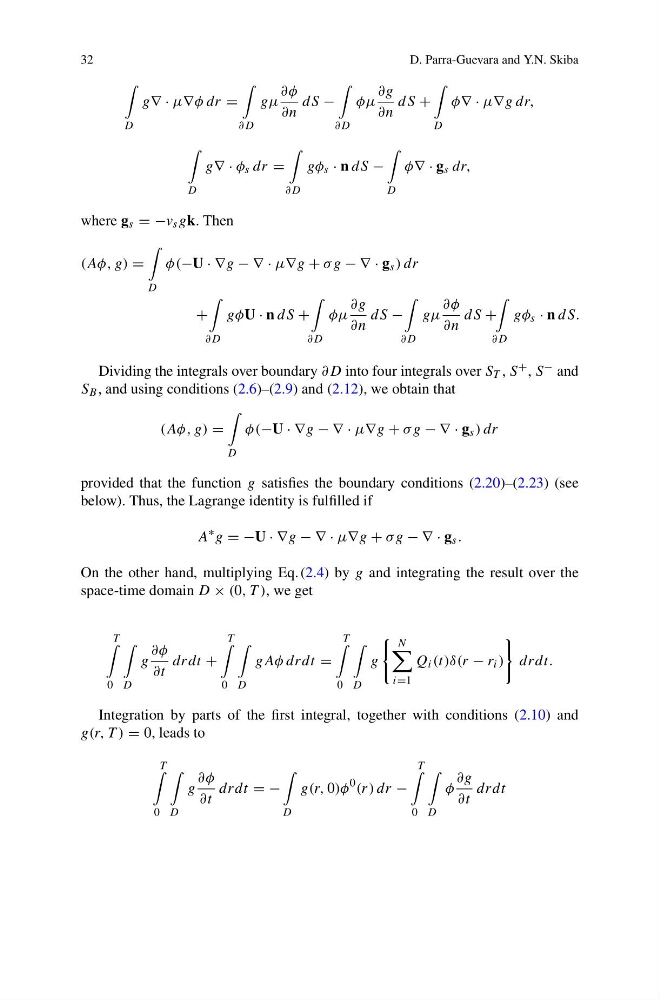
32
D. Parra-Guevara and Y.N. Skiba
D
g∇ · μ∇φ dr =
∂ D
gμ
∂φ
∂n
d S −
∂ D
φμ
∂g
∂n
d S +
D
φ∇ · μ∇g dr,
D
g∇ · φ s dr =
∂ D
gφ s · n d S −
D
φ∇ · g s dr,
where g s = −v s gk. Then
(Aφ, g) =
D
φ(−U · ∇g − ∇ · μ∇g + σ g − ∇ · g s ) dr
+
∂ D
gφU · n d S +
∂ D
φμ
∂g
∂n
d S −
∂ D
gμ
∂φ
∂n
d S +
∂ D
gφ s · n d S.
Dividing the integrals over boundary ∂ D into four integrals over S T , S + , S − and
S B , and using conditions (2.6)–(2.9) and (2.12), we obtain that
(Aφ, g) =
D
φ(−U · ∇g − ∇ · μ∇g + σ g − ∇ · g s ) dr
provided that the function g satisfies the boundary conditions (2.20)–(2.23) (see
below). Thus, the Lagrange identity is fulfilled if
A
∗ g = −U · ∇g − ∇ · μ∇g + σ g − ∇ · g s .
On the other hand, multiplying Eq. (2.4) by g and integrating the result over the
space-time domain D × (0, T ), we get
T
0
D
g
∂φ
∂t
drdt +
T
0
D
g Aφ drdt =
T
0
D
g
N
i=1
Q i (t)δ(r − r i )
drdt.
Integration by parts of the first integral, together with conditions (2.10) and
g(r, T ) = 0, leads to
T
0
D
g
∂φ
∂t
drdt = −
D
g(r, 0)φ
0
(r ) dr −
T
0
D
φ
∂g
∂t
drdt
D. Parra-Guevara and Y.N. Skiba
D
g∇ · μ∇φ dr =
∂ D
gμ
∂φ
∂n
d S −
∂ D
φμ
∂g
∂n
d S +
D
φ∇ · μ∇g dr,
D
g∇ · φ s dr =
∂ D
gφ s · n d S −
D
φ∇ · g s dr,
where g s = −v s gk. Then
(Aφ, g) =
D
φ(−U · ∇g − ∇ · μ∇g + σ g − ∇ · g s ) dr
+
∂ D
gφU · n d S +
∂ D
φμ
∂g
∂n
d S −
∂ D
gμ
∂φ
∂n
d S +
∂ D
gφ s · n d S.
Dividing the integrals over boundary ∂ D into four integrals over S T , S + , S − and
S B , and using conditions (2.6)–(2.9) and (2.12), we obtain that
(Aφ, g) =
D
φ(−U · ∇g − ∇ · μ∇g + σ g − ∇ · g s ) dr
provided that the function g satisfies the boundary conditions (2.20)–(2.23) (see
below). Thus, the Lagrange identity is fulfilled if
A
∗ g = −U · ∇g − ∇ · μ∇g + σ g − ∇ · g s .
On the other hand, multiplying Eq. (2.4) by g and integrating the result over the
space-time domain D × (0, T ), we get
T
0
D
g
∂φ
∂t
drdt +
T
0
D
g Aφ drdt =
T
0
D
g
N
i=1
Q i (t)δ(r − r i )
drdt.
Integration by parts of the first integral, together with conditions (2.10) and
g(r, T ) = 0, leads to
T
0
D
g
∂φ
∂t
drdt = −
D
g(r, 0)φ
0
(r ) dr −
T
0
D
φ
∂g
∂t
drdt