

2 A Strategy for Bioremediation of Marine Shorelines …
31
and hence,
∂
∂t
φ ≤ ≤ f .
Finally, the integration over time interval (0, T ) leads to
φ ≤ T max
0≤t≤T
f (r, t) +
φ
0
(r )
.
(2.16)
Since the dispersion model (2.4)–(2.11) is linear with respect to φ, estimation (2.16)
assures that the solution of problem (2.4)–(2.11) is unique and continuously depends
on the initial conditions and forcing. Also, using the method described by Skiba and
Parra-Guevara [43], it is possible to prove the existence of generalized solution of
problem (2.4)–(2.11), that is the model (2.4)–(2.11) is well posed in the sense of
Hadamard [13]. Also note that the positive semidefiniteness of operator A allows
us to split the operator A in coordinate directions, and with the help of numerical
schemes by Marchuk [22] and Crank-Nicolson [8] construct unconditionally stable
and efficient numerical algorithm of second approximation order in space and time
for the solution of problem (2.4)–(2.11) [41].
2.3 Adjoint Functions and the Duality Principle
It is rather difficult to analyse and solve the variational problem (2.1)–(2.3) because
the constraints in (2.2) are related with the solutions Q i of the control problem
implicitly through the solution φ of the dispersion model (2.4)–(2.11). In order to
establish an explicit dependence of the constraints on the control functions Q i , we
now introduce one more model which is adjoint to the dispersion model (2.4)–(2.11).
It means that the operator A ∗ is adjoint to the operator A of the model (2.4)–(2.11)
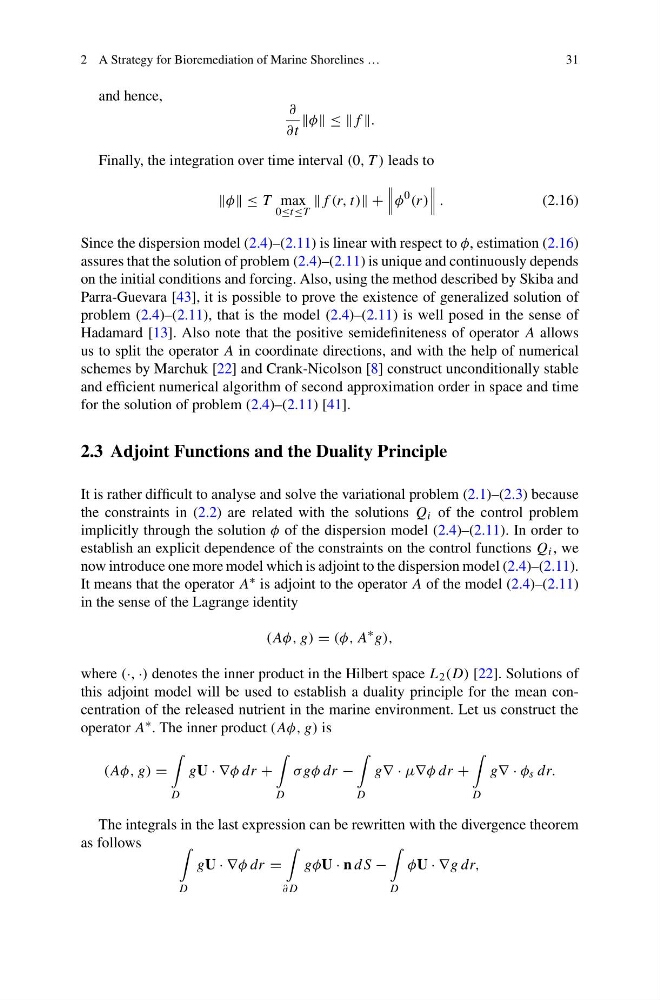
in the sense of the Lagrange identity
(Aφ, g) = (φ, A
∗ g),
where (·, ·) denotes the inner product in the Hilbert space L 2 (D) [22]. Solutions of
this adjoint model will be used to establish a duality principle for the mean concentration of the released nutrient in the marine environment. Let us construct the
operator A ∗ . The inner product (Aφ, g) is
(Aφ, g) =
D
gU · ∇φ dr +
D
σ gφ dr −
D
g∇ · μ∇φ dr +
D
g∇ · φ s dr.
The integrals in the last expression can be rewritten with the divergence theorem
as follows
D
gU · ∇φ dr =
∂ D
gφU · n d S −
D
φU · ∇g dr,
31
and hence,
∂
∂t
φ ≤ ≤ f .
Finally, the integration over time interval (0, T ) leads to
φ ≤ T max
0≤t≤T
f (r, t) +
φ
0
(r )
.
(2.16)
Since the dispersion model (2.4)–(2.11) is linear with respect to φ, estimation (2.16)
assures that the solution of problem (2.4)–(2.11) is unique and continuously depends
on the initial conditions and forcing. Also, using the method described by Skiba and
Parra-Guevara [43], it is possible to prove the existence of generalized solution of
problem (2.4)–(2.11), that is the model (2.4)–(2.11) is well posed in the sense of
Hadamard [13]. Also note that the positive semidefiniteness of operator A allows
us to split the operator A in coordinate directions, and with the help of numerical
schemes by Marchuk [22] and Crank-Nicolson [8] construct unconditionally stable
and efficient numerical algorithm of second approximation order in space and time
for the solution of problem (2.4)–(2.11) [41].
2.3 Adjoint Functions and the Duality Principle
It is rather difficult to analyse and solve the variational problem (2.1)–(2.3) because
the constraints in (2.2) are related with the solutions Q i of the control problem
implicitly through the solution φ of the dispersion model (2.4)–(2.11). In order to
establish an explicit dependence of the constraints on the control functions Q i , we
now introduce one more model which is adjoint to the dispersion model (2.4)–(2.11).
It means that the operator A ∗ is adjoint to the operator A of the model (2.4)–(2.11)
in the sense of the Lagrange identity
(Aφ, g) = (φ, A
∗ g),
where (·, ·) denotes the inner product in the Hilbert space L 2 (D) [22]. Solutions of
this adjoint model will be used to establish a duality principle for the mean concentration of the released nutrient in the marine environment. Let us construct the
operator A ∗ . The inner product (Aφ, g) is
(Aφ, g) =
D
gU · ∇φ dr +
D
σ gφ dr −
D
g∇ · μ∇φ dr +
D
g∇ · φ s dr.
The integrals in the last expression can be rewritten with the divergence theorem
as follows
D
gU · ∇φ dr =
∂ D
gφU · n d S −
D
φU · ∇g dr,