

64
Owing to the relative smallness of the sea depth and the horizontal density gradients, the last
term of (38) is negligible compared with - g V11, the pressure force due to the slope of the sea
surface (Deleersnijder, 1992).
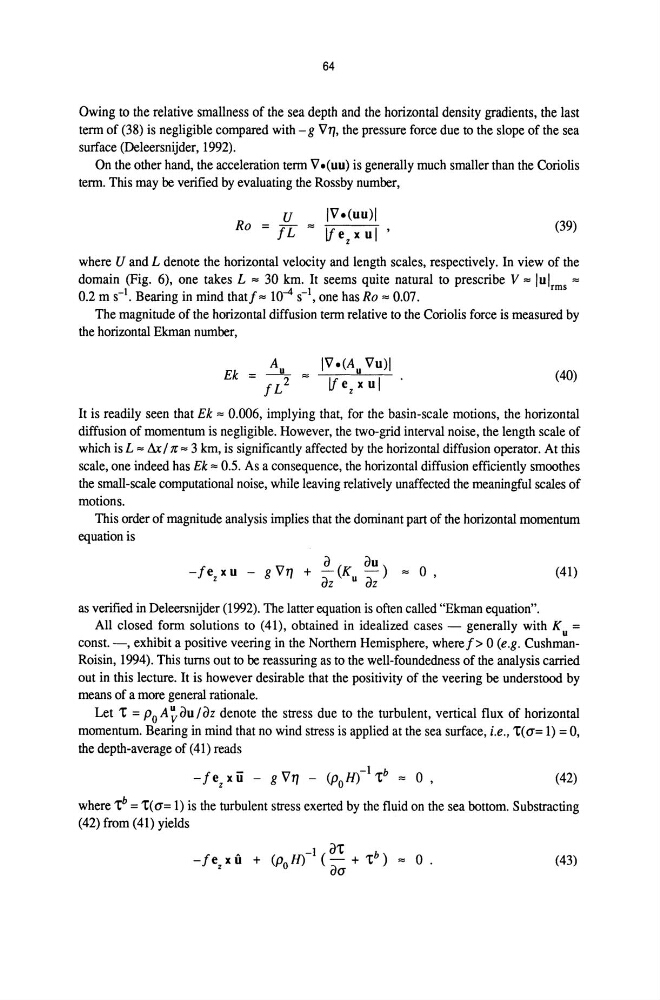
On the other hand, the acceleration term V.(uu) is generally much smaller than the Coriolis
term. This may be verified by evaluating the Rossby number,
u
IV.(uu)1
Ro = ! L '" If e x u I '
z
(39)
where U and L denote the horizontal velocity and length scales, respectively. In view of the
domain (Fig. 6), one takes L '" 30 km. It seems quite natural to prescribe V", lui
'"
0.2 m s-l. Bearing in mind that! '" 10-4 s-l, one has Ro '" 0.07.
rms
The magnitude of the horizontal diffusion term relative to the Coriolis force is measured by
the horizontal Ekman number,
Ek
IV .(A u Vu)1
lfezxul
(40)
It is readily seen that Ek '" 0.006, implying that, for the basin-scale motions, the horizontal
diffusion of momentum is negligible. However, the two-grid interval noise, the length scale of
which is L '" Ax / 7r '" 3 km, is significantly affected by the horizontal diffusion operator. At this
scale, one indeed has Ek '" 0.5. As a consequence, the horizontal diffusion efficiently smoothes
the small-scale computational noise, while leaving relatively unaffected the meaningful scales of
motions.
This order of magnitude analysis implies that the dominant part of the horizontal momentum
equation is
a au
- / e xu - g V 11 + - (K - ) '" 0 ,
z
az u az
(41)
as verified in Deleersnijder (1992). The latter equation is often called "Ekman equation".
All closed form solutions to (41), obtained in idealized cases - generally with Ku =
const. -, exhibit a positive veering in the Northern Hemisphere, where/> 0 (e.g. CushmanRoisin, 1994). This turns out to be reassuring as to the well-foundedness of the analysis carried
out in this lecture. It is however desirable that the positivity of the veering be understood by
means of a more general rationale.
Let t = poA~au/az denote the stress due to the turbulent, vertical flux of horizontal
momentum. Bearing in mind that no wind stress is applied at the sea surface, i.e., t( 0'= 1) = 0,
the depth-average of (41) reads
/
-
V
-\ b
0
- e z x u - g 11 - (Po H) t '" ,
(42)
where t b = t(O'= 1) is the turbulent stress exerted by the fluid on the sea bottom. Substracting
(42) from (41) yields
o.
(43)
Owing to the relative smallness of the sea depth and the horizontal density gradients, the last
term of (38) is negligible compared with - g V11, the pressure force due to the slope of the sea
surface (Deleersnijder, 1992).
On the other hand, the acceleration term V.(uu) is generally much smaller than the Coriolis
term. This may be verified by evaluating the Rossby number,
u
IV.(uu)1
Ro = ! L '" If e x u I '
z
(39)
where U and L denote the horizontal velocity and length scales, respectively. In view of the
domain (Fig. 6), one takes L '" 30 km. It seems quite natural to prescribe V", lui
'"
0.2 m s-l. Bearing in mind that! '" 10-4 s-l, one has Ro '" 0.07.
rms
The magnitude of the horizontal diffusion term relative to the Coriolis force is measured by
the horizontal Ekman number,
Ek
IV .(A u Vu)1
lfezxul
(40)
It is readily seen that Ek '" 0.006, implying that, for the basin-scale motions, the horizontal
diffusion of momentum is negligible. However, the two-grid interval noise, the length scale of
which is L '" Ax / 7r '" 3 km, is significantly affected by the horizontal diffusion operator. At this
scale, one indeed has Ek '" 0.5. As a consequence, the horizontal diffusion efficiently smoothes
the small-scale computational noise, while leaving relatively unaffected the meaningful scales of
motions.
This order of magnitude analysis implies that the dominant part of the horizontal momentum
equation is
a au
- / e xu - g V 11 + - (K - ) '" 0 ,
z
az u az
(41)
as verified in Deleersnijder (1992). The latter equation is often called "Ekman equation".
All closed form solutions to (41), obtained in idealized cases - generally with Ku =
const. -, exhibit a positive veering in the Northern Hemisphere, where/> 0 (e.g. CushmanRoisin, 1994). This turns out to be reassuring as to the well-foundedness of the analysis carried
out in this lecture. It is however desirable that the positivity of the veering be understood by
means of a more general rationale.
Let t = poA~au/az denote the stress due to the turbulent, vertical flux of horizontal
momentum. Bearing in mind that no wind stress is applied at the sea surface, i.e., t( 0'= 1) = 0,
the depth-average of (41) reads
/
-
V
-\ b
0
- e z x u - g 11 - (Po H) t '" ,
(42)
where t b = t(O'= 1) is the turbulent stress exerted by the fluid on the sea bottom. Substracting
(42) from (41) yields
o.
(43)