

63
Another type of analysis is suggested by the idealized fonn (34). Combining (32)-(34)
yields wuw = a.1 ez·(V xHU) O"(l- 0"), implying
(37)
where Wuw represents the depth-average of the upwelling velocity.
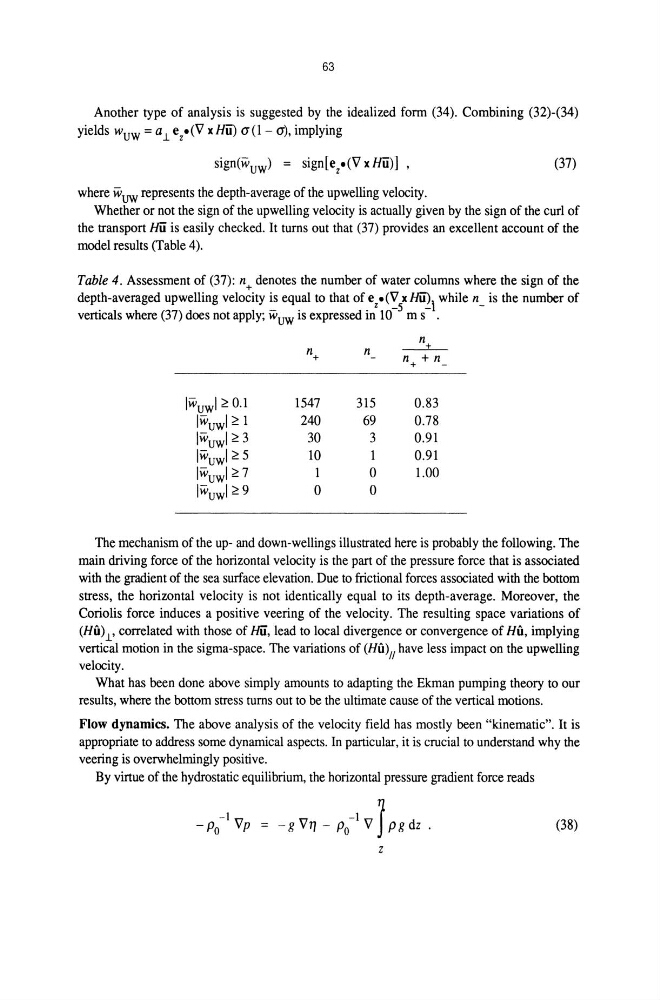
Whether or not the sign of the upwelling velocity is actually given by the sign of the curl of
the transport Hii is easily checked. It turns out that (37) provides an excellent account of the
model results (Table 4).
Table 4. Assessment of (37): n + denotes the number of water columns where the sign of the
depth-averaged upwelling velocity is equal to that of ez.(V xHU)i while n _ is the number of
verticals where (37) does not apply; Wuw is expressed in 10- 5 m s- .
n+
n
~
n + n
+
-
IWuwl ~0.1
1547
315
0.83
IWuwl ~ 1
240
69
0.78
IWuwl ~ 3
30
3
0.91
IWuwl ~5
10
1
0.91
IWuwl ~7
1
0
1.00
IWuwl ~9
0
0
The mechanism of the up- and down-wellings illustrated here is probably the following. The
main driving force of the horizontal velocity is the part of the pressure force that is associated
with the gradient of the sea surface elevation. Due to frictional forces associated with the bottom
stress, the horiwntal velocity is not identically equal to its depth-average. Moreover, the
Coriolis force induces a positive veering of the velocity. The resulting space variations of
(Hu) .1' correlated with those of Hii, lead to local divergence or convergence of Hu, implying
vertical motion in the sigma-space. The variations of (Hu)1I have less impact on the upwelling
velocity.
What has been done above simply amounts to adapting the Ekman pumping theory to our
results, where the bottom stress turns out to be the ultimate cause of the vertical motions.
Flow dynamics. The above analysis of the velocity field has mostly been "kinematic". It is
appropriate to address some dynamical aspects. In particular, it is crucial to understand why the
veering is overwhelmingly positive.
By virtue of the hydrostatic equilibrium, the horizontal pressure gradient force reads
-1 V
-Po P
-1
7
-gV1J - Po V J pgdz .
(38)
z
Another type of analysis is suggested by the idealized fonn (34). Combining (32)-(34)
yields wuw = a.1 ez·(V xHU) O"(l- 0"), implying
(37)
where Wuw represents the depth-average of the upwelling velocity.
Whether or not the sign of the upwelling velocity is actually given by the sign of the curl of
the transport Hii is easily checked. It turns out that (37) provides an excellent account of the
model results (Table 4).
Table 4. Assessment of (37): n + denotes the number of water columns where the sign of the
depth-averaged upwelling velocity is equal to that of ez.(V xHU)i while n _ is the number of
verticals where (37) does not apply; Wuw is expressed in 10- 5 m s- .
n+
n
~
n + n
+
-
IWuwl ~0.1
1547
315
0.83
IWuwl ~ 1
240
69
0.78
IWuwl ~ 3
30
3
0.91
IWuwl ~5
10
1
0.91
IWuwl ~7
1
0
1.00
IWuwl ~9
0
0
The mechanism of the up- and down-wellings illustrated here is probably the following. The
main driving force of the horizontal velocity is the part of the pressure force that is associated
with the gradient of the sea surface elevation. Due to frictional forces associated with the bottom
stress, the horiwntal velocity is not identically equal to its depth-average. Moreover, the
Coriolis force induces a positive veering of the velocity. The resulting space variations of
(Hu) .1' correlated with those of Hii, lead to local divergence or convergence of Hu, implying
vertical motion in the sigma-space. The variations of (Hu)1I have less impact on the upwelling
velocity.
What has been done above simply amounts to adapting the Ekman pumping theory to our
results, where the bottom stress turns out to be the ultimate cause of the vertical motions.
Flow dynamics. The above analysis of the velocity field has mostly been "kinematic". It is
appropriate to address some dynamical aspects. In particular, it is crucial to understand why the
veering is overwhelmingly positive.
By virtue of the hydrostatic equilibrium, the horizontal pressure gradient force reads
-1 V
-Po P
-1
7
-gV1J - Po V J pgdz .
(38)
z