

65
Near the sea bed, there is a thin boundary layer in which the velocity goes to zero - as the
bottom is approached - according to a logarithmic profile (e.g. Wimbush and Munk, 1971).
This boundary layer is not resolved by the numerical model, so that the modelled horizontal
velocity is not prescribed to be zero at the sea bed. Rather, a slip boundary condition is resorted
to, whereby the bottom stress is evaluated as 'tb = Po CD lu(d)1 u(d), where CD and d represent
an appropriate drag coefficient (CD'" 0.002) and the distance to the bottom of the first grid
point where u is computed, respectively. Since lui « liil, it is clear that r!' is approximately
equal to Po CD liil ii. Upon defining e as the unit vector parallel to ii, i.e., e = ii / liil, it is very
likely that
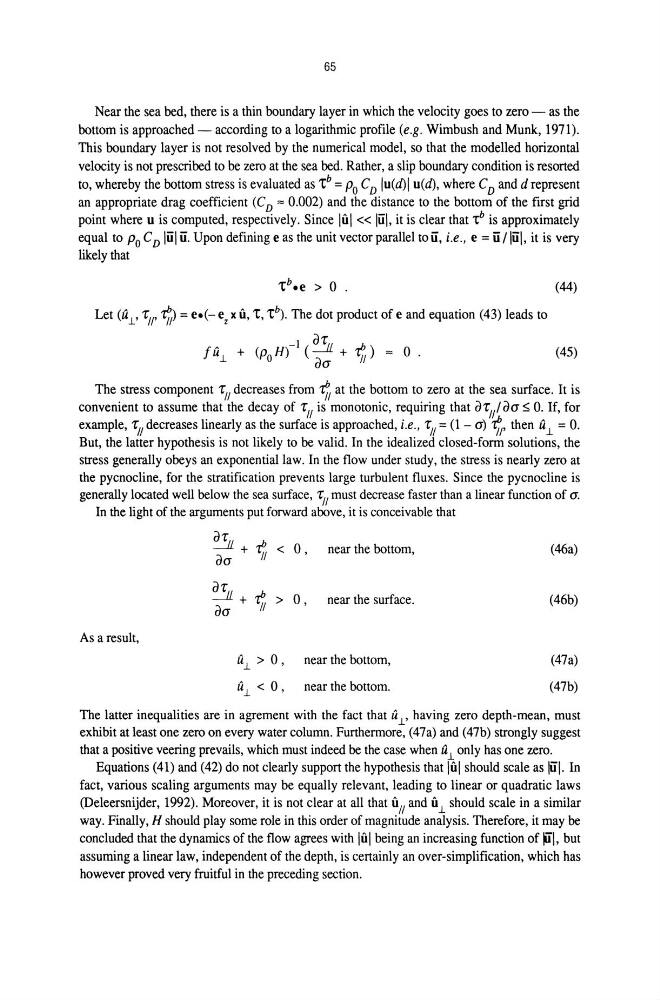
'tbee > 0 .
(44)
Let (u 1.' 'r", itt) = ee(- e z x u, 't, 't b ). The dot product of e and equation (43) leads to
l~ ...h
f u 1. + (po Hf (dO' + "1') '" 0 .
(45)
The stress component 'r" decreases from itt at the bottom to zero at the sea surface. It is
convenient to assume that the decay of 'r" is monotonic, requiring that d'rt/ dO' ~ O. If, for
example, ' r" decreases linearly as the surface is approached, i.e., ' r" = (1- 0') 'tft, then ul. = O.
But, the latter hypothesis is not likely to be valid. In the idealized closed-form solutions, the
stress generally obeys an exponential law. In the flow under study, the stress is nearly zero at
the pycnocline, for the stratification prevents large turbulent fluxes. Since the pycnocline is
generally located well below the sea surface, ~I must decrease faster than a linear function of 0'.
In the light of the arguments put forward above, it is conceivable that
~
~
< 0, near the bottom,
+
dO'
~ + f.
dO'
"
> 0, near the surface.
As a result,
U 1. > 0, near the bottom,
ul. < 0, near the bottom.
(46a)
(46b)
(47a)
(47b)
The latter inequalities are in agrement with the fact that u 1.' having zero depth-mean, must
exhibit at least one zero on every water column. Furthermore, (47a) and (47b) strongly suggest
that a positive veering prevails, which must indeed be the case when u 1. only has one zero.
Equations (41) and (42) do not clearly support the hypothesis that lui should scale as liil. In
fact, various scaling arguments may be equally relevant, leading to linear or quadratic laws
(Deleersnijder, 1992). Moreover, it is not clear at all that u" and u 1. should scale in a similar
way. Finally, H should play some role in this order of magnitude analysis. Therefore, it may be
concluded that the dynamics of the flow agrees with lui being an increasing function of ~I, but
assuming a linear law, independent of the depth, is certainly an over-simplification, which has
however proved very fruitful in the preceding section.
Near the sea bed, there is a thin boundary layer in which the velocity goes to zero - as the
bottom is approached - according to a logarithmic profile (e.g. Wimbush and Munk, 1971).
This boundary layer is not resolved by the numerical model, so that the modelled horizontal
velocity is not prescribed to be zero at the sea bed. Rather, a slip boundary condition is resorted
to, whereby the bottom stress is evaluated as 'tb = Po CD lu(d)1 u(d), where CD and d represent
an appropriate drag coefficient (CD'" 0.002) and the distance to the bottom of the first grid
point where u is computed, respectively. Since lui « liil, it is clear that r!' is approximately
equal to Po CD liil ii. Upon defining e as the unit vector parallel to ii, i.e., e = ii / liil, it is very
likely that
'tbee > 0 .
(44)
Let (u 1.' 'r", itt) = ee(- e z x u, 't, 't b ). The dot product of e and equation (43) leads to
l~ ...h
f u 1. + (po Hf (dO' + "1') '" 0 .
(45)
The stress component 'r" decreases from itt at the bottom to zero at the sea surface. It is
convenient to assume that the decay of 'r" is monotonic, requiring that d'rt/ dO' ~ O. If, for
example, ' r" decreases linearly as the surface is approached, i.e., ' r" = (1- 0') 'tft, then ul. = O.
But, the latter hypothesis is not likely to be valid. In the idealized closed-form solutions, the
stress generally obeys an exponential law. In the flow under study, the stress is nearly zero at
the pycnocline, for the stratification prevents large turbulent fluxes. Since the pycnocline is
generally located well below the sea surface, ~I must decrease faster than a linear function of 0'.
In the light of the arguments put forward above, it is conceivable that
~
~
< 0, near the bottom,
+
dO'
~ + f.
dO'
"
> 0, near the surface.
As a result,
U 1. > 0, near the bottom,
ul. < 0, near the bottom.
(46a)
(46b)
(47a)
(47b)
The latter inequalities are in agrement with the fact that u 1.' having zero depth-mean, must
exhibit at least one zero on every water column. Furthermore, (47a) and (47b) strongly suggest
that a positive veering prevails, which must indeed be the case when u 1. only has one zero.
Equations (41) and (42) do not clearly support the hypothesis that lui should scale as liil. In
fact, various scaling arguments may be equally relevant, leading to linear or quadratic laws
(Deleersnijder, 1992). Moreover, it is not clear at all that u" and u 1. should scale in a similar
way. Finally, H should play some role in this order of magnitude analysis. Therefore, it may be
concluded that the dynamics of the flow agrees with lui being an increasing function of ~I, but
assuming a linear law, independent of the depth, is certainly an over-simplification, which has
however proved very fruitful in the preceding section.