

59
The simplified upsloping velocity turns out to be reasonably close to wus ' Indeed, upon
denoting Irl
the root mean square taken over the whole computational domain of a variable r,
nns
one has Iwus,s - wuslrms / Iwuslrms = 0.24, which means that wus,s' roughly speaking,
accounts for 76% of wus'
O.OS
0.06
,~
.§.
t:>
0.04
'0
s:
0.02
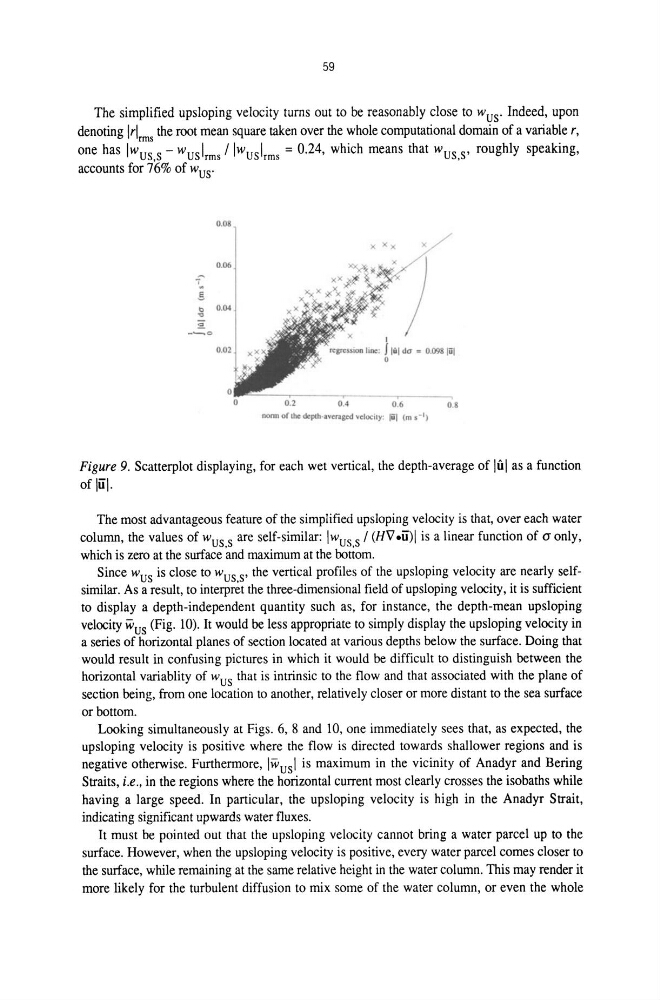
Figure 9. Scatterplot displaying, for each wet vertical, the depth-average of lui as a function
of liil.
The most advantageous feature of the simplified upsloping velocity is that, over each water
column, the values of wus,s are self-similar: I wus,s / (HV.ii) 1 is a linear function of a only,
which is zero at the surface and maximum at the bottom.
Since wus is close to wus,s' the vertical profiles of the upsloping velocity are nearly selfsimilar. As a result, to interpret the three-dimensional field of upsloping velocity, it is sufficient
to display a depth-independent quantity such as, for instance, the depth-mean upsloping
velocity wus (Fig. 10). It would be less appropriate to simply display the upsloping velocity in
a series of horizontal planes of section located at various depths below the surface. Doing that
would result in confusing pictures in which it would be difficult to distinguish between the
horizontal variablity of wus that is intrinsic to the flow and that associated with the plane of
section being, from one location to another, relatively closer or more distant to the sea surface
or bottom.
Looking simultaneously at Figs. 6, 8 and la, one immediately sees that, as expected, the
upsloping velocity is positive where the flow is directed towards shallower regions and is
negative otherwise. Furthermore, IWusl is maximum in the vicinity of Anadyr and Bering
Straits, i.e., in the regions where the horizontal current most clearly crosses the isobaths while
having a large speed. In particular, the upsloping velocity is high in the Anadyr Strait,
indicating significant upwards water fluxes.
It must be pointed out that the upsloping velocity cannot bring a water parcel up to the
surface. However, when the upsloping velocity is positive, every water parcel comes closer to
the surface, while remaining at the same relative height in the water column. This may render it
more likely for the turbulent diffusion to mix some of the water column, or even the whole
The simplified upsloping velocity turns out to be reasonably close to wus ' Indeed, upon
denoting Irl
the root mean square taken over the whole computational domain of a variable r,
nns
one has Iwus,s - wuslrms / Iwuslrms = 0.24, which means that wus,s' roughly speaking,
accounts for 76% of wus'
O.OS
0.06
,~
.§.
t:>
0.04
'0
s:
0.02
Figure 9. Scatterplot displaying, for each wet vertical, the depth-average of lui as a function
of liil.
The most advantageous feature of the simplified upsloping velocity is that, over each water
column, the values of wus,s are self-similar: I wus,s / (HV.ii) 1 is a linear function of a only,
which is zero at the surface and maximum at the bottom.
Since wus is close to wus,s' the vertical profiles of the upsloping velocity are nearly selfsimilar. As a result, to interpret the three-dimensional field of upsloping velocity, it is sufficient
to display a depth-independent quantity such as, for instance, the depth-mean upsloping
velocity wus (Fig. 10). It would be less appropriate to simply display the upsloping velocity in
a series of horizontal planes of section located at various depths below the surface. Doing that
would result in confusing pictures in which it would be difficult to distinguish between the
horizontal variablity of wus that is intrinsic to the flow and that associated with the plane of
section being, from one location to another, relatively closer or more distant to the sea surface
or bottom.
Looking simultaneously at Figs. 6, 8 and la, one immediately sees that, as expected, the
upsloping velocity is positive where the flow is directed towards shallower regions and is
negative otherwise. Furthermore, IWusl is maximum in the vicinity of Anadyr and Bering
Straits, i.e., in the regions where the horizontal current most clearly crosses the isobaths while
having a large speed. In particular, the upsloping velocity is high in the Anadyr Strait,
indicating significant upwards water fluxes.
It must be pointed out that the upsloping velocity cannot bring a water parcel up to the
surface. However, when the upsloping velocity is positive, every water parcel comes closer to
the surface, while remaining at the same relative height in the water column. This may render it
more likely for the turbulent diffusion to mix some of the water column, or even the whole