

58
(Deleersnijder, 1992). Hence, in (30), aV1J may be neglected compared with (1- a)Vh. Let u
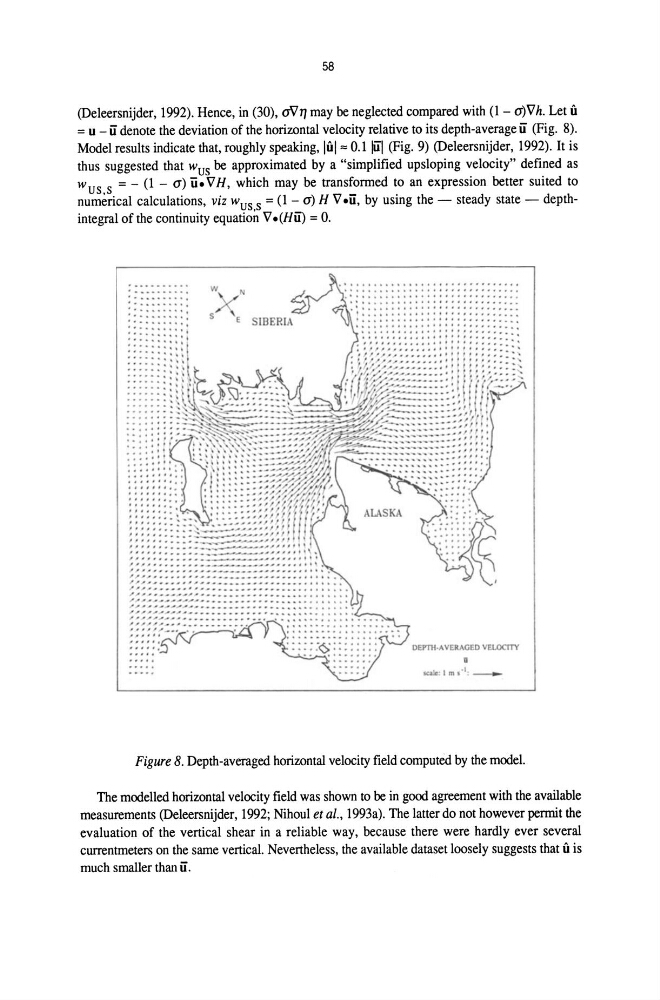
= u - ii denote the deviation of the horizontal velocity relative to its depth-average ii (Fig. 8).
Model results indicate that, roughly speaking, lui'" 0.11ii1 (Fig. 9) (Deleersnijder, 1992). It is
thus suggested that wus be approximated by a "simplified upsloping velocity" defined as
wus,s = - (1- a)u.VH, which may be transformed to an expression better suited to
numerical calculations, viz wus,s = (1 - a) H V.ii, by using the - steady state - depthintegral of the continuity equation V. (Hii) = O.
, "
• • • • • • •
• • • • • • • •
I I • • • • • • •
'" .. ............ ........ .
, " ........ " ... .. ... .... .
I' . . . . . . . . . • . . . • • • • • . • • . .
~ : : : : : :
: : : : :
: : : : : : : : : : : :
........................
• • • •
•
•
• • • • • • • • I I • • • • • • • •
' " .. .. . , ... ... . , ..... .
• • • • •
• • • • • • • • • •
I
I • • • • • •
. ...... .. ..... , ... ..... . " ,
, .. ' ............ ,., .... .
Figure 8. Depth-averaged horizontal velocity field computed by the model.
The modelled horizontal velocity field was shown to be in good agreement with the available
measurements (Deleersnijder, 1992; Nihoul et al., 1993a). The latter do not however permit the
evaluation of the vertical shear in a reliable way, because there were hardly ever several
currentmeters on the same vertical. Nevertheless, the available dataset loosely suggests that u is
much smaller than ii.
(Deleersnijder, 1992). Hence, in (30), aV1J may be neglected compared with (1- a)Vh. Let u
= u - ii denote the deviation of the horizontal velocity relative to its depth-average ii (Fig. 8).
Model results indicate that, roughly speaking, lui'" 0.11ii1 (Fig. 9) (Deleersnijder, 1992). It is
thus suggested that wus be approximated by a "simplified upsloping velocity" defined as
wus,s = - (1- a)u.VH, which may be transformed to an expression better suited to
numerical calculations, viz wus,s = (1 - a) H V.ii, by using the - steady state - depthintegral of the continuity equation V. (Hii) = O.
, "
• • • • • • •
• • • • • • • •
I I • • • • • • •
'" .. ............ ........ .
, " ........ " ... .. ... .... .
I' . . . . . . . . . • . . . • • • • • . • • . .
~ : : : : : :
: : : : :
: : : : : : : : : : : :
........................
• • • •
•
•
• • • • • • • • I I • • • • • • • •
' " .. .. . , ... ... . , ..... .
• • • • •
• • • • • • • • • •
I
I • • • • • •
. ...... .. ..... , ... ..... . " ,
, .. ' ............ ,., .... .
Figure 8. Depth-averaged horizontal velocity field computed by the model.
The modelled horizontal velocity field was shown to be in good agreement with the available
measurements (Deleersnijder, 1992; Nihoul et al., 1993a). The latter do not however permit the
evaluation of the vertical shear in a reliable way, because there were hardly ever several
currentmeters on the same vertical. Nevertheless, the available dataset loosely suggests that u is
much smaller than ii.