

48
N, defined by M2 = lawazl 2 and N 2 = -p~ap/az. The ~tability functions_are functions of the
dimensionless Prandtl and Brunt-ViiisiiIa frequencies, M = (IM/q) and N = (IN/q). Strictly
speaking, N is defined for statically stable situations only, where lighter water lies on top of
heavier water, so that N 2 ~ O. In the present study, it is assumed that N 2 ~ 0 at every
location and at every instant.
The eddy coefficients are thus assumed proportional to a velocity scale, q, and a length
scale, I, which is that of the largest turbulent eddies, those which contain most of t~e turbulent
kinetic energy.
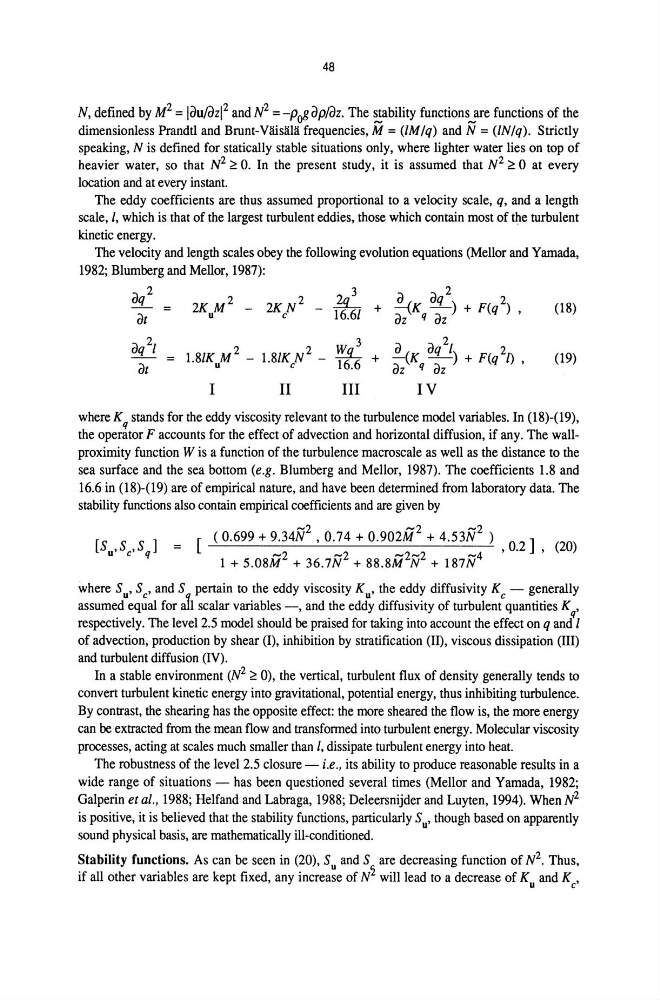
The velocity and length scales obey the following evolution equations (Mellor and Yamada,
1982; Blumberg and Mellor, 1987):
aq2
2K M2
u
.,,,3
a a 2
~ + ::-
az q az
(18)
at
2
2
Wq3
E....tK a q2 /) + F( 2 / )
1. 81K u M - 1.81KcN - 16.6 + a;' q az
q ,
(19)
I
II
III
IV
where K stands for the eddy viscosity relevant to the turbulence model variables. In (18)-(19),
the opecitor F accounts for the effect of advection and horizontal diffusion, if any. The wallproximity function W is a function of the turbulence macroscale as well as the distance to the
sea surface and the sea bottom (e.g. Blumberg and Mellor, 1987). The coefficients 1.8 and
16.6 in (18)-(19) are of empirical nature, and have been determined from laboratory data. The
stability functions also contain empirical coefficients and are given by
-2
- 2 - 2
[ (0.699 + 9.34N ,0.74 + 0.902M + 4.53N ),0.2], (20)
1 + 5.08M 2 + 36.7Ff1 + 88.8M 2 N 2 + 187N 4
where Su' Sc' and S pertain to the eddy viscosity Ku' the eddy diffusivity Kc - generally
assumed equal for aTl scalar variables -, and the eddy diffusivity of turbulent quantities K ,
respectively. The level 2.5 model should be praised for taking into account the effect on q andql
of advection, production by shear (I), inhibition by stratification (II), viscous dissipation (III)
and turbulent diffusion (IV).
In a stable environment (N 2 ~ 0), the vertical, turbulent flux of density generally tends to
convert turbulent kinetic energy into gravitational, potential energy, thus inhibiting turbulence.
By contrast, the shearing has the opposite effect: the more sheared the flow is, the more energy
can be extracted from the mean flow and transformed into turbulent energy. Molecular viscosity
processes, acting at scales much smaller than I, dissipate turbulent energy into heat.
The robustness of the level 2.5 closure - i.e., its ability to produce reasonable results in a
wide range of situations - has been questioned several times (Mellor and Yamada, 1982;
Galperin et al., 1988; Helfand and Labmga, 1988; Deleersnijder and Luyten, 1994). When N 2
is positive, it is believed that the stability functions, particularly Su' though based on apparently
sound physical basis, are mathematically ill-conditioned.
Stability functions. As can be seen in (20), Su and S are decreasing function of N 2 • Thus,
if all other variables are kept fixed, any increase of N~ will lead to a decrease of K and K ,
u
c
N, defined by M2 = lawazl 2 and N 2 = -p~ap/az. The ~tability functions_are functions of the
dimensionless Prandtl and Brunt-ViiisiiIa frequencies, M = (IM/q) and N = (IN/q). Strictly
speaking, N is defined for statically stable situations only, where lighter water lies on top of
heavier water, so that N 2 ~ O. In the present study, it is assumed that N 2 ~ 0 at every
location and at every instant.
The eddy coefficients are thus assumed proportional to a velocity scale, q, and a length
scale, I, which is that of the largest turbulent eddies, those which contain most of t~e turbulent
kinetic energy.
The velocity and length scales obey the following evolution equations (Mellor and Yamada,
1982; Blumberg and Mellor, 1987):
aq2
2K M2
u
.,,,3
a a 2
~ + ::-
az q az
(18)
at
2
2
Wq3
E....tK a q2 /) + F( 2 / )
1. 81K u M - 1.81KcN - 16.6 + a;' q az
q ,
(19)
I
II
III
IV
where K stands for the eddy viscosity relevant to the turbulence model variables. In (18)-(19),
the opecitor F accounts for the effect of advection and horizontal diffusion, if any. The wallproximity function W is a function of the turbulence macroscale as well as the distance to the
sea surface and the sea bottom (e.g. Blumberg and Mellor, 1987). The coefficients 1.8 and
16.6 in (18)-(19) are of empirical nature, and have been determined from laboratory data. The
stability functions also contain empirical coefficients and are given by
-2
- 2 - 2
[ (0.699 + 9.34N ,0.74 + 0.902M + 4.53N ),0.2], (20)
1 + 5.08M 2 + 36.7Ff1 + 88.8M 2 N 2 + 187N 4
where Su' Sc' and S pertain to the eddy viscosity Ku' the eddy diffusivity Kc - generally
assumed equal for aTl scalar variables -, and the eddy diffusivity of turbulent quantities K ,
respectively. The level 2.5 model should be praised for taking into account the effect on q andql
of advection, production by shear (I), inhibition by stratification (II), viscous dissipation (III)
and turbulent diffusion (IV).
In a stable environment (N 2 ~ 0), the vertical, turbulent flux of density generally tends to
convert turbulent kinetic energy into gravitational, potential energy, thus inhibiting turbulence.
By contrast, the shearing has the opposite effect: the more sheared the flow is, the more energy
can be extracted from the mean flow and transformed into turbulent energy. Molecular viscosity
processes, acting at scales much smaller than I, dissipate turbulent energy into heat.
The robustness of the level 2.5 closure - i.e., its ability to produce reasonable results in a
wide range of situations - has been questioned several times (Mellor and Yamada, 1982;
Galperin et al., 1988; Helfand and Labmga, 1988; Deleersnijder and Luyten, 1994). When N 2
is positive, it is believed that the stability functions, particularly Su' though based on apparently
sound physical basis, are mathematically ill-conditioned.
Stability functions. As can be seen in (20), Su and S are decreasing function of N 2 • Thus,
if all other variables are kept fixed, any increase of N~ will lead to a decrease of K and K ,
u
c