

47
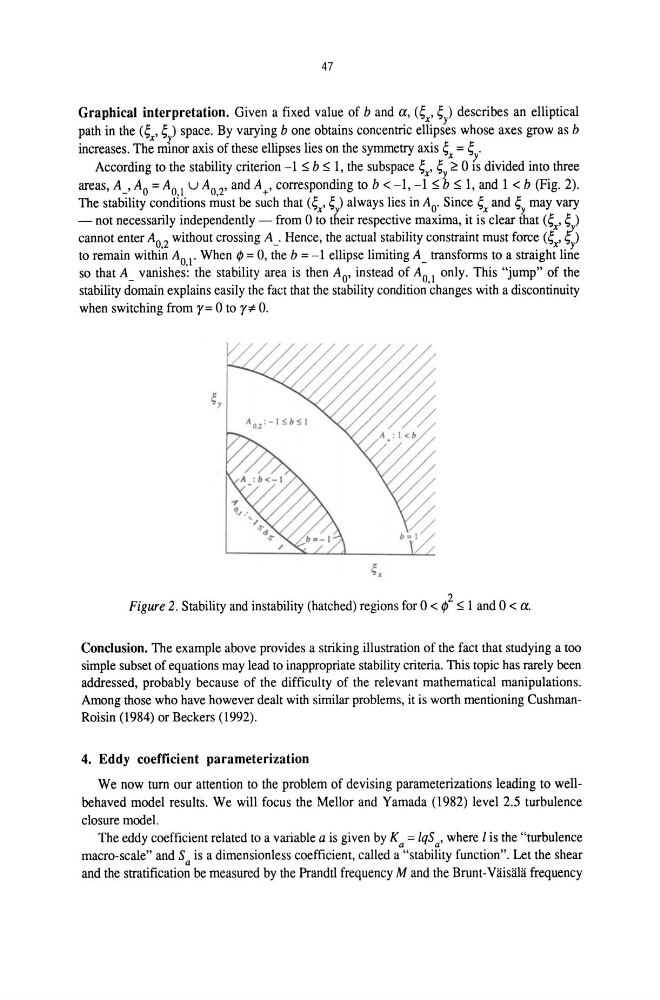
Graphical interpretation. Given a fixed value of b and a, (~ , ~ ) describes an elliptical
x y
path in the (~x' ~ ) space. By varying b one obtains concentric ellipses whose axes grow as b
increases. The minor axis of these ellipses lies on the symmetry axis ~ = ~ .
According to the stability criterion -1 $; b $; I, the subspace ~ , ~ ~ 0 fs divided into three
x y
areas, A _, Ao = AO,1 U A o ,2' and A +' corresponding to b < -1, -1 ~ b ~ 1, and 1 < b (Fig. 2).
The stability conditions must be such that (~x, ~ ) always lies in Ao' Since ~x and ~ may vary
- not necessarily independently - from 0 to their respective maxima, it is clear {hat (~ , ~ )
cannot enter Ao 2 without crossing A _. Hence, the actual stability constraint must force (~:, ()
to remain withi~ Ao l' When ¢ = 0, the b = -1 ellipse limiting A_ transforms to a straight li~e
so that A_vanishes': the stability area is then Ao' instead of Ao 1 only. This "jump" of the
stability domain explains easily the fact that the stability condition 'changes with a discontinuity
when switching from Y= 0 to y'# O.
Figure 2. Stability and instability (hatched) regions for 0 < ¢2 ~ 1 and 0 < a.
Conclusion. The example above provides a striking illustration of the fact that studying a too
simple subset of equations may lead to inappropriate stability criteria. This topic has rarely been
addressed, probably because of the difficulty of the relevant mathematical manipulations.
Among those who have however dealt with similar problems, it is worth mentioning CushmanRoisin (1984) or Beckers (1992).
4. Eddy coefficient parameterization
We now turn our attention to the problem of devising parameterizations leading to wellbehaved model results. We will focus the Mellor and Yamada (1982) level 2.5 turbulence
closure model.
The eddy coefficient related to a variable a is given by K a = /qS a' where I is the "turbulence
macro-scale" and Sa is a dimensionless coefficient, called a "stability function". Let the shear
and the stratification be measured by the Prandtl frequency M and the Brunt-VaisaIa frequency
Graphical interpretation. Given a fixed value of b and a, (~ , ~ ) describes an elliptical
x y
path in the (~x' ~ ) space. By varying b one obtains concentric ellipses whose axes grow as b
increases. The minor axis of these ellipses lies on the symmetry axis ~ = ~ .
According to the stability criterion -1 $; b $; I, the subspace ~ , ~ ~ 0 fs divided into three
x y
areas, A _, Ao = AO,1 U A o ,2' and A +' corresponding to b < -1, -1 ~ b ~ 1, and 1 < b (Fig. 2).
The stability conditions must be such that (~x, ~ ) always lies in Ao' Since ~x and ~ may vary
- not necessarily independently - from 0 to their respective maxima, it is clear {hat (~ , ~ )
cannot enter Ao 2 without crossing A _. Hence, the actual stability constraint must force (~:, ()
to remain withi~ Ao l' When ¢ = 0, the b = -1 ellipse limiting A_ transforms to a straight li~e
so that A_vanishes': the stability area is then Ao' instead of Ao 1 only. This "jump" of the
stability domain explains easily the fact that the stability condition 'changes with a discontinuity
when switching from Y= 0 to y'# O.
Figure 2. Stability and instability (hatched) regions for 0 < ¢2 ~ 1 and 0 < a.
Conclusion. The example above provides a striking illustration of the fact that studying a too
simple subset of equations may lead to inappropriate stability criteria. This topic has rarely been
addressed, probably because of the difficulty of the relevant mathematical manipulations.
Among those who have however dealt with similar problems, it is worth mentioning CushmanRoisin (1984) or Beckers (1992).
4. Eddy coefficient parameterization
We now turn our attention to the problem of devising parameterizations leading to wellbehaved model results. We will focus the Mellor and Yamada (1982) level 2.5 turbulence
closure model.
The eddy coefficient related to a variable a is given by K a = /qS a' where I is the "turbulence
macro-scale" and Sa is a dimensionless coefficient, called a "stability function". Let the shear
and the stratification be measured by the Prandtl frequency M and the Brunt-VaisaIa frequency