

46
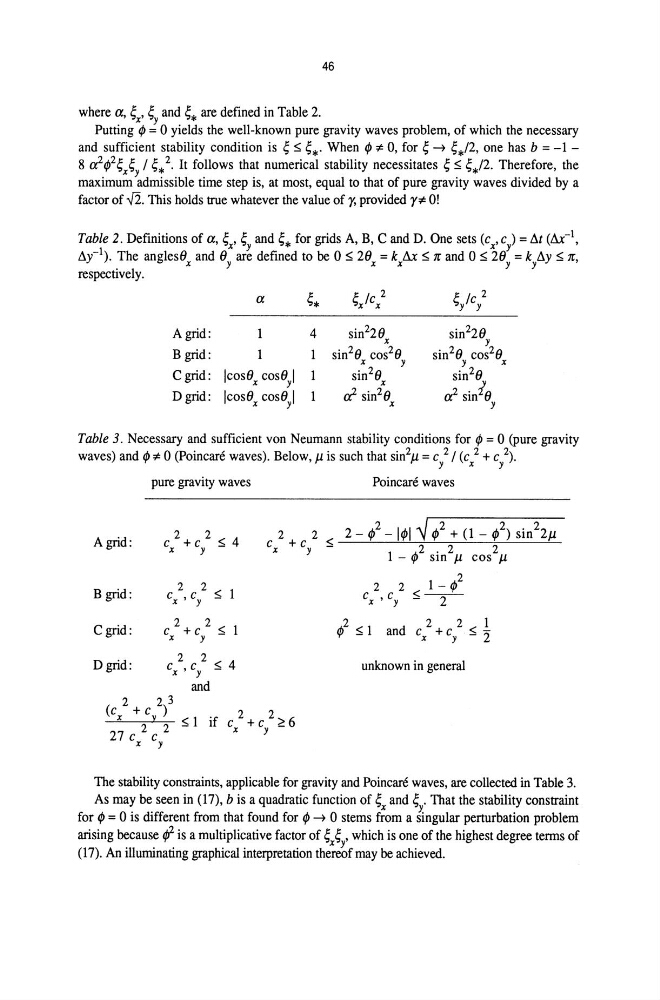
where a, g , g and g* are defined in Table 2.
x y
Putting ¢ = 0 yields the well-known pure gravity waves problem, of which the necessary
and sufficient stability condition is S ~ s*. When ¢ *- 0, for S ~ S*/2, one has b = -1 -
8 a'2¢2sxS / S* 2. It follows that numerical stability necessitates S ~ S*/2. Therefore, the
maximum Yadmissible time step is, at most, equal to that of pure gravity waves divided by a
factor of -fl. This holds true whatever the value of y, provided r*- O!
Table 2. Definitions of a, g , g and S* for grids A, B, C and D. One sets (c , c ) = t1t (t1x- 1 ,
x Y
x y
dy-l). The anglesO and 0 are defined to be 0 ~ 20 = k t1x ~ 11: and 0 ~ 20 = k dy ~ 11:,
x
Y
x
x
Y
Y
respectively.
a
S*
S Ie 2
x x
g Ie 2
Y Y
A grid:
4
sin 2 20 x
sin 2 20 y
B grid:
sin 2 0 cos 2 0
sin 2 0 y cos 2 0 x
x
y
C grid: IcosO x cosOy!
sin 2 0
sin 2 0
x
a 2 siio
D grid: IcosO x cosoy!
a' 2 sin 2 0 x
y
Table 3. Necessary and sufficient von Neumann stability conditions for ¢ = 0 (pure gravity
waves) and ¢ *- 0 (Poincare waves). Below, p. is such that sin 2 p. = c 2/ (c 2 + C 2).
Y
x
Y
pure gravity waves
Poincare waves
A grid:
2
2
C
+ C ~
x
y
2
...j2
2 . 2
2 - ¢ - I¢I
¢ + (1 - ¢ ) sm 2p.
1
".,2. 2
2
- 'I' sm P. cos P.
2
2
2
1 - ¢
C x ,C y ~--2B grid:
2
2
2
1
4i ~ 1 and c + c ~-2
x
y
C grid:
D grid:
2 2
c , C ~ 4
x
y
unknown in general
and
2
2 3
(c + c )
2
2
---"x'-----=-J-v --=- ~ 1 if c + c ;:: 6
27 c 2 c 2
x
y
x
y
The stability constraints, applicable for gravity and Poincare waves, are collected in Table 3.
As may be seen in (17), b is a quadratic function of g and g . That the stability constraint
for ¢ = 0 is different from that found for ¢ ~ 0 stems &om a lingular perturbation problem
arising because f is a multiplicative factor of g g , which is one of the highest degree terms of
(17). An illuminating graphical interpretation the~~f may be achieved.
where a, g , g and g* are defined in Table 2.
x y
Putting ¢ = 0 yields the well-known pure gravity waves problem, of which the necessary
and sufficient stability condition is S ~ s*. When ¢ *- 0, for S ~ S*/2, one has b = -1 -
8 a'2¢2sxS / S* 2. It follows that numerical stability necessitates S ~ S*/2. Therefore, the
maximum Yadmissible time step is, at most, equal to that of pure gravity waves divided by a
factor of -fl. This holds true whatever the value of y, provided r*- O!
Table 2. Definitions of a, g , g and S* for grids A, B, C and D. One sets (c , c ) = t1t (t1x- 1 ,
x Y
x y
dy-l). The anglesO and 0 are defined to be 0 ~ 20 = k t1x ~ 11: and 0 ~ 20 = k dy ~ 11:,
x
Y
x
x
Y
Y
respectively.
a
S*
S Ie 2
x x
g Ie 2
Y Y
A grid:
4
sin 2 20 x
sin 2 20 y
B grid:
sin 2 0 cos 2 0
sin 2 0 y cos 2 0 x
x
y
C grid: IcosO x cosOy!
sin 2 0
sin 2 0
x
a 2 siio
D grid: IcosO x cosoy!
a' 2 sin 2 0 x
y
Table 3. Necessary and sufficient von Neumann stability conditions for ¢ = 0 (pure gravity
waves) and ¢ *- 0 (Poincare waves). Below, p. is such that sin 2 p. = c 2/ (c 2 + C 2).
Y
x
Y
pure gravity waves
Poincare waves
A grid:
2
2
C
+ C ~
x
y
2
...j2
2 . 2
2 - ¢ - I¢I
¢ + (1 - ¢ ) sm 2p.
1
".,2. 2
2
- 'I' sm P. cos P.
2
2
2
1 - ¢
C x ,C y ~--2B grid:
2
2
2
1
4i ~ 1 and c + c ~-2
x
y
C grid:
D grid:
2 2
c , C ~ 4
x
y
unknown in general
and
2
2 3
(c + c )
2
2
---"x'-----=-J-v --=- ~ 1 if c + c ;:: 6
27 c 2 c 2
x
y
x
y
The stability constraints, applicable for gravity and Poincare waves, are collected in Table 3.
As may be seen in (17), b is a quadratic function of g and g . That the stability constraint
for ¢ = 0 is different from that found for ¢ ~ 0 stems &om a lingular perturbation problem
arising because f is a multiplicative factor of g g , which is one of the highest degree terms of
(17). An illuminating graphical interpretation the~~f may be achieved.